
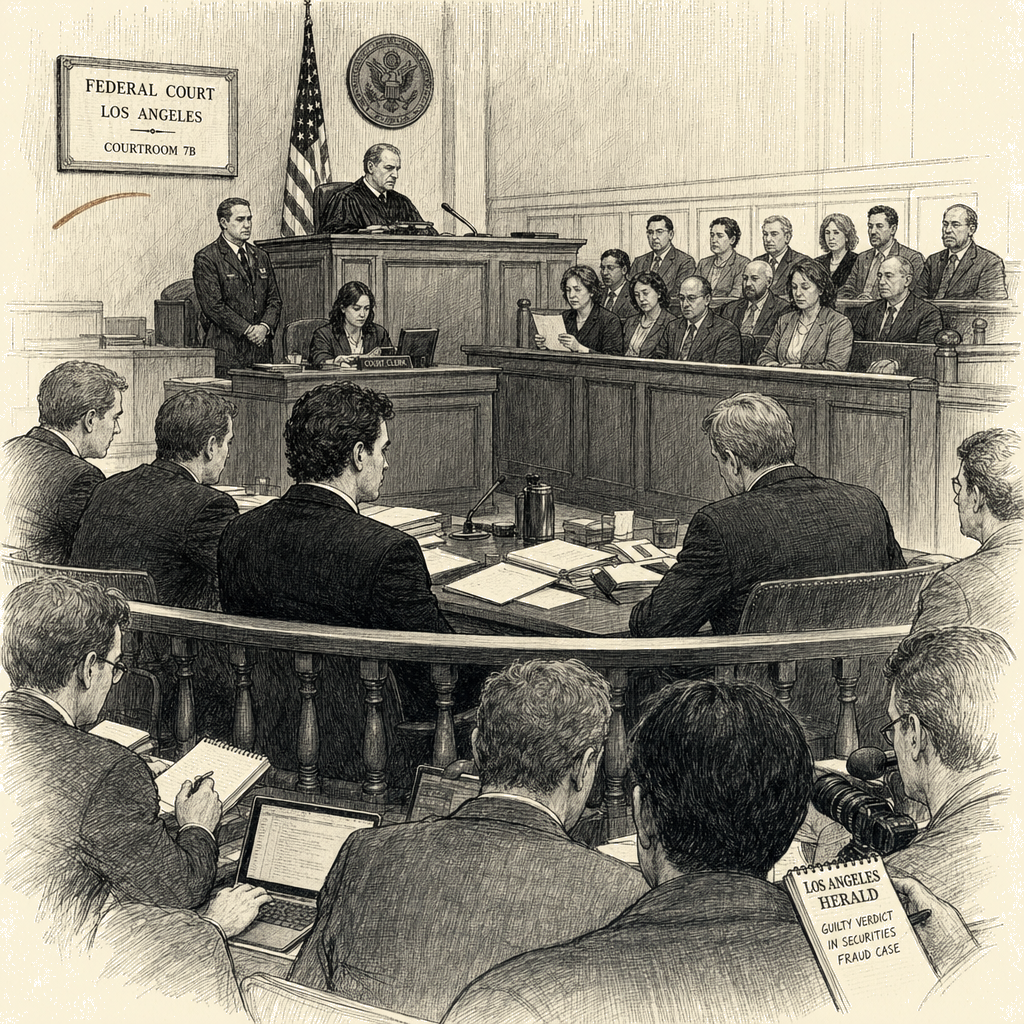
Andrew Left told the world he had “skin in the game.” His own money rode on every call, he said, so you could trust him. It was his favorite credential, a beautiful piece of marketing: the honest crusader, the researcher who exposed China Evergrande in 2012 and Valeant in 2015, the one guy on Wall Street who told you the truth because it was his own wallet on the line.
The wallet was on the line. So was yours. His came off first. Every time.
A federal jury in Los Angeles convicted him Monday. A short seller who made his name calling other people’s companies frauds is now, by the verdict of his peers, a fraud himself. Prosecutors walked the jury through the template: short the stock, tweet that it is “uninvestable,” cover the position at a profit before the tweet’s effect reverses, then delete the post. The delete key does not erase the deposit.
The central exhibit was Roku. Left shorted it, tweeted his judgment, covered for a $700,000 profit hours later, and scrubbed the evidence, writing only that he was “watching Roku from the side.” The pattern repeated across trades in Cronos Group, Nvidia, Tesla, and American Airlines. In all, prosecutors said the total haul was roughly $20 million. The jury convicted on most of the seventeen counts. It acquitted on some — Namaste Technologies, Beyond Meat, General Electric, Luckin Coffee — but the rhythm across the guilty counts was more than enough. Left says “the jury got it wrong” and plans to appeal. He faces sentencing on August 31; the lead securities-fraud charge carries a maximum twenty-five years.
One voice in the trial was a retired firefighter. He sold his shares for a loss after Left called the company “a total joke” and promised to short it “until it goes to zero.” That is whose skin is in the game.
The machinery worked. An investigation begun in 2018, FBI agents at his Beverly Hills home in early 2021, a criminal prosecution, a three-week trial, a potential quarter-century behind bars. For one man and his Twitter account. This is what the system can still do when the defendant is small enough to prosecute, prominent enough to publicize, and connected to no one who matters. He is, in the vocabulary of the machinery, reachable.
Now. The ledger.
HSBC laundered money for Mexican drug cartels and sanctioned regimes — Iran, Cuba, Sudan, Libya, Burma. The bank admitted the violations and paid $1.9 billion. No one was prosecuted. Senator Grassley said HSBC “has quite literally purchased a get-out-of-jail-free card.” Wells Fargo opened millions of unauthorized accounts over fourteen years. Settlement: $3 billion via a deferred-prosecution agreement — with the bank, not with any individuals. The CEO was fined and banned from banking. No cell. Purdue Pharma pleaded guilty twice, in 2007 and 2020, for its marketing of OxyContin. The Sacklers extracted billions. No criminal charges. General Motors hid a deadly ignition switch for over a decade; 124 people died. Forfeiture: $900 million, again via deferred prosecution. No individuals charged. After the 2008 financial crisis, after the collapse that cost millions of families their homes, no major Wall Street CEO went to prison. Not one.
This is not an accident. When HSBC laundered cartel money, the government chose a deferred-prosecution agreement because prosecuting a systemically important bank might destabilize the financial system. The crime was real. The punishment was a line item. The short seller with no political connections, no army of lobbyists, no “systemic importance” excuse is exactly the kind of defendant the machine was built to process. Andrew Left is reachable. The banks are not.
I have watched this movie since Charles Keating went to prison during the savings-and-loan crisis — back when the system still worked roughly the way it was supposed to, when a man who looted a bank and helped crash an industry could still draw a cell. Keating served four and a half years. Then 2008 happened, and the pattern broke. The banks paid fines. The people who built the bombs kept their freedom.
Left is no Keating. He once did the market a genuine service: his 2012 report on China Evergrande identified rot years before the company collapsed; his 2015 work on Valeant highlighted an undisclosed mail-order pharmacy, and Valeant subsequently paid a $45 million regulatory fine. He then used the credibility those calls earned him to do the opposite. The jury said so. The firefighter who lost his savings said so. The delete key cannot unsay what the deposit ledger records.
Henry Blodget, the Merrill Lynch internet analyst, famously touted stocks he privately called “a piece of junk.” He was barred from the securities industry. He was never jailed. The SEC has been chasing this machine for decades — from the boiler rooms of the nineties to the social-media pump-and-dump shops that sprouted after GameStop. The machinery shifts. The move stays the same. Credibility is gathered, a following is built, and at the moment of maximum trust the trust is converted into a private exit. The follower is left holding the price that the influencer has already abandoned. Left’s Citron Research gave him the template: research a company, accuse it of fraud, short the stock, and profit from the collapse. The version that landed him in court ran the same play faster than his followers could follow, then hit delete.
Left calls the verdict “chilling” for anyone who gives “honest opinions and trades at the same time.” The firefighter might call the chilling something else.
The conviction is real. The fraud was real. And the system that produced it — swift, thorough, and certain for the small operator; slow, negotiated, and discretionary for the large one — is the oldest story in American finance. The reachable man gets the trial, the verdict, the cell. The unreachable get the press release, the fine subtracted from a shareholder’s dividend, and Monday morning.
Mr. Skin in the Game faces August 31. The banks open Monday.