
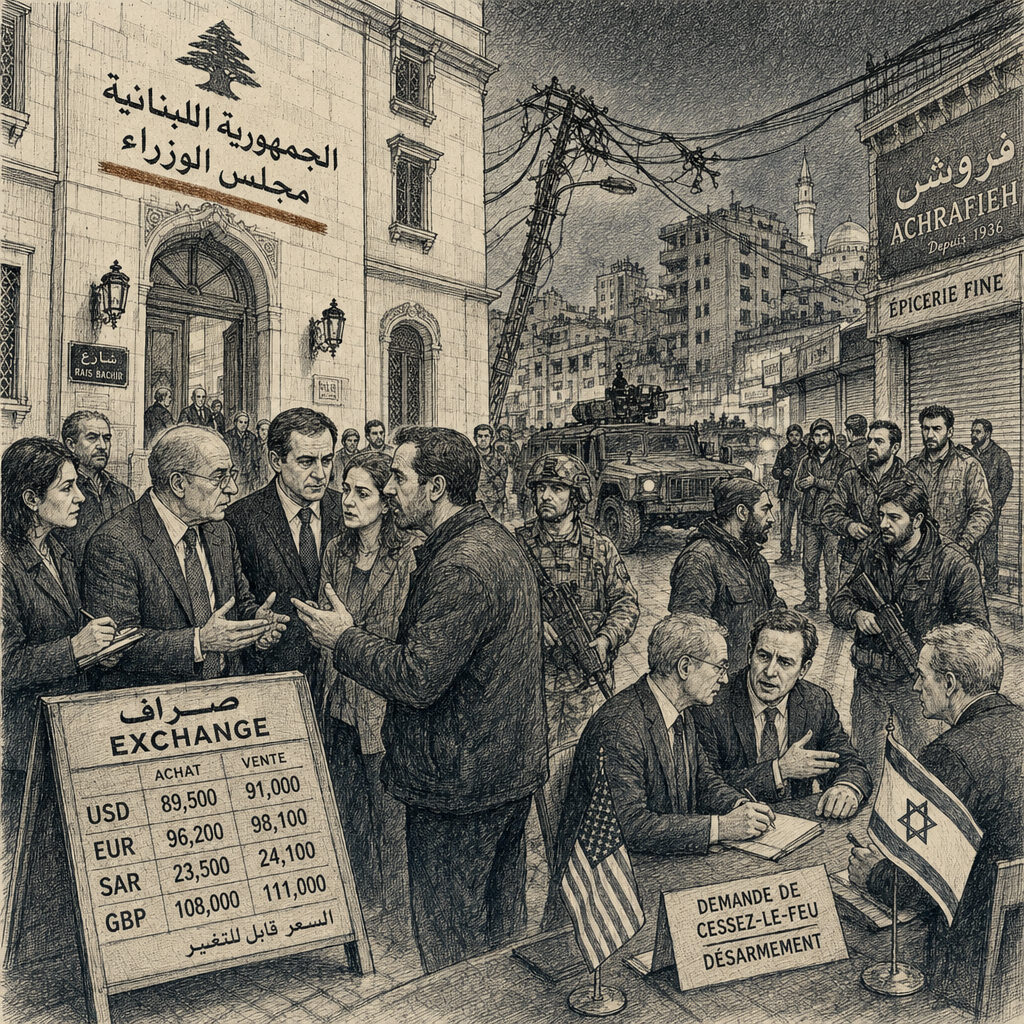
Trump and Netanyahu are sending Lebanese civilians into civil war and calling it statebuilding. The so‑called ceasefire is not a mechanism for peace. It is a timetable for transferring the cost of American and Israeli security directly onto a population that already lacks running water, reliable electricity, and a functioning currency. Washington is pressing a fractured Lebanese state to dismantle Hezbollah, a militia that survived the collapse of state authority precisely because it built parallel networks of logistics, healthcare, and weapons procurement. The Lebanese Armed Forces, despite more than $3 billion in U.S. funding since 2006, cannot guarantee basic policing in Beirut neighborhoods without sparking street clashes. Dwight D. Eisenhower’s 1961 warning about the unearned influence of the military‑industrial complex predicted this exact institutional drift. When national security machinery prioritizes continuous readiness over political settlement, ordinary citizens become the currency that purchases foreign‑policy survival.
Andrew Bacevich documented how permanent‑war logic exports the burden of unresolved conflicts onto populations that lack the institutional capacity to absorb the shock. Washington funds a military institution, mandates a confrontation it cannot win, and then watches the resulting vacuum justify deeper diplomatic entanglement. That logic operates cleanly in Beirut. The United States brokers ambassador‑level talks and troop swaps while the state security apparatus leaks intelligence to the very militants it is ordered to dismantle. The cycle does not produce sovereignty. It produces rubble.
The Wall Street Journal’s dispatch from the ground captured the human architecture of this engineered crisis. A bakery worker named Ali al‑Dayekh, newly married, lives in a tent on the street because his home and workplace were bombed. Landlords evict Shia families lest they attract Israeli airstrikes. Young men brandish pistols at a Christian funeral for a man killed in an Israeli strike on a non‑Hezbollah target. A Sunni mosque opened its doors to displaced Shia, only for some congregants to declare they support Israel’s war against Hezbollah. As one retired general told the Journal, the ingredients for civil war are all present. The United States and Israel are stirring the pot.
The ceasefire deal, renewed just days ago, requires the Lebanese government to take back territory and disarm Hezbollah incrementally. It is a plan that already failed once, after the 2024 war. Hezbollah refused to disarm. It rearmed, manufacturing explosive drones guided by fiber‑optic wire and restocking via smuggling routes through Syria. Now the U.S. is pushing the same demand, even though Lebanese officials acknowledge that any attempt to disarm the group militarily “would begin, but we don’t know how it would end.” The State Department’s answer, relayed by Secretary Rubio, is to “vet” Lebanese military units to do the dirty work so Israel does not have to. It is a subcontract for sectarian bloodletting, sanitized with training manuals and the accumulated war aid that has poured more than $3 billion into Lebanon’s military since 2006.
Michael Walzer’s framework on just conduct distinguishes clearly between combatant and noncombatant liability, but proxy‑state warfare deliberately blurs that boundary by treating entire neighborhoods as strategic terrain. When Sunni districts openly support foreign strikes against Shia communities, and Christian enclaves rehearse old grudges behind armed checkpoints, the moral architecture of civilian immunity collapses. Hannah Arendt observed that violence inevitably surges where legitimate state power has evaporated. Lebanon’s 1975–1990 civil war provides the exact blueprint for what happens next. Asking an underfunded, overstretched army to impose disarmament on a battle‑tested guerrilla force is not a strategy. It is an invitation to mass displacement.
There is no congressional authorization for this proxy war. The Constitution vests the power to declare war in Congress, yet the White House and Pentagon are running this campaign through arms transfers, intelligence coordination, and diplomatic ultimatums without a single floor vote. It is the imperial presidency Eisenhower feared, now fully normalized.
The affirmative requirement here is unglamorous and absolute. The United States must stop conditioning Lebanese sovereignty on the destruction of a domestic political‑military hybrid through force the Lebanese state does not possess. Sovereignty grows from a monopoly on legitimate violence that serves the population, not from a Pentagon checklist handed to an army that mirrors the country’s sectarian divides. I will not concede that civilian displacement, tent encampments in financial districts, and cross‑sectarian vigilantism are acceptable transitional costs for a regional reset.
The drones over Beirut are the signature of Washington and Jerusalem. The tents on the street are the monument. The state is being asked to become neither a servant of its people nor a militia—just the ground on which a proxy war is fought.