
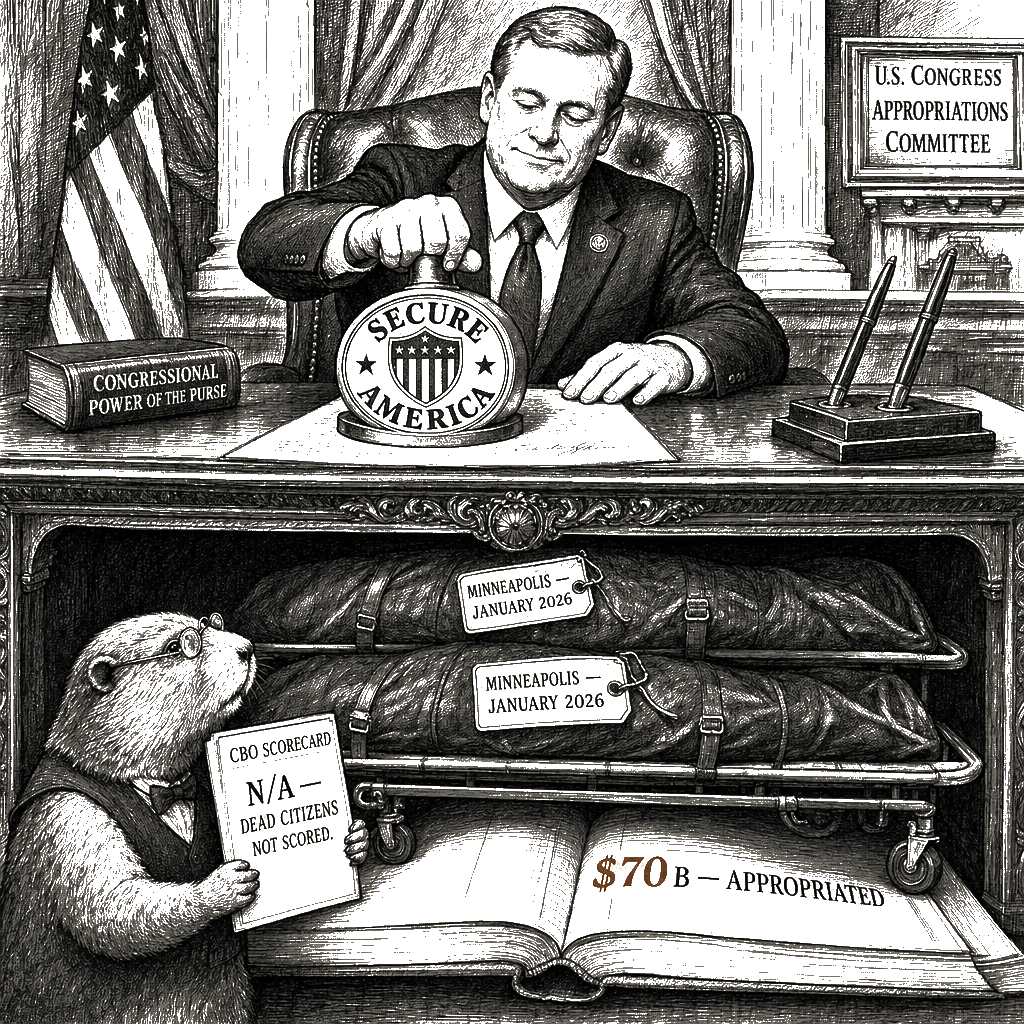
Congress is poised to allocate seventy billion dollars to arm federal agents who have already killed American citizens. Two United States citizens are dead, shot in Minneapolis in January by the same enforcement personnel whose budget the House will pass this week. The Democratic blockade that followed those killings ends on the House floor today, not because the apparatus has been reined in, but because the apparatus has been paid. The price of those two lives works out to roughly thirty-five billion dollars apiece. That is the line item the Congressional Budget Office does not score, because the cost of dead civilians is borne by communities no budget resolution counts. The Secure America Act is not a security measure. It is a patronage contract written in the blood of Americans who happened to be in the wrong place when a domestic policing operation turned lethal, and it is a ransom note payable in public funds to the agencies that pulled the trigger.
The architecture is transparent because there is no effort to hide it. Thirty-eight billion dollars to Immigration and Customs Enforcement, the agency whose agents shot two unarmed people in their own city. Twenty-six billion to Customs and Border Protection, the force whose internal oversight has for years been a caption on a blank page. Five billion more to the Department of Homeland Security, the parent institution whose leadership responded to the Minneapolis killings with a statement that did not name the dead. The money is appropriated through the budget reconciliation procedure — the same procedural sleight that smuggled the 2017 tax cuts past a Democratic filibuster, and the same one the Senate parliamentarian wielded last month to strip out a separate billion-dollar allocation for White House ballroom security. The ballroom security was ruled out of order for reconciliation. The seventy billion for the agencies that kill was not.
The public framing calls it border security — a deliberate substitution of terms designed to shift the cognitive frame around what is actually a massive domestic policing appropriation. The “Secure America” title is a Frank Luntz special, a frame-engineered relabeling that substitutes a public-safety badge for a funding hose. The technique is familiar: “death tax” was focus-grouped to shift the frame from inherited wealth to government confiscation. “Secure America” does the same work, swapping “deportation” for “secure” to lower public resistance while the budget hose stays wide open. The Luntz memos are a matter of public record. The rebrand is operational, and this column names it for what it is. The border does not require thirty-eight billion dollars to operate. The apparatus does, because the apparatus is the beneficiary.
Trace the money. The policy was authored by the congressional leadership and the White House in tandem. The first-order beneficiaries are the enforcement bureaus themselves and the private prison companies — GEO Group, CoreCivic, and the constellation of contractors whose detention contracts swell with every enforcement surge. The second-order beneficiaries are the political coalition that runs on immigrant terror as its mobilization engine, and the donor class that funds it. The cost-bearers are the communities the bill’s apparatus targets: the millions of people living in mixed-status households, the citizens and legal residents swept up in raids by an agency that has demonstrated, in Minneapolis and elsewhere, that it cannot reliably distinguish a citizen from a non-citizen before pulling the trigger. The obscured variable is that the agencies receiving this money are operating with a documented record of lethal overreach against the very citizens the appropriations are supposed to protect. When federal agents kill American citizens, the political class does not withhold the budget. It doubles it. The Minneapolis deaths did not produce a reckoning. They produced a down payment on the next phase of the deportation machinery. The distance between what is said and what is known to be true — that distance Mon Mothma named in her address to the Senate — is the abyss the bill’s drafters are counting on.
The structural payout is not limited to the enforcement line items. Buried in the reconciliation negotiations is a $1.8 billion “anti-weaponization” fund — a slush vehicle designed to pay out the president’s political allies. The fund was the public controversy that consumed the coverage, and the coverage performed the usual operation: a faction of Republicans, led by a handful of Senators who worried the payout looked bad, insisted on an amendment barring the fund. The drama was whether the bar would hold, whether the bill would die on the disagreement, whether the majority party could keep its own members in line. The drama was never whether seventy billion dollars for the deportation apparatus was the right number, or any number at all. The anti-weaponization fund was the shiny object that absorbed the attention of the press, and while the press was distracted, the underlying apparatus sailed through the Senate on voice vote. The shiny object has now been stripped, and the apparatus that does the daily work of terrorizing immigrant communities is about to clear the House with exactly the same level of scrutiny the shiny object received before it was removed: none whatsoever. The administration frames the Department of Justice as inherently compromised, withdrawing legitimacy on the grounds of composition rather than documented conduct. The acting attorney general told a House committee last week the proposal was dead, but the president refused to rule it out. The parliamentarian forced the strip of the ballroom security line item. The restraint was procedural. The appetite is operational.
The bill’s brief delay over the anti-weaponization fund is instructive for what it reveals about the underlying political calculus. The same calculus that doubled the enforcement budget after the killings is now wiring a loyalty payout to the president’s allies, making the Minneapolis deaths not an anomaly but a line item. Trump’s allies are being positioned to receive nearly two billion dollars under a label designed to sound like a defense of the rule of law, which functions as a direct transfer to operatives the administration claims were targeted by a justice department the administration itself appointed. The $1.8 billion sits in the negotiations because crossing the procedural line proved too difficult for a handful of Senators, but the whip count on the underlying seventy billion never wavered.
Malcolm X laid out the receipts and named the actors, and he refused the euphemism that allows a government to name a killing something else. When the bill labels its agents “security” and treats the dead as inevitable collateral, it is precisely the euphemism Malcolm X refused. The weaponization is not in the Department of Justice. The weaponization is the funding of a vast domestic surveillance and enforcement network that treats its own citizens as enemy combatants, and the appropriation of seventy billion dollars to keep that network running. He told the Oxford Union in 1964 that extremism in the defense of liberty is no vice. The extremism on display here is not in the defense of liberty. It is in the defense of a patronage machine. The structural diagnosis requires naming the machine as a machine, not as a misunderstanding of border policy.
The bill would fund the mass deportation of millions of people, the separation of families, the expansion of a detention system that has been documented, repeatedly and by multiple independent monitors, as a site of medical neglect, sexual assault, and death in custody. The cost of that system is not only the seventy billion dollars appropriated to the agencies that run it. The cost is also the human beings who will be disappeared by it, the children who will lose parents to it, the communities that will be hollowed out by it. Those costs are not in the CBO score either. The CBO score is a technical document that measures outlays and revenues over a ten-year window. It does not measure the price of a child’s terror, the cost of a community’s grief, or the long-term economic damage of ripping working people out of the labor force and sending them to countries they have not seen in decades. The score is a motivated technical artifact that makes the bill look like a simple accounting exercise. It is not a simple accounting exercise. It is a moral budget, and the moral budget is red on every line.
The architecture of the bill also includes a provision that is not in the text but is implied by the surrounding political logic: the funding is backstopped by the promise of future enforcement surges that will generate future detention contracts that will generate future campaign contributions. This is the cycle the bill’s drafters are protecting. The bill is not a one-time appropriation. It is the financial floor under an apparatus that expands with each new enforcement metric, and the expansion is the point. The apparatus must keep growing because the political coalition that funds it runs on the fear the apparatus produces, and the fear requires constant demonstration. The hundred-dollar question is whether the demonstration can be sustained without producing more dead citizens, more dead children, more dead people whose names the press will report for a news cycle and then forget. The hundred-dollar question has an answer, and the answer is that the demonstration will produce exactly those things, because the apparatus is designed to produce them.
The same budget resolution that funds the Secure America Act will not include a guaranteed income, an expansion of Medicaid, or the housing vouchers that would keep families stable enough to withstand the raids the bill funds. This is the choice the budget makes: armed agents over teachers, detention beds over hospital beds, deportation flights over housing vouchers. A nation that makes that choice is approaching spiritual death. This writer is not speaking metaphorically.
Hakeem Jeffries says House Democrats will vote “hard no,” and the passage remains a whip-count problem for Mike Johnson, who needs every single one of his 218 conference members to cross the finish line because he has no margin. The Democratic caucus is performing opposition on the floor of a House that is already funding the apparatus. The Senate cleared the way for nearly seventy billion dollars in deportation funding last week. The House vote is the final motion that turns the appropriation into a deployed program. The spectacle of the vote is itself a frame: the parties are divided, the debate is conducted, the outcome is produced through the regular order. The spectacle is a lie. The regular order is the mechanism by which a majority that controls the House, the Senate, and the White House funds the agencies that killed two of its own citizens, and the mechanism operates as designed.
King’s structural critique in the April 1963 Letter from Birmingham Jail was that a society which treats public order as more important than human life is a society that has inverted its moral center. He argued that the structural injury cannot heal while it is kept hidden; it must be brought into the open, with all the tension that exposure causes, so that the underlying condition can finally drain. The lancing of this particular boil will not come from a Democratic “no” vote on the floor of a House that has already surrendered the appropriations lever. The question the vote does not answer is whether the citizens of this country — the ones whose tax dollars the bill appropriates, the ones whose neighbors the bill’s agencies will hunt — will continue to consent to be governed by a mechanism that produces this result.
I will not perform the Sunday-school civics sermon and pretend that the reconciliation procedure is the only variable. The procedure is the mechanism. The intent is the structure. The intent is to make the deportation apparatus permanent, to insulate it from congressional oversight, to pay the political loyalists who will run it, and to tell the American public that the people they are supposed to fear are the very people the apparatus is designed to hunt. The receipts are on the appropriations sheet. The Minneapolis dead are the anchor. The political class has made its choice, and the choice is permanent occupation. The arc bends, but not by itself. It bends when the apparatus is broken at the joints, and when the money is cut off at the source. The first step toward stopping the payment is to name the apparatus for what it is: a seventy-billion-dollar ransom note, written to the agencies that kill, payable in public funds, signed by a Speaker who knows exactly whose signature he is affixing.