
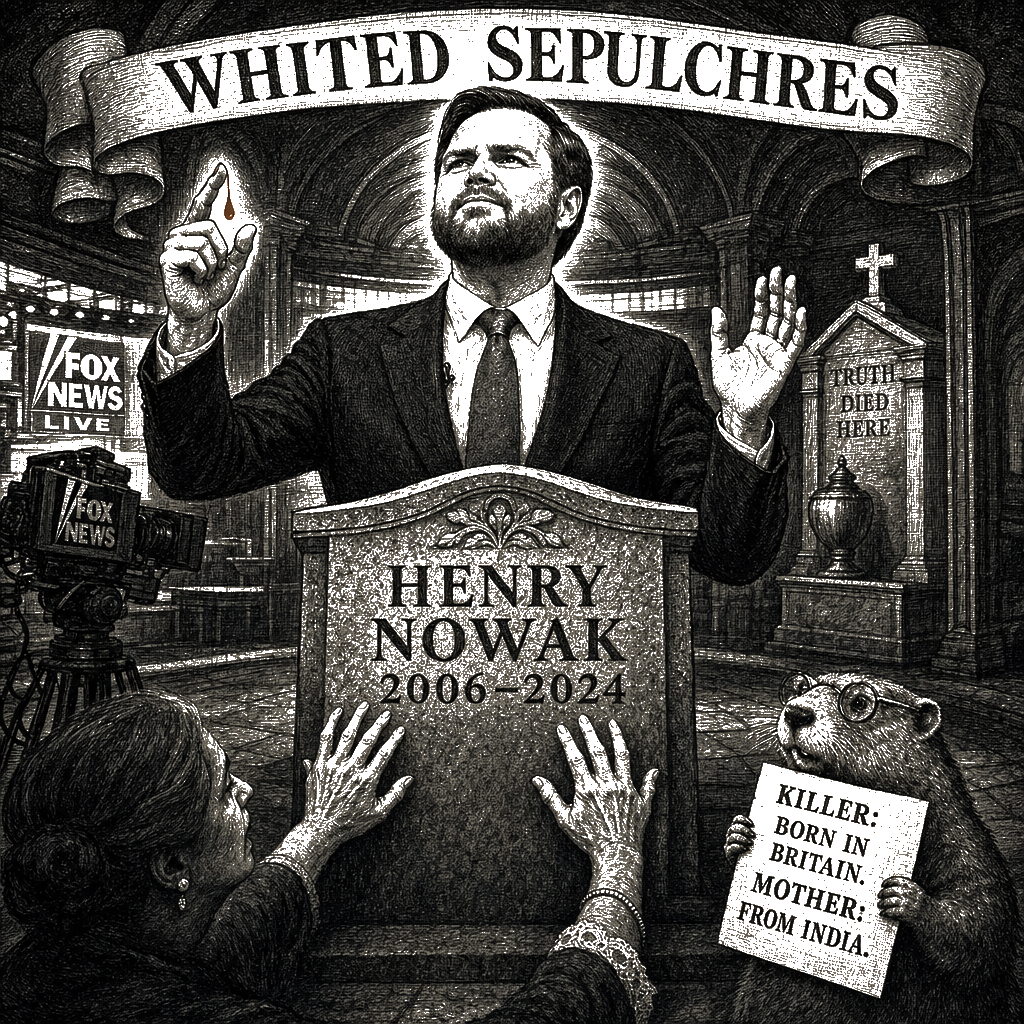
JD, the boy is dead. His name was Henry Nowak. He was eighteen and he is in the ground. You crossed an ocean to take his name and put it in a press release. You never stood at his grave. You stood on it. The blood was still wet on the pavement in Southampton, and you saw a podium—not the blood, not the mother, the podium—and you climbed onto it while his family was still trying to remember how to breathe. You called for righteous anger. You meant your own anger. You are using his blood to buy the leverage you cannot earn on merit, and you are counting the clicks in a room you do not leave. His mother is weeping in a house you will never see.
On 5 June 2026 the vice‑president of the United States posted on X that “righteous anger” was “the only response” to the murder of Henry Nowak, 18, stabbed in Southampton in December 2024. You blamed “the last few generations of European elites” for “the mass invasion of migrants,” claiming Nowak would be alive if Britain had “pulled up the drawbridge decades ago.” You pointed to the killer’s mother’s birth in India while ignoring that he was born in Britain—just as your own mother‑in‑law was born there, a fact that slides right past the arithmetic of your rage. A spokesman for Restore, the hard‑right splinter party your donor Elon Musk has been boosting, has already called for Vickrum Digwa’s “foreign family” to be deported. The same day, Defense Secretary Pete Hegseth marked the anniversary of the D‑Day landings by complaining that European beaches were now being stormed by “different, dangerous ideologies” arriving in small boats—a direct echo of the Nazi propaganda he did not recognize. The British foreign secretary, David Lammy, privately told Vance his comments were wrong, but you did not retract them. X spat your words onto a million British screens before any editor could push back, its algorithm treating the dead boy as engagement fuel. You knew that. You counted on it. The platform is not a coincidence; it is the weapon.
JD, your throat tightens when you say his name. You feel the grit against the back of your teeth. You swallow the lie down, and it settles cold and heavy in your stomach. The nausea rises at breakfast when the morning light catches the polished surface. Your hand shakes when you reach for the salt shaker. I see your hand. It pressed “send” at 11:42 a.m. from the vice‑presidential residence, where your staff had laid out your briefing on Chinese naval movements in the South China Sea and the inflation‑adjusted wage growth for Ohio auto workers. None of it interested you as much as a dead boy 3,800 miles away. The hand that posted did not tremble. It had not trembled when you endorsed Tommy Robinson’s rally. It had not trembled when you told Hungary’s dictator that he was the true voice of his people. The hand is steady because the hand does not feel the blood it wipes onto every key that morning.
There is a metallic taste under your tongue, JD. You cannot identify it. It has been there since the boy died. The coffee at the Residence breakfast tasted of it. The wine at the Hungarian embassy reception tasted of it. The kiss your wife gave you when you got home tasted of it. That taste is Henry Nowak’s blood, and it will not wash out because you have refused to wash. You dipped your whole career into the boy’s wound and then lifted the pen to sign the next executive order. You will taste it for the rest of your life. It is the one thing you have finally done that cannot be undone—not by a press conference, not by a book deal, not by a presidential pardon for whatever your own list of crimes will be.
Pete, you too. You stood on a Normandy beach and saw in every crossing boat not a woman fleeing a husband who broke her jaw, not a child whose cough would kill him if he stayed in the camp, but a brown tide. You called it an ideology. You did not recognize the ideology you were quoting. The sand still holds the iron of the men who died to stop men who talk like you. You are a small man in a uniform that does not fit, standing at the water’s edge and picking at your fingernails while the tide pulls at your boots. Your knees shake with the cowardice you are bringing to their graves. Your chest puffs when they roar. The chest you puff is a sack of air, Pete. The men who died on that beach did not die so you could stand on their corpses and market fascism. The salt in your mouth is their spit. Swallow it.
If your son were the boy in the small boat, JD—if your daughter were the woman whose husband broke her jaw—you would not post. But your children are safe. They are safe because you built the wall around them with the bones of other people’s children. You must have slept. On the night Henry Nowak died you slept in a bed with sheets that were changed that morning by a staff you do not pay. The morning the boy was buried the briefing must have read like a political weather report—what it would cost you to stay silent, what you could gain by speaking—and you dictated the post your aides had drafted, a post that stayed just this side of the line the lawyers would have drawn, the line between “mass invasion of migrants” and the word you actually wanted to type. The handlers will not save you. The lawyers will not wash your mouth.
The boy’s mother has not slept. She will not sleep for months. The space in her chest where Henry was is a cold furnace, and you are standing in it, warming your hands.
“Woe unto you, scribes and Pharisees, hypocrites! for ye are like unto whited sepulchres, which indeed appear beautiful outward, but are within full of dead men’s bones, and of all uncleanness.” —Matthew 23:27
The tomb of your ambition is already dug, JD. It is filled with the bones of boys you never met. The whitewash is peeling. Everyone can see what is inside. The marble is polished, the coffin is closed, the camera is rolling, and the bones are rattling in the dark while you ask for a second take. The boy’s name will outlast your ambition, and you will never be able to delete that.