
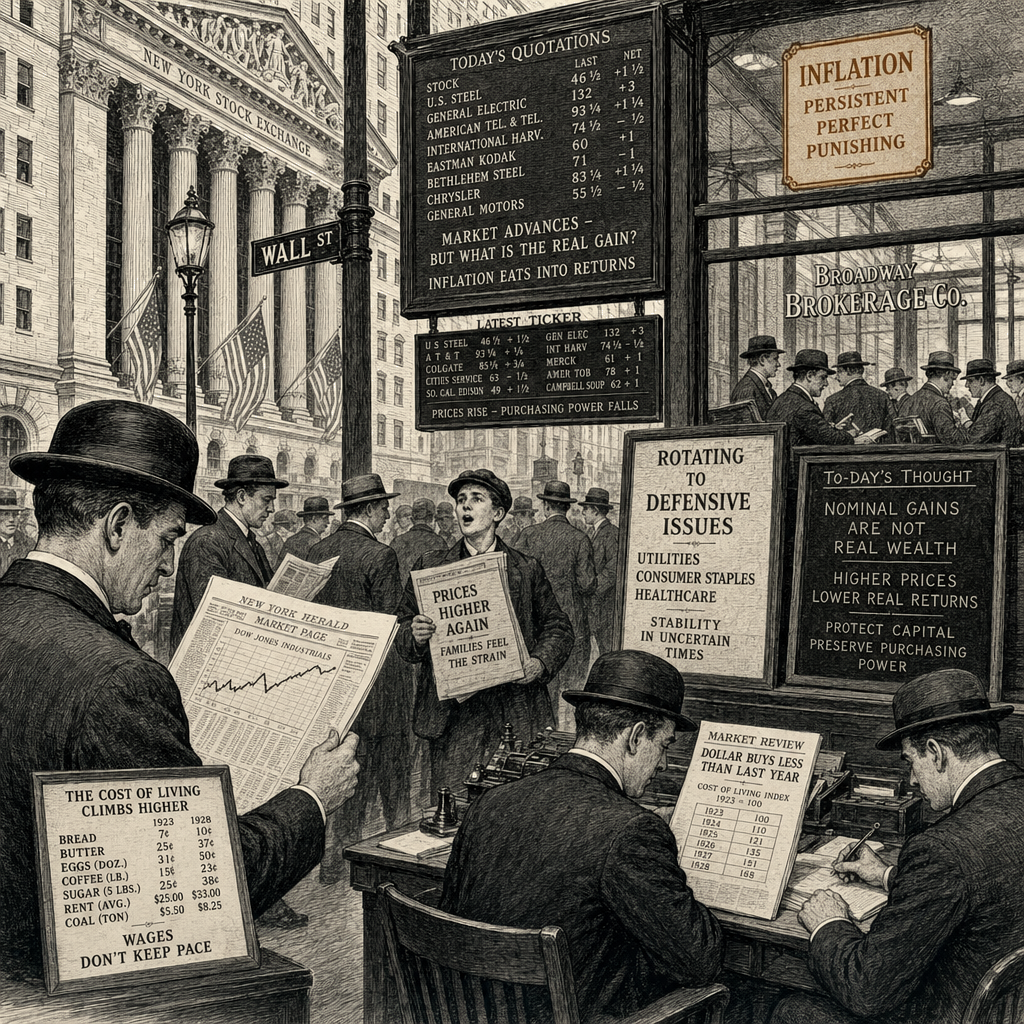
The Wall Street Journal is gaslighting American families about the cost of living. This morning’s Markets A.M. newsletter calls inflation “the cruelest tax” and warns it could take fifteen years for stock valuations to recover after a bubble burst. It acknowledges, almost as an aside, that inflation “irks people when they buy milk.” Then it moves on to portfolio strategies, the S&P 500’s cyclically adjusted valuation, and whether stagflation will crush the next decade of returns.
The financial establishment is starving working families to keep the S&P 500 climbing. The cruelest tax isn’t on your future nest egg. It’s at the checkout counter right now, and it has been for more than five years. The Federal Reserve’s preferred inflation gauge has run above its own target for 62 straight months. That’s sixty-two months of families paying more for everything while the financial press frames inflation as a risk to investors rather than a daily emergency in the dairy aisle.
My household takes home $8,800 a month after taxes. Childcare for my four-year-old and one-year-old runs $2,400 a month. Mortgage, utilities, student loans, and insurance eat the rest before I buy a single box of pasta. When the Journal worries about inflation eroding the purchasing power of a savings account, I watch inflation erode the purchasing power of a weekly grocery run. The “cruelest tax” isn’t levied on a portfolio that has gained, in real terms, nearly 50 percent in five years. It is levied on the family whose real income has flatlined while the price of diapers and heating oil compounds.
The Bureau of Labor Statistics’ latest CPI shows shelter costs climbing 5.4 percent over the trailing twelve months for rented dwellings and 7.0 percent for owners’ equivalent rent. The Penn Wharton Budget Model documented years ago that a working household making $40,000 paid almost a full percentage point more in inflation than a household making $150,000. The Atlanta Fed’s sticky-price CPI—the measure of things whose prices don’t change frequently, the things families cannot defer—remains stubbornly elevated, well above the Fed’s target. That’s rent. That’s medical care. That’s daycare. A quick cart run at Aldi last night ran $47 on paper—milk, eggs, bread, thighs—and the number at the bottom of the slip is what I subtract from the checking account before I subtract anything else. The margin is gone. The CPI says inflation is cooling toward the Fed’s target. The receipt says it isn’t.
The Journal’s concern is that stock multiples are too rich, that corporate earnings won’t “grow into” today’s prices if valuations return to normal. But the families who buy the milk are not waiting for earnings to catch up. Their wages have been trying to catch up to the price of milk for five years while the S&P 500 soared. The inflation-adjusted household budget is down. The inflation-adjusted S&P 500 is up. The “irksome” cost of milk is the same cost the newsletter advises its readers to hedge against by rotating into “dowdier names” like J.M. Smucker—the company that sells the peanut butter those families pour onto store-brand bread because it stretches an extra meal.
Annie Lowrey has documented for years that the United States does not have a structural affordability problem; it has a policy problem. The safety net that should catch families during a 62-month inflation cycle was deliberately dismantled in the 2025 reconciliation and never rebuilt. The dependent-care flexible-spending account ceiling that would have saved my family $5,000 a year—the same $5,000 cap Congress preserved while stripping adjacent family credits—was walked away from by lawmakers who decided the rounding error was acceptable. Rerum Novarum wrote in 1891 that wages ought to be sufficient to support a frugal and well-behaved wage-earner’s family, a standard the United States has not met for decades. This country remains the only OECD member where the school district serving low-income children receives less funding than the district serving wealthy children, where the Pell Grant covers a quarter of a public college education instead of the 80 percent it covered in 1972, and where the federal government has never funded its promised 40 percent share of special education. The shortfalls are not accidents. They are the arithmetic of a policy choice to prioritize the S&P 500 over the kitchen table.
Taylor Swift showed us the interior of that choice in “Anti-Hero”—the narrator metabolizing a broken structure as a personal flaw, internalizing a rigged mechanism as a failure of self-discipline. And she named the outcome in “You’re On Your Own, Kid.” The friendship bracelets from the other mothers in the group text, the ones who trade information about which store has eggs on sale and who Venmo each other the last forty dollars before payday—those are the only safety net we have left. The financial press can tell you to worry about stagflation, about the next fifteen years of stock returns, about whether the Fed will cut rates too late. The rest of us are trying to get through the next fifteen days.
The affirmative fix does not require a new spreadsheet. It requires expanding the Child Tax Credit to cover the true cost of raising a child, capping childcare costs at 7 percent of family income, fully funding the Individuals with Disabilities Education Act, and guaranteeing a federal paid-leave standard that matches the AEI–Brookings compromise. It requires a Federal Reserve that targets wage growth as aggressively as it targets asset prices.
The families who buy the J.M. Smucker peanut butter are not looking at the cyclically adjusted valuation chart the Journal puts in front of its subscribers. They are looking at what is missing from their plates. The financial sector treats this starvation as an acceptable cost of doing business. The households absorbing it do not have a portfolio to hedge. They have children to feed.