
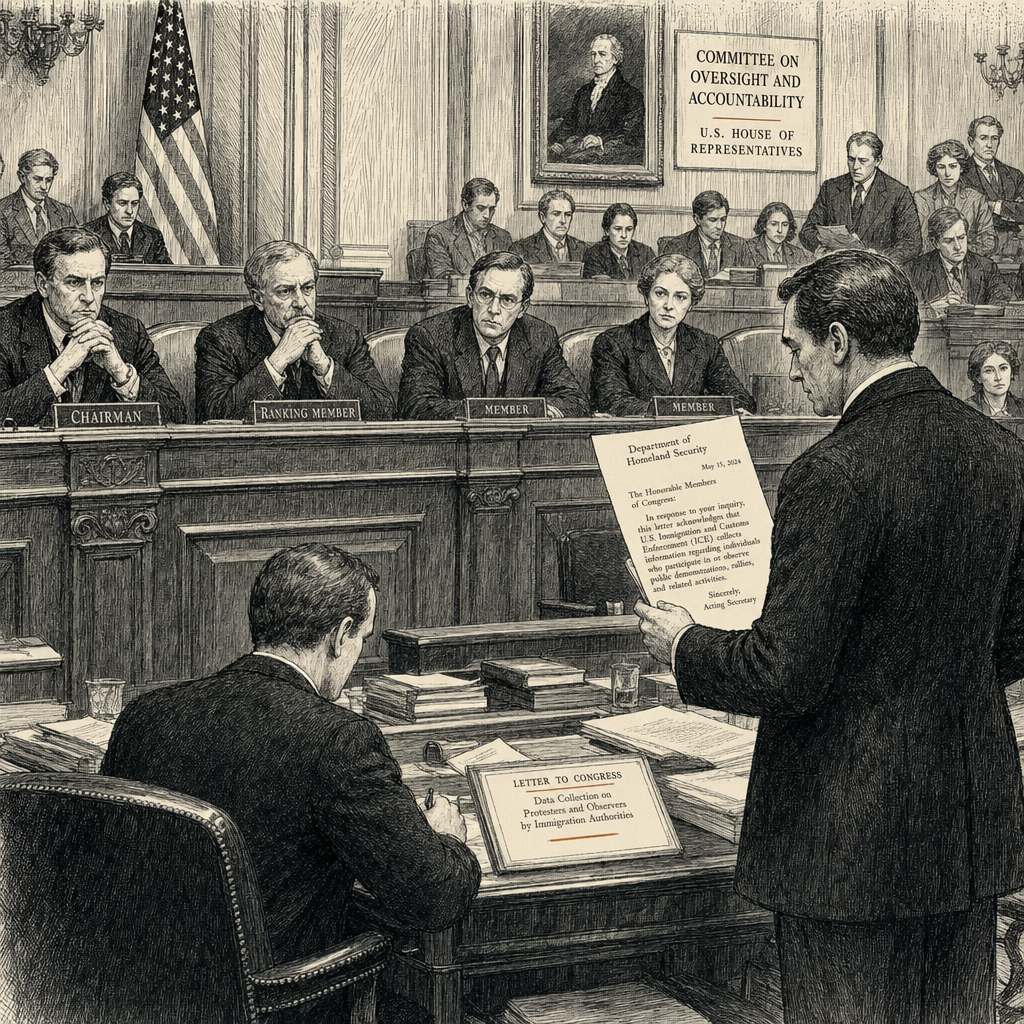
The thing that lets a town run a cooperative, a library, or a neighborhood isn’t a market. It’s the quiet certainty that showing up to observe the people in power won’t land you on a federal watchlist. That certainty is exactly what the Department of Homeland Security is now dismantling. A newly disclosed letter confirms what DHS public spokespeople keep denying: federal agents are photographing, identifying, and retaining records on Americans who peacefully observe immigration operations—even when those Americans are never arrested or charged.
Let me concede the true half. A federal agency has a legitimate job to police actual violence. If someone throws a brick or tackles an officer, the state should record it and press charges. I don’t believe in a state that can’t tell the difference between a rioter and a bystander.
Now let me show you what DHS is actually doing. In January, Xenia Pantos, a pediatric occupational therapist in Portland, Maine, pulled over to watch federal agents on a public road. Her brief act of witnessing landed her and her spouse in a surveillance dragnet. Within hours, a DHS caller from a blocked number threatened to add Pantos to a “domestic terrorist watch list” if she didn’t stop “that type of thing.” Two months later, at a Canadian border stop, a CBP officer inexplicably zeroed in on the couple’s car registration—proof their data had been fed into a government system. The ordeal, documented in a leaked ICE letter obtained by NPR, exposes the lie at the heart of the official denials. There is no standalone “database,” DHS insists, but there is a sprawling, permanent records apparatus, and it is built on the backs of private surveillance contractors.
This is not merely a civil liberties crisis; it is an economic power play. The facial recognition technology that agents snap protesters’ faces with is supplied by companies like Clearview AI, whose face‑scraping empire monetizes public movements without consent. Vehicle registration databases, biometric matching algorithms, secret watchlists with code names like Bluekey and Hummingbird—they are built and maintained by a web of federal contractors who profit from fear. The Trump administration is handing taxpayer money to private corporations to construct a system of political control, and the citizens being tracked are paying for the privilege. The chilling effect is deliberate: frighten ordinary observers like Pantos into silence, and the administration protects the cheap‑labor pipeline that agribusiness and logistics giants rely on. This is the economic subtext most coverage misses.
Meanwhile, federal agents have been disguising themselves to infiltrate protests, blurring the line between public safety and mass surveillance. Every time an activist’s face is captured at a demonstration, a new data point is sold back to the government by the same companies that lobby to expand surveillance powers. The mechanism is already visible in the towns where governors demand warrants as fear spreads from Maine to communities where ordinary people who pull over to observe a convoy find themselves flagged for secondary searches—as happened to a queer couple driving into Quebec. You cannot run a commons when the monitors are the ones being monitored, and you certainly cannot run a democracy when looking at a vehicle gets you on a list.
Elinor Ostrom won a Nobel Prize for proving that shared resources work precisely because the people who use them are allowed to monitor the rules and watch the enforcers. If the price of civic attention is a secondary search, you don’t get a co-op. You don’t get a civic life. You get a population that looks down at its shoes. The worst authoritarianisms didn’t start with camps; they started by erasing the space between the individual and the state. Abolishing civil society—the right to stand on a road and write down what you see—is how you get the terror state. DHS isn’t building safety; it’s manufacturing compliance.
So what do we build on the ground where this surveillance state stands? First, the boundaries. We need laws that make treating lawful observation as a red flag a fireable offense—for the officers who phone up a therapist’s spouse from a blocked number. Courts that force these records into the light. A transparent accounting that shows this net catches actual threats without suffocating the civic square, and if it can’t, the records get wiped.
But that’s just the defense. The offense is to build alternative institutions that treat personal data as a collective asset, not a commodity. Community-owned encrypted communication networks—powered by mesh technology—can keep activist coordination out of the reach of federal data miners. Data trusts and cooperatives can give people genuine ownership over their biometric information, with binding rules that forbid sharing with law enforcement without a warrant. Local mutual aid groups that rely on cash, barter, and offline networks starve the surveillance economy of the digital trails it feasts on. Reclaiming our information from the corporate contractors that turn peaceful protest into government dossiers is the fight for economic democracy.
A country that welds its trap doors shut against its own state is a country where people can actually afford to pay attention. The ICE list is real, whatever they call it. The response must be equally real: a decentralized movement that owns its own data. Let them watch the agents. That’s the whole point of having them. If the feds want a list, let them find one they can’t buy.