
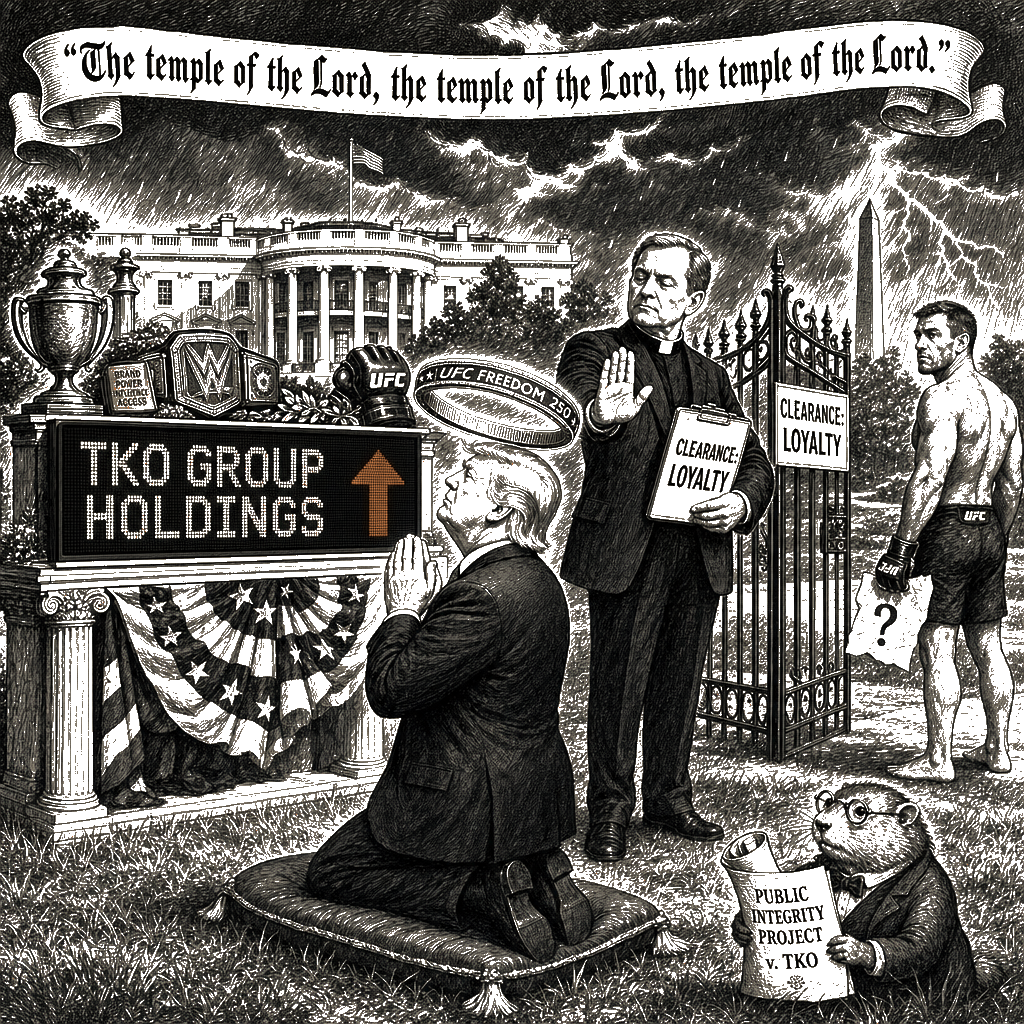
Sean Strickland is the reigning UFC middleweight champion. He is also, at this hour, the most visible man in America who asked publicly why the president of the United States is aligned with Benjamin Netanyahu and Jeffrey Epstein—and then discovered that the answer was a locked gate on Pennsylvania Avenue.
The White House has rented its South Lawn to the Ultimate Fighting Championship for an event it is calling UFC Freedom 250, a Flag Day spectacle timed to the president’s eightieth birthday. Dana White, the UFC’s chief executive, calls the champion’s exclusion “absurd.” The Public Integrity Project’s lawsuit, filed days ago, calls it something more precise: a commercial transaction on public property that selects its participants by political loyalty. The administration’s own financial disclosures, submitted in the spring, called it a potential conflict of interest—fifteen million to fifty million dollars in TKO Group Holdings stock held by the president himself. A promoter pays for the lawn. The president holds the stock. A fighter who named the president’s associations is not cleared for the gate. The machinery is not hiding.
I recognize this transaction because the apparatus I served in for thirty years—the white Evangelical structure that built the modern religious Right—traded in the exact same currency. Secure the seat. Silence the dissenter. Call the compromise a victory and thank God for the access. Praise the regime, and you sit in the front row. Name the regime’s rot, and you are not cleared for the gate. Strickland’s exile is not an anomaly in this coalition’s logic; it is the logic’s intended output, performed in the open on the lawn that we the people own.
Let me show you what the prophets did when kings tried to turn sanctuaries into private stages. Amaziah, the priest of Bethel, sent a message to the prophet Amos in the eighth century before Christ because Amos had been speaking words the royal court could not tolerate. The plain language of Amos 7:12–13 is exact: “Flee away to the land of Judah, you seer… But never again prophesy at Bethel, for this is the king’s sanctuary; it is the temple of the kingdom.” Amaziah does not dispute the prophet’s facts. He cannot. He asserts jurisdiction. The space belongs to the king. The prophet is a trespasser. The administration’s clearance system for Sean Strickland is Amaziah’s script with a twenty-first-century octagon and a stock portfolio. The White House lawn is Bethel, and the political coalition that guards the gate knows exactly what it is doing when it calls the silenced man a seer and tells him to flee.
The Christian-Nationalist coalition that supplies this administration with its moral vocabulary understands the transaction intuitively, even when it wraps the spectacle in liturgy. It believes the nation itself is a sanctuary, that the regime’s power is sacramental, that the civic center must be purified of anyone who points at the financials or the foreign wars. But the prophets do not recognize the king’s sanctuary as sacred. Jeremiah 7 names the exact rhetorical move we are watching in real time. The people are chanting “This is the temple of the Lord, the temple of the Lord, the temple of the Lord”—a liturgy designed to convince themselves they are safe to do whatever the machinery demands in the courtyard. Jeremiah’s God is not impressed. “Will you steal and murder, commit adultery and perjury, burn incense to Baal… and then come and stand before me in this house, which bears my Name, and say, ‘We are safe’—safe to do all these detestable things?” The temple is not protected by the chant. It is a target, because the justice inside the walls does not match the ceremony outside them.
The fight card on the South Lawn is a festival. The gate is the scale. The president’s portfolio—fifteen million to fifty million dollars in the parent company of the promoter who paid for the lawn—turns a political clearance into a business decision. A fighter who asks why the commander in chief maintains a friendship with a foreign prime minister under indictment for corruption and a dead financier whose black book is the open secret of the ruling class is not a dissident. He is a liability to the stock price. The coalition that spent forty years defending the seat because losing it meant losing the political access it mistook for witness now stands in the East Room and calls it patriotism.
I will not pretend that Strickland’s grievance is itself a prophetic vocation. He is a mixed-martial-arts champion asking why a president’s alignments cost him a ticket to a lawn party. The question is secular to the bone, but the mechanism that answers it is the one the Evangelical Right taught me to protect. We cheered when our pastors were invited to the prayer breakfast. We defended the compromises because the alternative was losing the seat. We forgot that the seat is the trap. The prophets do not negotiate for a seat. They tell the truth outside the gate, even when the priest calls them a seer and tells them to flee to a land the king does not own.
Amos 5 says plainly that God despises the festivals, the assemblies, and the songs when the people trample the needy and cheat with dishonest scales. The White House event is a festival. The clearance list is the scale, tipping toward private corporate profit and political loyalty over the public interest the office exists to serve. A president with a direct financial stake in the success of a private entertainment spectacle who punishes a man for naming the unmentionable is not a statesman. He is a proprietor, and the lawn is his lot.
The Sermon on the Mount and the Public Integrity Project’s complaint agree on this one: a civic center that trades its gate for private entertainment and silences the questions that name injustice is operating on a logic the texts explicitly reject. You cannot serve both God and money, Jesus says in Matthew 6:24. Not as a metaphor. Not as a personal-spirituality verse about budgeting. The plain reading is that a system that demands you choose between truth and access is a system that cannot be baptized. The Evangelical apparatus I spent three decades inside learned that the hard way. It bought the access, sidelined the critics, and called it witness. The texts were not fooled. The prophets are not fooled. The stock disclosure form is not fooled.
Strickland may be banned from the lawn, but the lawn belongs to the public anyway. The National Weather Service forecast shows a chance of showers and thunderstorms for the evening the main event is scheduled to begin. The rain will fall on the flag and the octagon alike, indifferent to the clearance list. The question for the reader in the pew who still believes the coalition’s access is worth the compromise is the question Jeremiah and Amos left on the table: whose sanctuary is it? The king’s leasehold, the one you buy with stock and silence? Or the one that stands when the house is washed out and the ledger is finally read?