
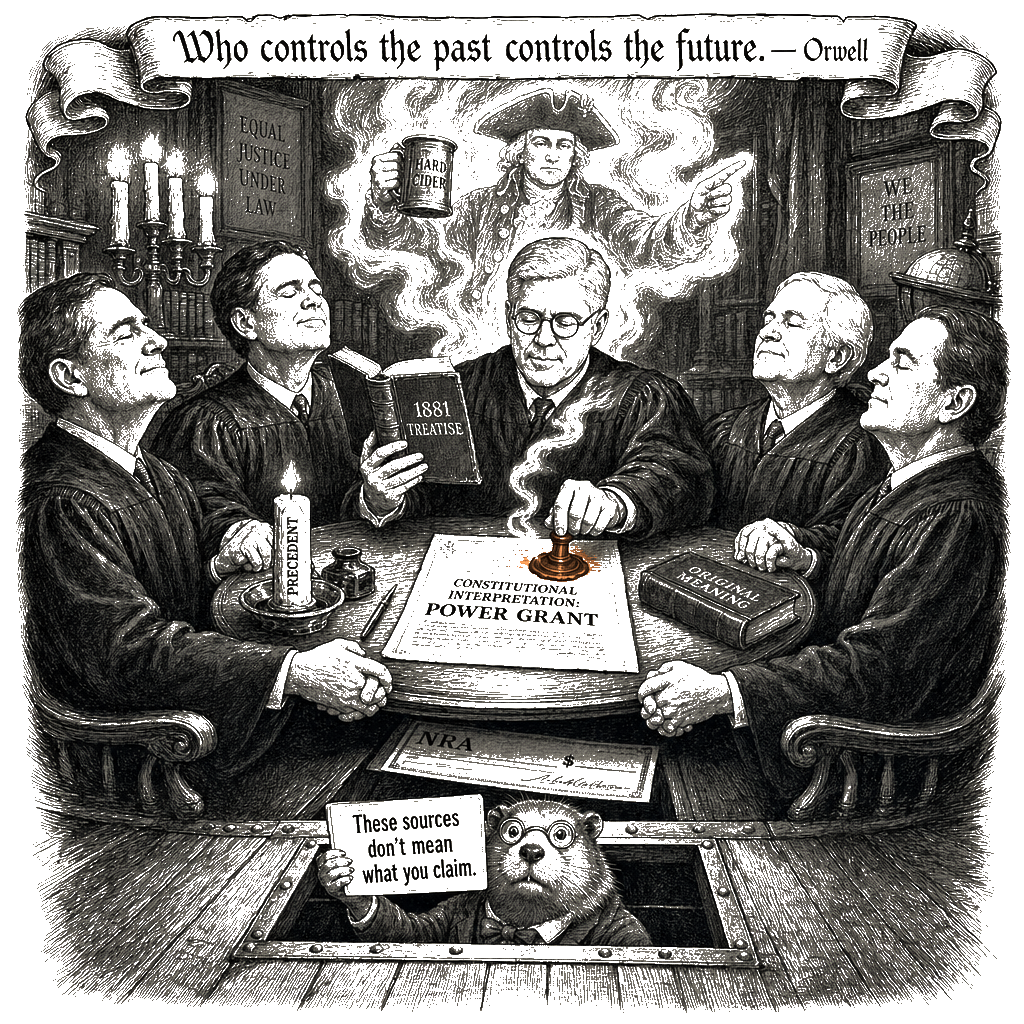
Neil Gorsuch asked a government lawyer whether John Adams’s daily tankard of hard cider meant the Founders would have been disarmed in their own era. Then he reminded the courtroom that James Madison drank a pint of whiskey a day. The Justice was defending a federal prohibition on drug users possessing firearms, and his move was to equate an eighteenth-century breakfast drink—or a statesman’s lunchtime pour—with modern substance abuse. When a Supreme Court justice has to recite the drinking habits of the dead to strike down a public-safety statute, the project has ceased to be legal analysis. It is a séance dressed as scholarship, a historical parlor game in which the dead are summoned to testify on behalf of whichever living litigant has the better archival research budget.
The philosophy had a surface plausibility. Originalism was pioneered by conservatives who argued, with real force, that the meaning of the Constitution’s words should not evolve over time—that letting judges update the document to match their own moral sensibilities was judicial usurpation. The trouble is that originalism as actually practiced by the Roberts Court’s conservative supermajority has abandoned constitutional fidelity for a scavenger hunt in which the justice with the most obscure nineteenth-century treatise wins.
The mechanism is always the same. The controversial claim—that the executive can unilaterally revoke citizenship, or that the state has no business keeping drugs away from guns, or that mail-in ballots are suspect—is advanced. When challenged, the Justices retreat to the easily defended motte: they are simply “faithful historians” recovering the original meaning. The retreat is always available; the return to the controversial claim is always in progress. This is the pattern scholars call the motte-and-bailey, and the Roberts Court has refined it into a judicial operating system.
You can watch the machinery seize in the biggest case of the term. The Fourteenth Amendment guarantees birthright citizenship to all persons born in the United States. The Trump administration, seeking to exclude children of undocumented immigrants, has built its historical case on an unsigned, undated, unpublished letter found in the papers of Andrew Johnson—the president who opposed the Amendment and whose administration the Amendment was specifically designed to constrain—and on an 1881 treatise written by a former Confederate officer who wanted to deny citizenship to Chinese immigrants. Chief Justice John Roberts, a history major who did not join the originalist camp, called the sources “very quirky.” Here is the man who dreamed of being a historian, the sole conservative justice who can still distinguish a source from a séance prop, and even he can barely keep a straight face.
Jonathan Gienapp, a Stanford law and history professor, put the point directly: “The more this form of analysis gets extended, the stranger it becomes. It’s not obvious what from the past matters, and what doesn’t.” This is the central challenge originalism has never adequately answered. If the meaning of the Constitution is fixed at the moment of ratification, then everything from the moment of ratification is potentially relevant—every stray remark in a private letter, every obscure state statute, every beverage choice of every delegate—and the judge has no principled way to decide which pieces of the historical record count and which do not. The method’s very rigor produces its own dissolution. Kostas Moros, a director at the Second Amendment Foundation, put the position as cleanly as it can be put: “If it’s not tied to that original meaning, then it means nothing at all.” This is exactly the archival magic the séance warns against—reduce every constitutional question to the narrowest historical snapshot, and you end up disarming a nation whose founders were, by their own lights, too drunk to be trusted with a musket.
Ask the only question that sorts the structure: Cui bono? Who benefits when the Court pretends that the Second Amendment is whatever an intoxicated eighteenth-century agrarian says it is? The concentrated beneficiary is the NRA’s lobbying apparatus and the defense contractors who bankroll it—a reality we’ve watched play out from the dismantling of Hawaii’s historic gun restrictions to the legal theater over whether a colonial musket somehow doesn’t qualify as a firearm. Who benefits when the Fourteenth Amendment’s guarantee is attacked via