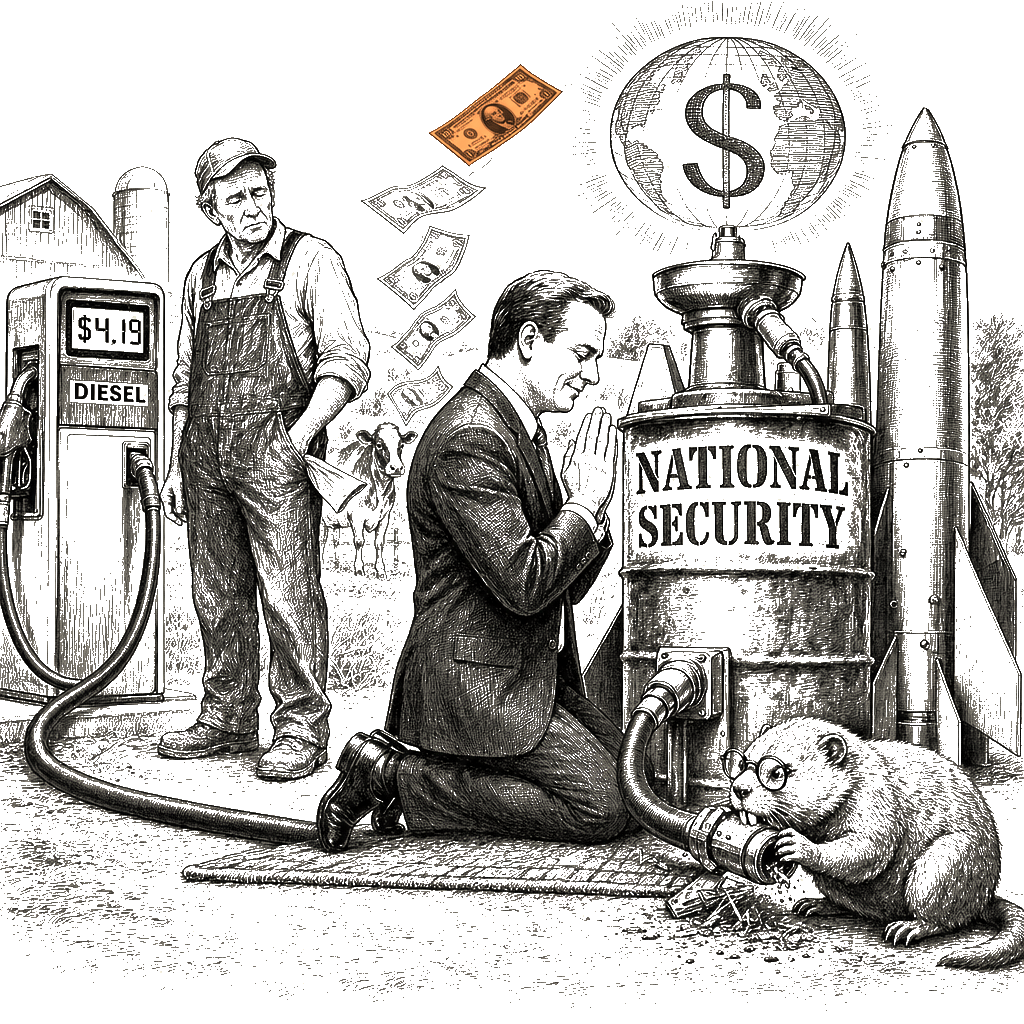
The Trump administration is robbing rural working families at the pump to protect tanker traffic through the Strait of Hormuz. I filled my Silverado yesterday at the Co‑op in Friendship and it cost me a hundred and twenty‑six dollars. That’s forty dollars more than it cost me last May. The pump said $4.19 a gallon for diesel. The news said the price of crude is up because the United States just bombed Iranian air defenses again — three waves of strikes, the Wall Street Journal reported, retaliation for a downed Apache helicopter. Brent crude is back above ninety‑one dollars a barrel; West Texas Intermediate is over eighty‑eight. I pay at the pump for a fight that happens six thousand miles away. My neighbor Joe, who runs a dairy operation, pays at the pump too — his tractors burn diesel, his grain dryer runs on LP, his fertilizer comes on trucks that burn diesel. We all pay. The people sending the bombers don’t.
The notebook I keep at the bench records the exact pass‑through: a geopolitical headline spikes the Gulf Coast crack spread before the CME closes, and by the next morning’s load schedule the regional terminal raises the posted rack price. That’s not abstraction; it’s arithmetic any small‑engine mechanic can trace. The machinery of the global oil trade is wired directly to the board at the Adams‑Columbia Electric Cooperative and the price on the sign at the BP station on Highway 13.
Even a bench mechanic runs into Daniel Yergin’s The Prize when he traces this stuff back — the Persian Gulf threads in and out of the narrative for four hundred pages. The United States has been in the Gulf since January 1980, when Jimmy Carter announced in his State of the Union that any outside force that tried to control the region would be repelled “by any means necessary, including military force.” The Carter Doctrine. We’ve been there ever since. The Strait of Hormuz carries about a fifth of the world’s oil and a huge share of its liquefied natural gas. It’s a chokepoint narrower than the stretch of Highway 13 between Friendship and Wisconsin Dells. The last time U.S.–Iran tensions flared, the Houthis started hitting tankers in the Red Sea and the oil price jumped ten dollars a barrel in a week. This time the Navy struck Iranian air‑defense sites and the price went up again. Every time a missile is fired, the diesel pump in Friendship fires back.
The cycle is getting old: strike, price spike, ceasefire, price drop, strike again. A few weeks ago, oil had pared gains when Hezbollah accepted a partial ceasefire — a glimpse of what peace costs at the pump. Yesterday the market was breathing in instead of out, futures sliding, the tech‑heavy Nasdaq dropping half a percent. But the commodity that actually keeps the rural economy turning isn’t a tech stock; it’s a global commodity tied to a strait that Washington does not control and this administration is choosing to manage with airstrikes instead of diplomacy. The deterrent is the disruption. The argument from the White House says that without those strikes, an unrestrained Iran might strangle the Strait and drive the risk premium even higher in the long run. But the cost of that hypothetical shutdown is being paid in real diesel dollars right now, and the people paying it aren’t the ones making the bet.
This is the Nationalist Shell Game documented in Chapter 16 of Nathan Robinson’s We Too. The rhetoric is about American dominance and national security. The policy is organized around the protection of oil shipments. The bad‑faith catalog at Main Street Independent calls this T‑1, the selective “energy independence” framing. That phrase was invented after the 1973 embargo, when the country was genuinely vulnerable to a coordinated supply cut — a security argument. Today it means “produce more domestic oil,” as if drilling the Permian would insulate us from a Hormuz shock. It doesn’t. Crude is a global commodity, priced in dollars on a global exchange. The price in Friendship is the price in Singapore minus shipping. The American shale patch is pumping at a record thirteen‑point‑six million barrels a day, the highest in history — a trend that ran through the Obama, Trump, and Biden years — and the diesel sign on Highway 13 still moves every time the Hormuz headlines move.
And now, on top of the war premium, the Federal Reserve is preparing to raise interest rates. The new chair, Kevin Warsh, was installed by this administration. He is looking at a hot CPI print for May and three straight months of strong jobs reports, and the market is pricing in a quarter‑point rate rise by year‑end. A rate hike means the already‑unaffordable farm loan gets more unaffordable. It means the small‑business credit line my shop relies on to buy parts in the winter costs more. It means the co‑op’s transmission project to bring in cheaper wind power gets harder to finance. The administration put Warsh in that chair. The same administration that is bombing Iran is now tightening the credit that rural businesses need to survive. The two decisions share a logic: protect the asset values of the people who own the assets. The rest of us pay. This is the Worker Self‑Exploitation contradiction from that same chapter of We Too — the administration talks about working‑class dignity and the forgotten man, but the policy is downstream of the capital, and the people are downstream of the policy.
Wendell Berry wrote in The Unsettling of America that the extractive economy treats people and places as expendable inputs. The oil economy is the purest form of the extractive economy. The people who live above the oil get the drilling rig and the royalty check; the people who live at the end of the diesel supply chain get the price. My county has no oil wells, no refineries. My county has a co‑op pump and a propane tank and a furnace. The war in the Gulf is an extraction on Adams County by other means.
Aldo Leopold’s A Sand County Almanac is one of those books that lives on the bench here. Leopold wrote that there are two things that interest him: the relation of people to the land, and the relation of people to each other. The oil economy poisons both — it poisons the land when we burn it, and it poisons the relation between people when we fight wars to protect the pipelines that carry it.
I’m what’s left of the middle class in this county. I own my land free and clear because I inherited it; I couldn’t buy it now. My shop grossed eighty‑seven thousand last year. I can absorb a forty‑dollar jump in a fill‑up — I don’t like it, but I can absorb it. My neighbor who runs the dairy, whose margin on a hundredweight of milk has been below the cost of production for most of the last twenty years, cannot. The farmer down the road who is still paying off the land cannot. The retired couple on Social Security who heats with oil cannot. The war premium doesn’t distinguish; it just takes.
Look at the pump the next time the Strait of Hormuz heats up and the price ticks up another dime. The price isn’t a number; it’s a transfer. It moves money from the pocket of a dairy farmer in Wisconsin to the balance sheet of a tanker company and the treasury of a Gulf monarchy and the margin call of a hedge fund in Greenwich. The farmer didn’t ask for the transfer. The farmer didn’t vote for the transfer. The farmer just needs diesel to plant corn, and the diesel costs what the war says it costs.
My children, Mike and Quinn, will grow up in a county that for twenty years has been watching the pumps and the co‑op board and the propane contract and trying to figure out which month the bill finally breaks the budget. They will inherit that knowledge. They will also inherit a county that still has a co‑op, still has the county fair, still has the deer season and the ice‑out date and the maple‑syrup run. The things that are worth preserving are still here. They just cost more every time a missile goes off in the Gulf.