Donald Trump closed the asylum door on the climate-displaced and called it law.
The crops are dead. The river is mud. The hurricane took the roof. The water rose in Honduras and the bodies floated past the windows. Evelyn was a teenager. The mosquitoes came after the water. The house was gone. The furniture was gone. The doors and windows were gone.
That was 1998. The door was open then.
Donald, the door is closed now. You closed it.
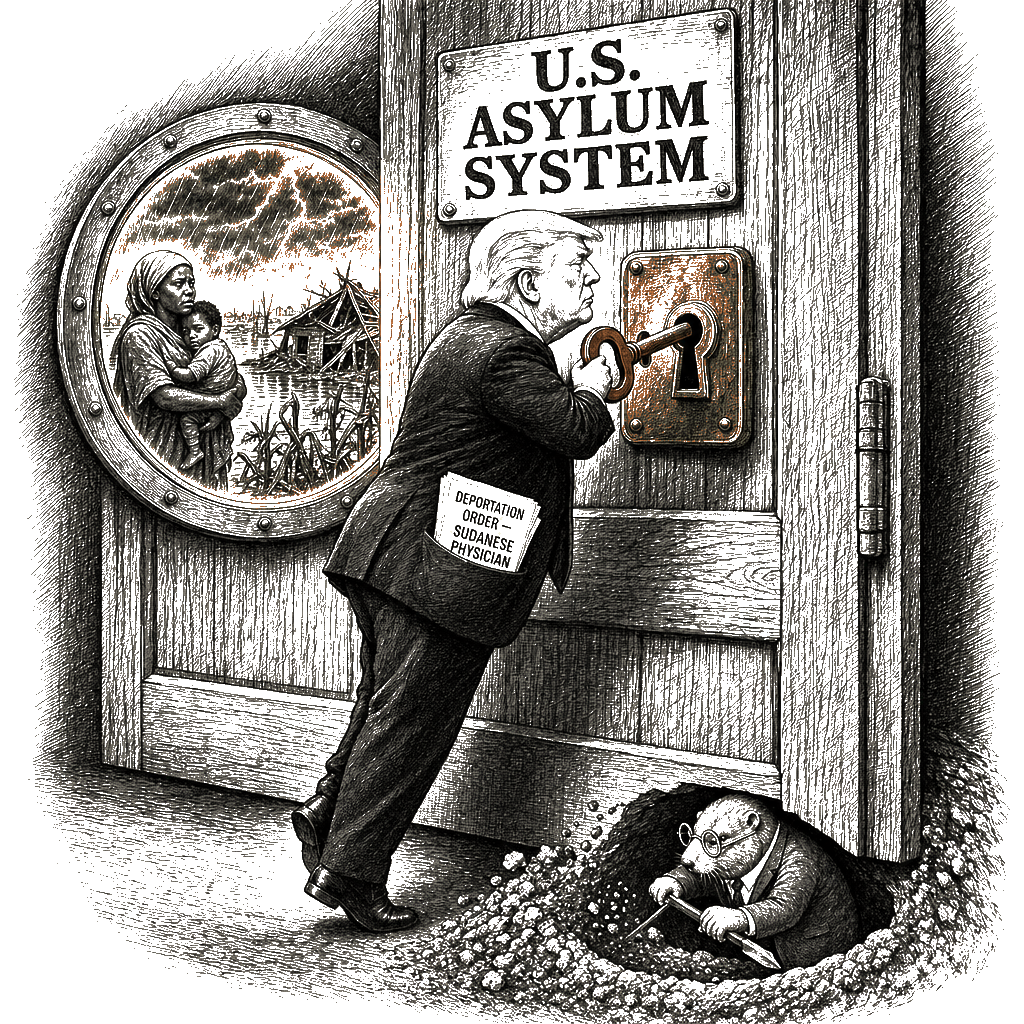
You signed the order that shuts down the refugee program for everyone except white South Africans. You blocked entry from Sudan, from Somalia, from dozens of nations fractured by climate shocks. You made no provision — none — for the 250 million people the United Nations says have been displaced by environmental factors in the past decade. Neither your courts nor international tribunals recognize the overheating planet as valid grounds for sanctuary. Your policy advisors call it a general hostility to certain races, not an intentional climate strategy. The result is the same: no visa, no pathway, just a tightening border where families in Chiapas watch their kin vanish on dangerous sea routes. Six people were found dead in a shipping container at a Texas rail yard in May. Heat stroke was the suspected cause. They walked across the bone-dry land to stand at your gate. You check the lock. You feel safe. You call it sovereignty.
The lock is small. The drought is vast.
Donald, hear what your door-closing does.
Your throat closes when you swallow your morning coffee. It is the powder of the Sudanese farmland that dried up and blew out to sea. You taste the grit. It does not leave. The doctor from Sudan you are deporting — he was invited here to train, he came legally, he trained in medicine because the drought stole the water that steals the harvest that steals the peace. His people are dying in a war the drought helped start. You did not cause the drought alone. You are causing the deportation alone. Your hand signs the paper. Your hand does not shake. Your diaphragm does not drop. The signature is clean. The grit does not wash out of your throat.
Evelyn stood in the floodwater when the storm took everything. Bodies and dead animals floated past her. The river that rose through her living room was warmed by the carbon America burned for a century. The storm that killed seven thousand of her countrymen was fed by an ocean your country helped heat. She did not burn the carbon. She is paying for the burning. She crossed an ocean to build a life; her daughters are studying to be lawyers and doctors in the city you would have barred their mother from reaching. You sign the edict that sends others back to the mud. Your jaw aches at breakfast. It is the ache of the Somali farmer whose teeth grind as the wells go dry.
The Somali man who watched his animals die, who watched his neighbors die, who fled to a city where the bombs fell in the market — the cattle dead in the sun, the children forced to carry rifles — he is now afraid of your government the way he was afraid of the armed groups. You have become what he fled. Your shoulders set forward, heavy and locked, as you review the asylum denials. It is the weight of the Somali mother who runs from the farm to the city and finds the bombs waiting. The heat you cannot cool with your air conditioning radiates in your bones.
There is a scratch in your throat, Donald, that you do not notice. There is a tightness behind your sternum that does not belong to you. It belongs to the boy in Mogadishu who is thirsty. It belongs to the farmer in Sudan whose well ran dry. It belongs to the Sudanese doctor whose deportation order you signed. It belongs to Evelyn, who was a teenager when the water came, who is now in New York and cannot bring her cousin here because you shut the door.
You tell yourself it is the law. You tell yourself it is sovereignty. The law is the ink on the order. Sovereignty is the fear in your chest when you hear the knock. You are a small man, Donald, with an iron key in your hand, turning it twice to make sure the lock holds.
The door you closed is not a metaphor. The door is the barrier between a flooded home and a dry apartment. The door is the difference between a hospital in Khartoum and a hospital in Queens. The door is the difference between a market that gets bombed and a market where children buy candy. The heatwave does not care about your lock. The storm does not care about your edict. The ocean is rising, and you are sitting inside checking the latch. The carbon America burned is still in the atmosphere, still warming the ocean, still feeding the storms that will send more Evelyns into the water. You know this. You have been told this. The heat is in your own lungs, Donald, and you are exhaling it onto the nations.
I name the cruelty beneath the signature. You wash your hands in the executive washroom. The water runs clear. The grit does not wash out of your throat. The not-washing is the indictment. You will not feel the powder in your own lungs, but you put it in theirs.
The prophet Isaiah wrote of a shelter from the storm, a refuge from the heat. The righteous were to be a hiding place from the wind, a covert from the tempest, as the shadow of a great rock in a weary land.
The hiding place is locked. The covert is empty. The shadow of the great rock falls on no one.
“Inasmuch as ye did it not to one of the least of these, ye did it not to me.” Matthew 25:45.
The lock is small. The drought is vast. The Christ is standing in the water with the dead animals. The water is still rising. Donald, the gate is shut. The heat is coming.