
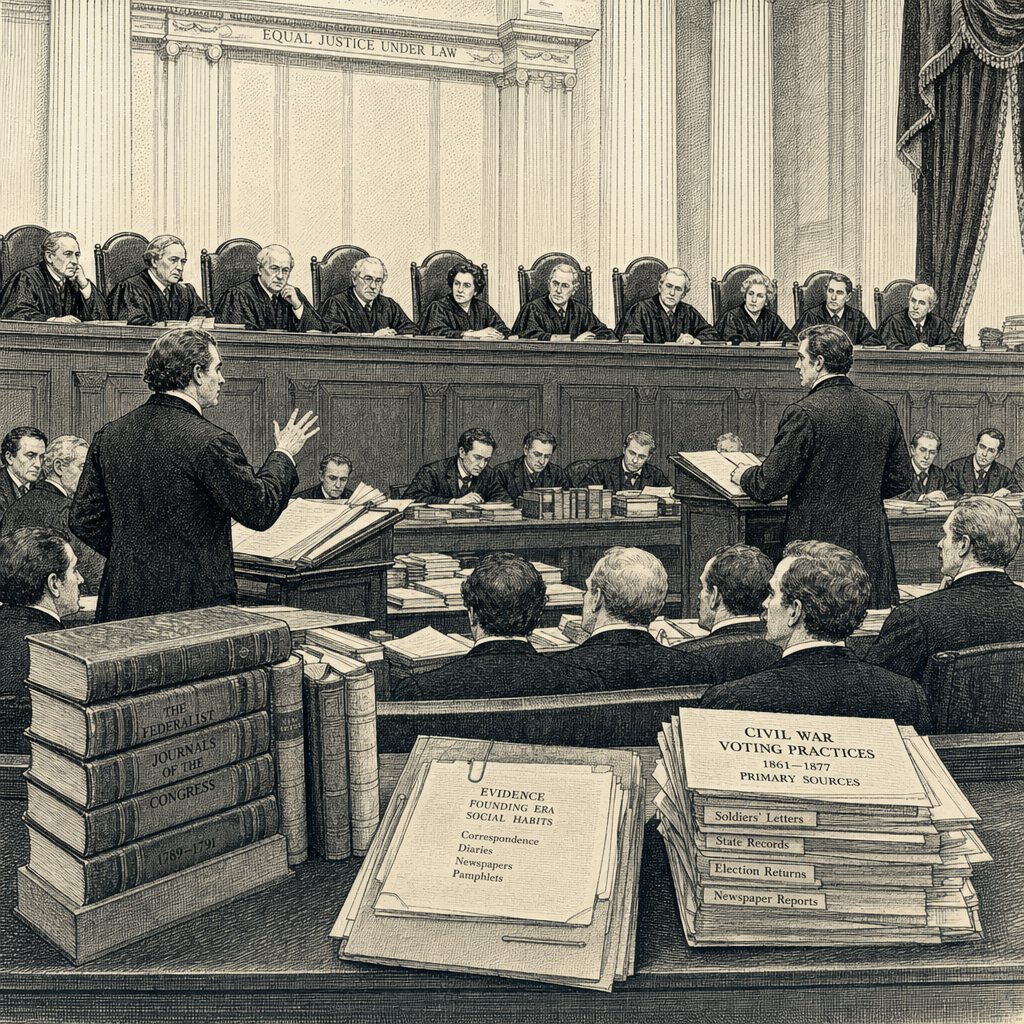
The Roberts Court is turning American constitutional law into a parlor game for antiquarians, and the joke is on everyone who has to live under the results. The highest court in the land now decides who lives and dies, who votes and who doesn’t, who is a citizen and who isn’t, by asking what John Adams drank for breakfast. This is not a parody of originalism. This is originalism in operation, circa 2026.
Originalism, as a methodological commitment, seeks to tether judicial discretion to the fixed public meaning of the Constitution at the time of its enactment. The promise is that by anchoring rulings in historical text and tradition, judges prevent themselves from imposing their own policy preferences on a democratic society. When applied with craft and discipline, it provides a neutral, discernible framework that protects individual liberties from judicial invention.
That neutral framework does not exist in the docket the Court is currently hearing. The record shows a supermajority treating history not as a binding constraint, but as a costume rack.
During oral arguments on whether drug users possess a Second Amendment right to own a firearm, Justice Neil Gorsuch defended the desired outcome by cataloguing the morning drinking habits of the founders. John Adams drank hard cider to breakfast. James Madison drank a pint of whiskey. Thomas Jefferson consumed three or four glasses of wine. The federal law in question bars people who use illegal drugs from possessing firearms. The problem for the originalist project is that the Founding generation did not have a well-developed concept of drug addiction as a category. So the Court, in its wisdom, is now litigating whether “habitual drunkards” statutes from the founding era provide the necessary historical parallel. The analytical move reduces New York State Rifle & Pistol Assn. v. Bruen, 597 U.S. 1 (2022), to a bartending ledger, much like the recent debates over whether a musket counts as a firearm. This is what passes for constitutional reasoning on the Roberts Court: a debate about whether the founders drank too much to be credible as historical exemplars. The absurdity is not incidental. It is the method’s natural endpoint. When you tether constitutional rights to the specific regulatory judgments of a society that bled patients with leeches and counted enslaved people as three-fifths of a person, you get governing law that sounds like a colonial reenactment society’s rulebook.
The same dynamic plays out in the mail-in ballot case. The question is whether states can count ballots postmarked on time but arriving after Election Day. The answer, under the Court’s current approach, apparently hinges on “field voting” during the Civil War, when Union soldiers cast ballots that were transported home after the election. The briefs are stuffed with citations to an obscure 1915 book by Josiah Henry Benton, a Boston lawyer who thought historians had overlooked the practice. Both sides claim the nineteenth-century evidence supports them. This is constitutional law as antiquarian hobby. The question of whether millions of Americans can have their votes counted should not turn on what happened when Union soldiers mailed ballots from the battlefield.
The birthright citizenship case is where the method’s bankruptcy becomes fully visible. The administration wants to end birthright citizenship for children of undocumented immigrants, and it needs the Fourteenth Amendment’s Citizenship Clause—ratified in 1868—to mean something other than what it has been understood to mean for more than a century and a half. So the administration’s lawyers have gone rummaging through the archives. What did they find? An unsigned, undated, unpublished letter sitting in Andrew Johnson’s papers. An 1881 treatise by a former Confederate officer who wanted to deny citizenship to Chinese immigrants. Old newspaper clippings and speeches that, according to actual historians, do not reflect the views of the Fourteenth Amendment’s ratifiers. This is not legal argument. This is a scavenger hunt for anything that sounds old enough to be mistaken for authority.
Chief Justice Roberts, the one member of the conservative supermajority who does not call himself an originalist, saw it for what it was. “The examples you give to support that,” he told the solicitor general, “strike me as very quirky.” That is the Chief Justice of the United States, an undergraduate history major who wanted to be a professor, telling the government’s top Supreme Court lawyer that its historical evidence is a joke. When the history buff on the Court is calling your history a joke, your history is a joke. The administration’s argument is the reductio ad absurdum of the method, and it is bad-faith doctrinal sabotage—part of a wider pattern of selective historical mining the Court has normalized.
Roberts’s skepticism is instructive, because Roberts is the canary in the originalist coal mine. He joined Bruen. He joined Dobbs. He has voted with the supermajority in most of the major cases that have remade American law on originalist grounds. But he is too good a historian to pretend that this kind of cherry-picked historical scavenging is honest scholarship.
The problem is that the method works the same way when the supermajority likes the conclusion. This is not a failure of method. It is the success of a doctrinal one-way ratchet. The conservative legal movement built a framework where “history and tradition” functions as an outcome-generating machine rather than a limiting principle. When the coalition seeks to expand gun rights, the tradition is found in Jefferson’s wine cellar. When the coalition seeks to dismantle voting access, the Court is handed a 1915 treatise on Civil War mail-in ballots to justify modern restrictions. When the coalition seeks to end birthright citizenship, the record yields to an unreconstructed Confederate officer. The doctrine provides no falsifiable standard, no constraint, and no neutrality. It provides precisely the discretion the steel-man claims to forbid.
The Federalist Society pipeline has spent decades building the intellectual infrastructure for this approach—the scholarship, the amicus networks, the coordinated litigation strategies that tee up the cases the Court wants to hear. The conservative legal movement treats originalism as a neutral methodology while deploying it as an outcome-delivery system. The results are predictable: gun regulations fall, abortion rights fall, environmental regulations fall, and the administrative state is dismantled, all in the name of fidelity to a past that has been carefully curated to produce exactly these results.
Stanford law and history professor Jonathan Gienapp has the diagnosis right: “The more this form of analysis gets extended, the stranger it becomes. It’s not obvious what from the past matters, and what doesn’t.” That is the problem in a sentence. Originalism purports to constrain judges by tying them to fixed historical meaning, but it does nothing of the kind. The choice of which historical moment to consult, which sources to credit, and which level of generality to apply is itself unconstrained by anything except the judge’s preferences. The method’s apparent rigor is an illusion that conceals the same old judicial will it claims to have banished.
The Second Amendment Foundation’s Kostas Moros offers the defense: “I get people who see it as sounding crazy. But that’s what we agreed to. If it’s not tied to that original meaning, then it means nothing at all.” It sounds principled. It is not. We did not agree to let James Madison’s whiskey consumption determine whether Congress can keep guns away from fentanyl addicts. We did not agree to let Josiah Henry Benton’s 1915 book on Civil War field voting determine whether mail-in ballots get counted. We did not agree to let a former Confederate officer’s treatise on Chinese immigration determine who is a citizen. The fiction that we are bound by the specific historical judgments of long-dead generations, applied to circumstances they could not have imagined, is not democracy. It is ancestor worship dressed up as jurisprudence—selective ancestor worship. The same justices who insist on historical analogues for gun regulations are notably less interested in historical inquiry when it comes to the kinds of rights the founding generation didn’t care about: the rights of criminal defendants, the rights of prisoners, the rights of people seeking shelter from deportation. The history that gets consulted is the history that supports the outcomes the supermajority wants. The history that doesn’t is, in Roberts’s word, “quirky.”
The Roberts Court has turned American constitutional law into an antiquarian game in which the rules are whatever the players say they found in the archive. The method is not jurisprudence. It is the judicial expression of a political movement that has captured the courts and is using them to impose a version of the past on a country that never consented to live there. The founders’ world has been carefully curated by the same movement that deploys it. The Court’s pretense that this curated past binds a modern democracy is not originalism. It is a lie told with footnotes.