
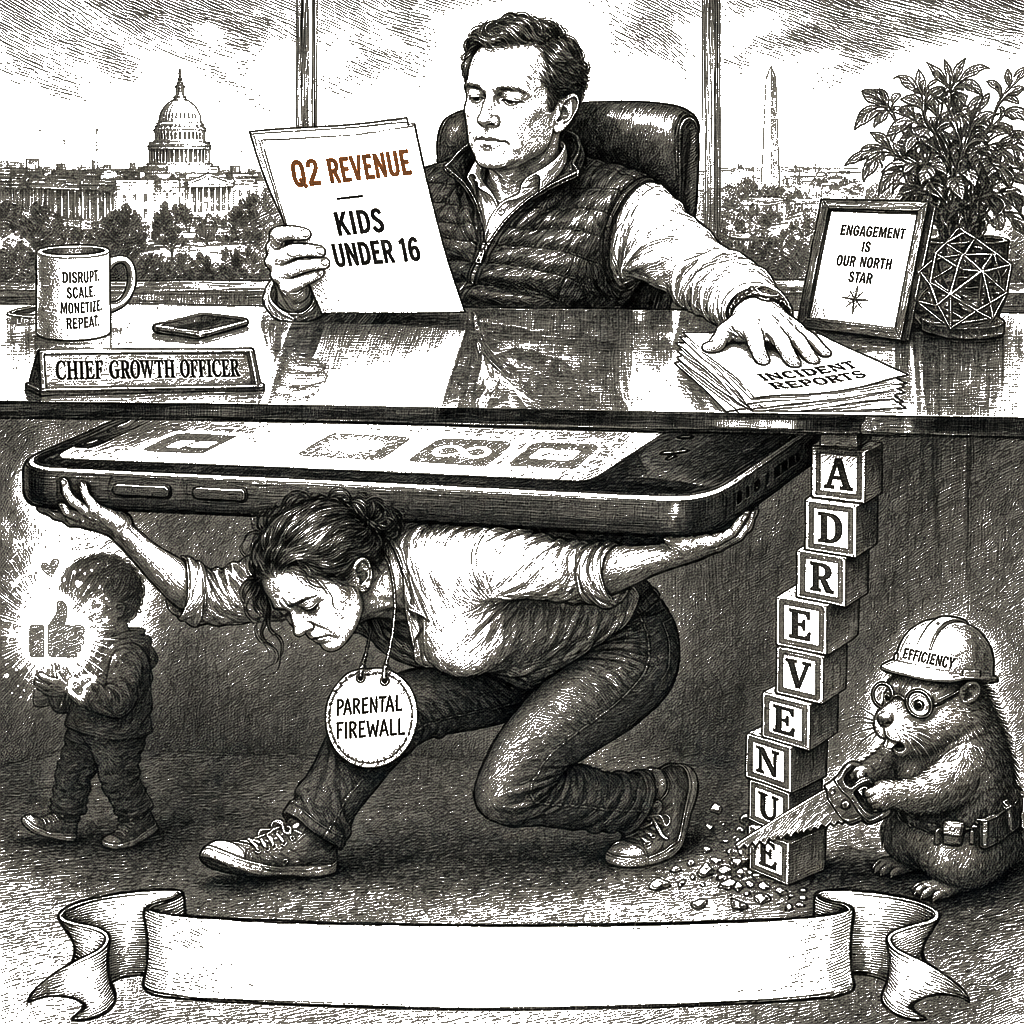
Washington is letting tech giants break our children for ad revenue.
Under Canada’s proposed Safe Social Media Act, platforms like Meta and Snap face penalties up to 3 percent of global revenue if they fail to verify age and keep kids under 16 off social media. It forces the companies that engineered the extraction machine to absorb the cost of keeping kids away from it. In the United States, we have no such firewall. We have a trade policy. The Wall Street Journal notes that the U.S. already classifies Canadian digital regulations as “trade irritants” — a classification that mirrors the pushback we’ve tracked globally — but while other nations are drawing perimeters, Washington has built a vocabulary where a child-safety law and a lumber tariff occupy the same category.
And on top of the financial math, there’s the surveillance shift — the hours spent doing what a regulator should be doing. The kitchen-table version of this abandonment is just hours and friction. I run the household spreadsheet. I know what the $2,400-a-month childcare line item means, and I know what my own sanity costs. Without a federal age floor, American parents are the unpaid compliance officers for billion-dollar extraction algorithms. We are the human firewalls. We are the ones checking browser histories at eleven at night after the kids are finally asleep, negotiating device confiscation, and fighting the dopamine drip that these platforms engineered to override a child’s impulse control. The cognitive load of this unpaid labor isn’t a line item in any national budget; it’s just the water we swim in. Anne Helen Petersen named it burnout, but when the burnout comes from trying to parent a child whose nervous system is actively being hacked by a firm that calls you a “monthly active user,” it isn’t burnout. It’s a job we never applied for. When the state refuses to build a guardrail, the parent is left holding the car to keep it from rolling down the hill.
Canadian parents are about to get the guardrail. The algorithm will not be able to touch their fourteen-year-olds. American parents are still just the hands on the bumper. Taylor Swift put the diagnosis in three words on Midnights: “You’re on your own, kid.” We used to read the line as a millennial empowerment anthem, the friendship bracelets and the self-reliance. It isn’t. It is the American care infrastructure’s mission statement. The song’s narrator is being told she’ll have to figure it out alone — and that is exactly what American policy tells parents when it refuses to build the guardrail Canada is building right now.
The Catholic working-class formation I grew up with in Lansdale didn’t outsource boundary-setting to the family in the exact same way. It wasn’t perfect, and it wasn’t universal, but the parish and the parish-school provided a shared perimeter. The adults in the room maintained the boundary so the children didn’t have to carry the moral and psychological cost of navigating an unregulated environment. The corporal works of mercy included protecting the vulnerable. Today, that work has been privatized. The vulnerable are our children, and the protection is entirely up to the family trying to run the math on a single-income mortgage that doesn’t exist anymore. We are drowning in the labor of compensating for policy choices that Washington refuses to make.
And even Canada’s law, for all its ambition, carves a hole the size of Mountain View’s most irresponsible product category into its own architecture. The bill allows most social-media platforms to obtain exemptions from the ban if they meet safety requirements established by a new regulator. Pornography platforms cannot. AI chatbots get the carve-out — for three distinct reasons, some structural, some studied, some that will hit the kitchen table roughly five seconds after AI chatbots are how teenagers actually talk to one another, while Marc Miller is looking in the opposite direction. Social media is the country’s most formidable family-precarity vector, and proposing to wall off teenagers from it while exempting the platform’s own chatbot is like saying the lead pipe is illegal but the faucet attached to it is none of your business. The policy architecture has a hole the size of a generation in it.
The Wall Street Journal’s reporting on the February mass shooting at a school in British Columbia — an eighteen-year-old describing violence to a chatbot, and OpenAI deciding against alerting anyone — is the vignette that any working mother will read with her hand over her mouth. Miller’s carve-out for chatbots because the risks “aren’t as well studied” is the admission that the people who decide whether to alert enforcement are the same people who are positioned to benefit from confusing child-safety-as-research-program for child-safety-as-obligation. The children I am raising are underwritten by terms-of-service contracts.
Meta’s response calling the Canadian ban “counterproductive” is a masterclass in gaslighting the people who pay the real price. It is the exact register Jia Tolentino documented in Trick Mirror — the platform’s demand on the user is treated as a voluntary optimization choice rather than an extraction requirement. When Meta says sufficient safeguards “provide real value to young people,” they mean safeguards that do not interfere with the revenue curve. “Counterproductive” is a corporate-communications phrase for “we have done the regulatory-capture math and determined that parents will absorb the cost of our product’s externalities.” The people saying “the harms are not well-attested by the science” are the same people who designed, iteratively, the most-precise attention-extraction machine ever built, and they are telling the government the cause-and-effect is unknown. The Wall Street Journal’s own reporting on Meta’s internal teenage-girl-self-image research established that Meta knew Instagram was harmful and proceeded anyway. Hearing “counterproductive” from the people who made the product this productive-at-scale is like hearing an arsonist call the fire department a “burden on first responders.”
The daycare-bill spreadsheet is a multiple-page tab in my household’s Google Sheets file. The cognitive-load-to-income ratio of tracking Ben’s tablet time is my department. I don’t have the bandwidth to be a full-time cybersecurity auditor on top of my day job, my mortgage, and raising two kids. I want the state to do the thing Canada is trying to do — force the verification, hit the bottom line so hard the product stops trying to serve children who are legally and developmentally incapable of consenting to its terms of service. The U.S. trade objection that the Canadian proposal is “an irritant” is the foreign-capital equivalent of Meta’s position, just dressed in foreign-policy language: your regulation is interfering with the profit-margin activity that my sector has built its valuation around. Trade-policy language treats platforms as something the country exports, which is a way of saying the household’s ability to make the rules about the household’s own children is a negotiable line item.
The Trudeau and Carney governments keep proposing laws like this — complicated, exemption-built-in, regulator-provisioned, and insufficiently engineered against the next vector — and it would be easy to be cynical about the pattern. It would also be wrong: the attempts matter because parents watching the bills fail is a different data point than the government’s apparatus having never known a child-protective digital law was on the floor. The UK just pushed ahead with its own ban this week, reinforcing that this is a genuine international momentum, not a one-off political gesture. If eventually you stack many attempts, the attempt-level resistance from trade-negotiating partners becomes a different argument for the attempt.
In my house, the ages-old debate about what my children can see online is not “if.” The kitchen-table question is “when” — when does the third-grader’s Chromebook allow the chat function that the filter didn’t quite catch, and how many weeks will it take me to notice? Until Washington builds the firewall, the math on the kitchen table stays the same. The cost of the algorithm is my time, my kid’s nervous system, and the slow erosion of a childhood that is supposed to be protected before it ever gets put on the market. Counterproductive is the highest compliment Mark Carney will receive this week.