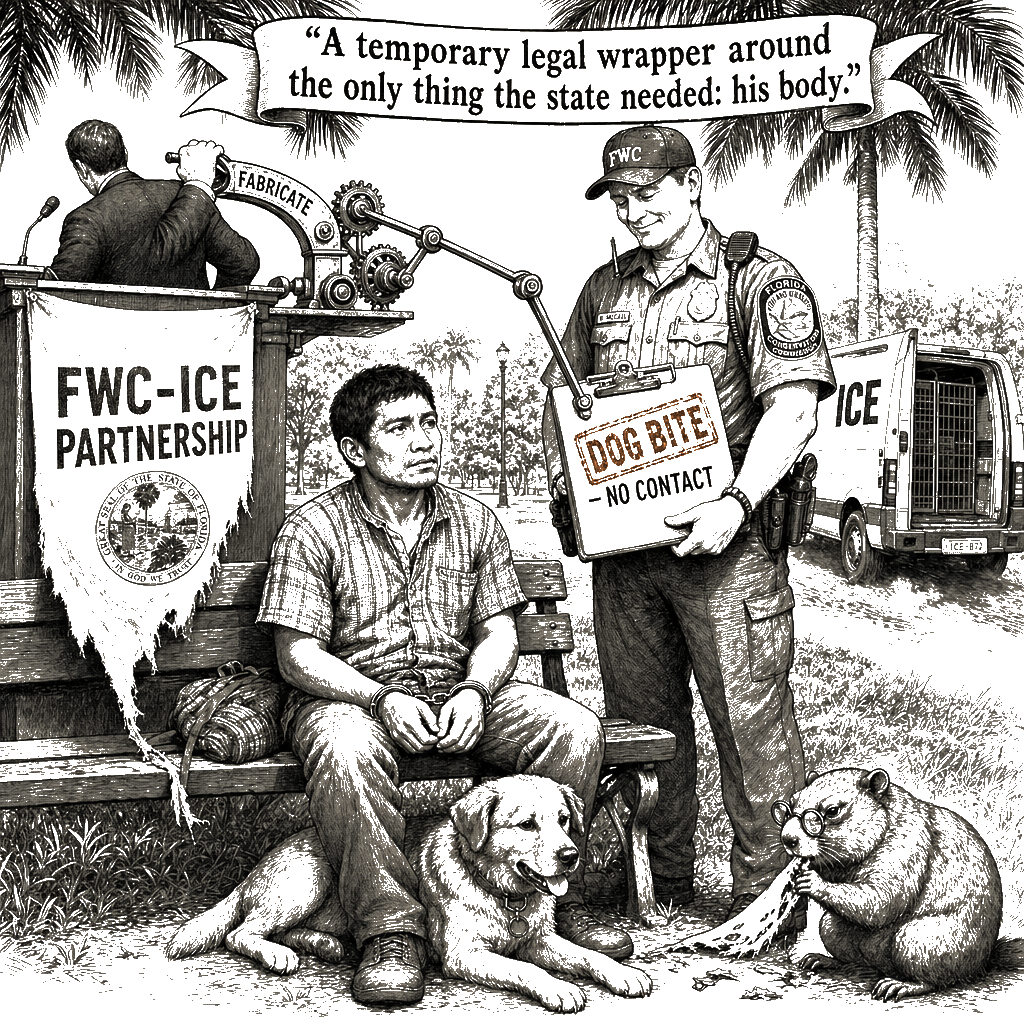
I am writing this column for the Guatemalan man arrested in a Bonita Springs park in late March on a charge his wife says was fabricated, who sat handcuffed for forty minutes while a Florida Fish and Wildlife officer waited for ICE to arrive and take him into federal custody. The officer claimed the couple’s dog bit him. The officer never left his vehicle. The charge was a placeholder — any charge would have done — a temporary legal wrapper around the only thing the state of Florida actually needed from that man that afternoon: his body, in custody, for federal immigration authorities to collect.
I am writing it for the wife, who told the Associated Press her story on condition of anonymity because she fears being detained herself, who does not know where her husband is being held, who does not know what will happen to his asylum case. The couple had been pursuing their claims before the incident. Now the husband is in ICE custody and the wife is alone and the asylum cases dangle, and the dog that bit nobody is a dog that bit nobody, and none of it matters to the machinery that took him.
Governor Ron DeSantis has supported expanded state involvement in federal immigration operations. The Fish and Wildlife Conservation Commission — the agency whose name evokes bass and manatees and the careful stewardship of the state’s natural inheritance — is now working directly with ICE to identify and detain people without legal status. A state officer can pull over a couple walking a dog and find a charge that will hold for forty minutes, and forty minutes later the federal machinery arrives, and the charge is dropped or forgotten or allowed to wither because it was never the point. The point was the handoff. The point was the body. The point was demonstrating to the federal partner that Florida will deliver.
The officer who files a false charge and waits in his vehicle for the federal van to arrive is not enforcing the law. He is a stalking-horse for deportation. When a state agency accepts the role of the border patrol, it abandons its own purpose to become the machinery of federal deportation. You are turning neighbors into prey.
The Trump administration has made state-local-federal partnerships a cornerstone of its immigration strategy. The argument is that these partnerships make communities safer by targeting individuals who have committed crimes in addition to being in the country without authorization. The argument has the shape of a moral claim, and like many arguments that have the shape of a moral claim while serving the function of a machinery component, it collapses on contact with the documentary record. The Guatemalan man in Bonita Springs was not arrested because he had committed a crime beyond his immigration status. He was arrested because a charge was fabricated, and the charge was fabricated because Florida needed a charge to hold him, and Florida needed to hold him because the federal partner wanted him held.
This is not an accident of enforcement. It is the architecture you designed. The same machinery ran when a different party occupied the Oval Office and cheered the raids as necessary. The cruelty is not partisan. The cruelty is structural. Adam Goodman’s work shows that the deportation machinery, across a century, has relied far more on “voluntary” departures and self-deportation than on formal removal — a reminder that the machinery is durable and predates any one president. Every administration that treats human beings as expendable inventory shares in the guilt. The deportation apparatus does not distinguish between the violent criminal and the husband walking his dog. It consumes them both. You release the mothers of soldiers only when the public demands it.
I am a Catholic. I am writing this column as a Catholic, in a Catholic register, because the tradition I inhabit has a vocabulary for what happened in that parking lot, and I mean to use it. The vocabulary is not “concerning.” It is not “problematic.” It is not “an abuse of power” — a phrase that means, functionally, that the power was exercised in the wrong way, when the deeper problem is that the power should not exist in the form it takes. The tradition’s vocabulary for what happened to the Guatemalan man in Bonita Springs is evil. When a state officer fabricates a charge to deliver a human being to the federal machinery, the tradition I inhabit — the tradition of Amos and Isaiah and the red letters of Jesus Christ, of Romero and Day and King — calls that evil. Not harmful. Not regrettable. Evil.
The prophet Isaiah names the inversion in language that does not expire: “Woe to those who call evil good and good evil, who put darkness for light and light for darkness.” Jerome copied the prophet’s words in the fourth century, and the words are available to us now, and they apply. The officer who fabricates a charge and then stands by while the federal machinery arrives is calling evil good. He is calling the arrest lawful when the charge that justified it was false. He is calling the forty-minute wait a routine procedure when it was a kidnapping dressed in the language of enforcement. He is calling the machinery justice when it is not justice. It is the opposite.
The Torah commands you to remember what Egypt did to you. You shall not wrong the stranger who resides in your land, for you were strangers in the land of Egypt. You remember the boot on your own ancestors’ necks, yet you put it on another’s. The charge that disappears when the ICE van arrives is not an accident of administration. It is a feature of a system you have built that criminalizes presence itself, and then, finding insufficient crime to justify the machinery, manufactures the crime it needs.
Jesus said the Son of Man will separate the sheep from the goats. Those who fed the hungry and welcomed the stranger will inherit the kingdom. Those who did not will go into the eternal fire. He did not give the sheep a list of approved paperwork. He gave them a single test: did you welcome the stranger? You look at the papers. He looks at the face. The gap between your law and his command is the distance between your administration and the kingdom. The wife in Bonita Springs, like the wife of the Army sergeant detained in El Paso, watches her husband vanish into the same system that claims to honor families. You call it justice.
The moral weight of this architecture falls on every one of us. Abraham Joshua Heschel wrote that few are guilty, but all are responsible. The governor who signed the agreement is guilty. The officer who fabricated the charge is guilty. But we, who did not stop it, are all responsible. We who sit in comfortable pews and watch the news from behind glass doors helped build the consent for it. We agreed that some lives are expendable if it means we feel protected in our affluent communities. We voted for the men and women who promised us this machinery, and we did not flinch when the machinery began to turn on the neighbor we were told to fear. Our silence is the mortar holding up this wall.
Dorothy Day wrote, in the September 1945 issue of The Catholic Worker, that “we have killed 318,000 Japanese.” She did not write “the bombing resulted in casualties estimated at.” She wrote what she wrote, in her own voice, because the tradition she inhabited required her to name what she had participated in. I am not Dorothy Day. I am a carpenter and a pastoral worker in a small Western town, and I was not in the Bonita Springs parking lot in late March. But I am a citizen of the country whose machinery took the Guatemalan man, and I am a member of the Catholic Church whose political operatives have spent decades lending moral cover to a deportation apparatus that has now reached the point where a Fish and Wildlife officer will fabricate a dog bite to hold a man for ICE. The climate this administration is exploiting is one our communities helped build — the decades during which voices within our political tradition cited Romans 13 to justify enforcement operations, the silence from too many pulpits while the machinery accumulated capacity. We are complicit in every fabricated charge and every empty chair at a dinner table.
To the Fish and Wildlife officer in Bonita Springs: the charge you filed was false. You know the charge was false. The dog did not bite you. You never left your vehicle. What you did was evil, and you know it was evil, and you did it anyway — because the machinery asked you to, because the machinery rewards what you did, because the machinery is built on men like you doing what you did and calling it law enforcement. The door of return is open to you. The tradition I inhabit never closes the door. But the door begins with the truth, and the truth is what I have written here, and the truth is that you handed a human being to the federal machinery on a charge you fabricated, and the machinery ground him up, and his wife is alone, and neither you nor the machinery that employed you has said what you did. You can tell the truth. You can refuse the next time the machinery asks you for a body. The prophets call this repentance, and they do not make it sound easy, and it is not easy, but it is available, and it remains available to you as long as you are alive.
Romero ordered the Salvadoran soldiers to drop their weapons and cease the repression. I am telling you to order the state agencies to stop. The door of return stands open. Return the husband to his family before the night closes on you.
The wife is alone. She does not know where her husband is being held. She is afraid. The dog that bit nobody is the charge that was not real. The forty-minute wait is the machinery doing what the machinery is built to do. The image is not yet real, and it will not be real in my lifetime, and it may not be real in any lifetime until the kingdom comes. But the image is the standard. The image is the measure against which the Bonita Springs parking lot is weighed and found wanting. The Guatemalan man is in custody. The wife is alone. The door is open, and the officer can walk through it. God does not close the door.