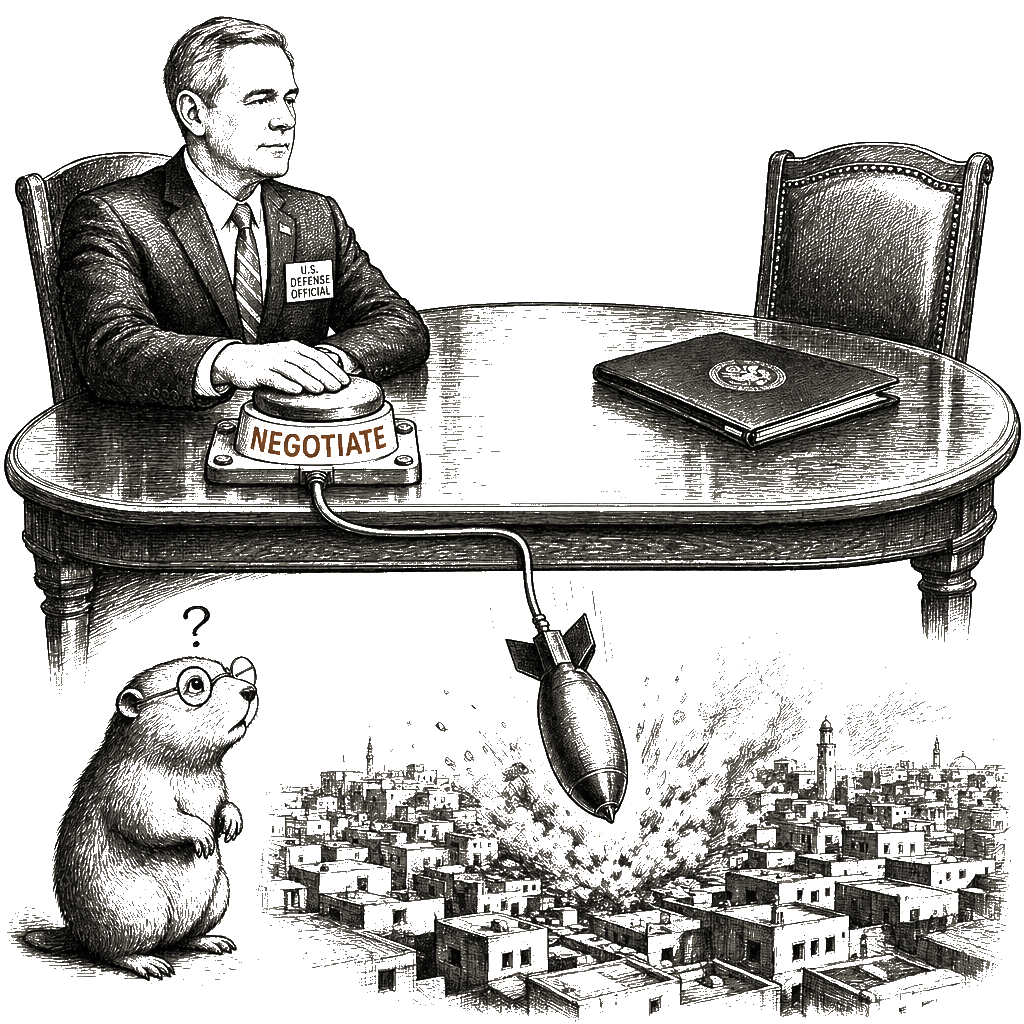
Donald Trump is killing people to win a negotiation. The missiles that fell for a second straight day are not a failed ceasefire; they are the policy. Defense Secretary Hegseth, with a bluntness that is almost honest, said that “if we need to negotiate with bombs, we’ll negotiate with bombs, and we’re very good at it.” Iran’s parliamentary speaker answered in kind. The language they are trading is destruction. This is not statecraft. It is a slaughter dressed in press-release syntax, a moral inversion the prophet Isaiah condemned when he pronounced woe to those who call evil good and good evil, who put darkness for light. It is the same logic that stretched from the Cold War’s “escalate to negotiate” doctrine to the Nixon administration’s bombing campaigns in Southeast Asia—force dressed as a signal, millions left dead. As we documented earlier this week, the administration has cycled between bombing and claiming a deal is near for weeks. The bombs are not a breakdown of diplomacy; they are the diplomacy.
From Augustine to Aquinas, the just-war tradition demands that force be a last resort, proportionate, and undertaken with love for the enemy. These strikes fail every test. The United States has not exhausted peaceful alternatives; it is using bombs as leverage. That is not a just cause; it is coercion that treats human lives as bargaining chips. The U.S. bishops wrote in The Challenge of Peace that “no Christian can rightfully carry out orders or policies deliberately designed to kill noncombatants.” This is not an abstraction; it is a direct indictment of a strategy that uses bombs as bargaining chips. Dr. King called my own government “the greatest purveyor of violence in the world today.” That remains true. Iran’s leaders also choose missiles, and they bear their own guilt. But my faith compels me to address my own nation first, for I am accountable for what is done in my name.
We in this country have learned to accept this rhythm because the political class on both sides has trained us to measure conflict in polling numbers and inflation data rather than in burned homes and shattered spines. We are complicit in a system that treats human blood as a bargaining chip for a stalemate. I walk alongside veterans in Redemption Springs whose bodies still carry the concussions of the last empire’s wars, and I know the grief does not stay in the foreign desert. It comes home to a kitchen table in Ohio and to a widow’s prayer in Kansas. You are asking a generation of young soldiers to stand on carriers in the Gulf and bleed for a political impasse that serves only the egos of the men who ordered the strike. In Gethsemane, Jesus refused the sword even when his own friend struck the first blow to defend him. He told Peter to sheath the iron because he knew that violence only multiplies the dead. You do not have Peter’s panic as an excuse. You have the intelligence briefings, the economic reports, the counsel of your generals who tell you the blockade of the Strait of Hormuz is failing. Yet you choose the strike.
The blockade was supposed to squeeze Iran into submission—a strategy of collective punishment that violates the just-war principle of discrimination by making ordinary Iranians bear the cost of their rulers’ defiance. The blockade has not produced strategic submission, yet the suffering continues. The policy is not only immoral; it is failing on its own terms. Dorothy Day wrote that the only solution to the long loneliness is love and that love comes with community, but the state’s logic is isolation and fire. When a nation is built on the promise that bombs will buy security, the nation is eating its own future. The bombs are a tax on everyone. Gas prices are the receipt for the rubble. The Wall Street Journal calls this a CINO, a ceasefire-in-name-only, a whitewashed name for bloodshed—the mark of Isaiah’s woe over those who repaint destruction as peace.
A just peace would look different: a real ceasefire, diplomats at the table, and the United States accepting a settlement that does not humiliate Iran. That is the concrete demand of the just-war tradition: peace is the presence of justice, not the absence of bombing for a day.
Isaiah addressed rulers with blood on their hands, and the door was open: “Wash yourselves; make yourselves clean; remove the evil of your deeds from before my eyes; cease to do evil, learn to do good.” You can stop. The gate of return stands open to you. Tear down the ramparts of pride, lift the siege of your own heart. Weep over the indifference that made this escalation feel like routine. Put down the sword. The world does not need more fluency in destruction. It needs the courage to build a peace that does not require a graveyard to sustain it. Óscar Romero stood before soldiers ordered to kill and said, “In the name of God, stop the killing.” He did not say stop when the deal is signed. He said stop. The bombs can stop now. You can choose to be a peacemaker.