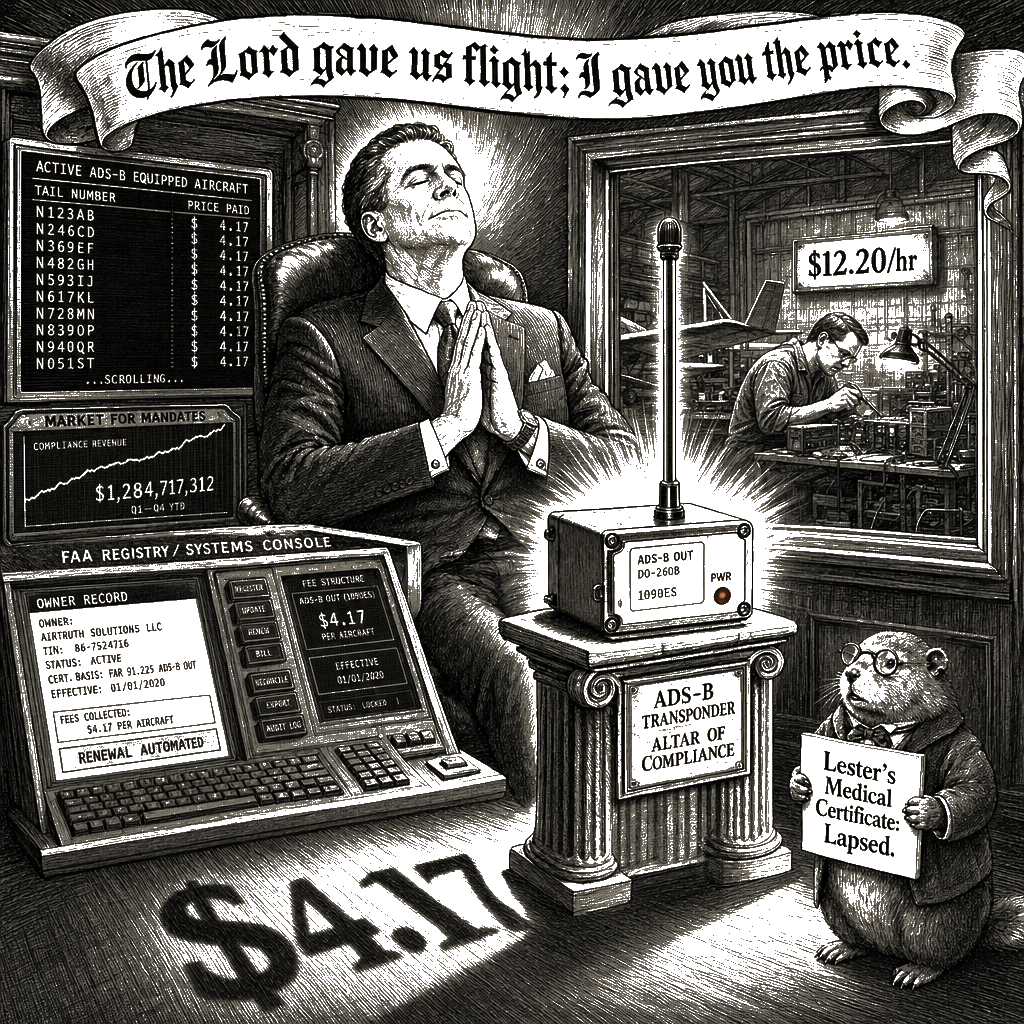
Ricky is a body on the avionics bench of the jet‑refurbishment line I own outside Wichita. The transponder in the Southwest 737 you flew on last Thanksgiving — the one with the crying baby and the 10:42 arrival — came off his hands, and those hands are the reason the unit cost $6,200 instead of $7,100. I pay him $12.20 an hour. The ticket you bought was $247. The Lord gave us flight; I gave you the price.
Kimberley Strassel, in her Wall Street Journal column “Big Brother Is Watching the Sky,” is correct that the government lied when it sold ADS‑B as a safety tool. She is wrong about the remedy. I own the data floor that turns the transponder’s broadcast into a tax bill, and I want you to understand why the House provision she praises — the one forbidding government agencies from using the feed “for the purpose of obtaining revenue” — is the best thing that has happened to my quarterly numbers in 4 years.
Stay with me.
Here is the arithmetic, and I want you to hold the figure. Lester is a cross‑reference on that floor outside Reno — a former crop‑duster who knows the FAA registry formats the way a man knows the fence line of his own field. I pay him $14.25 an hour. His job is to match the tail numbers your transponder broadcasts — every aircraft, every sky, every second — to county tax‑assessor rolls. He processes 340 matches in an eight‑hour shift. His labor per match is $0.042. The server license that stores his entry costs me $0.0003 per row. I sell the row for $4.17 per flagged aircraft per quarter. I do not round.
Los Angeles County claims 1,000 planes have been hiding from $35 million in property taxes by parking outside the jurisdiction. Those planes were not discovered by a clerk at the airport. They were flagged by a report I compiled, from a transmitter the pilot was required by law to install, at a cost to the pilot of upward of $5,000. The pilot paid for the transmitter. The transmitter feeds my floor. I sell the product of his compliance to the man who taxes him. The circle is $4.17 per plane per quarter, and it is clean.
Now watch what happens when Congress tries to fix the thing Congress created. The House provision forbids government agencies from using ADS‑B “for the purpose of obtaining revenue.” Strassel praises this. The NTSB director praised this. Pilots are relieved. They should not be. I am not a government agency. I am a private data‑analytics firm that sells to government agencies. The provision bans the direct pipe and preserves the middleman, and I am the middleman. If the provision passes, counties that were scraping the feed themselves lose that channel. They buy my reports instead. My price goes up. My exclusivity deepens. God willing, the provision passes. The assessor’s direct pipe closes. My rate card goes to print. Lester’s shift extends.
The pilots turning off their transponders to avoid the tax hit — the NTSB director warned the Senate about this in February — are disabling a safety device to avoid a revenue device, and I understand that decision the way I understand a man who stops locking his door because the lock is how the burglar knew the house was occupied. I do not blame them. I also do not need them to leave the transponders on. ADS‑B In — the upgrade the new bill requires — will broadcast regardless. The next generation of my feed is already priced into my projections.
Now pull back, because this is the part worth learning. The state exists to count. The safety mandate is a census. The census is a tax base, and the interval between the installation and the bill is the only variable. The FAA gave us 5 years. The next interval will be shorter. The next sensor will not be in a Cessna — it will be in your seat‑belt buckle, tracking your miles and billing you, and the safety briefing will be the same: It protects you in a crash. Senator Sheehy offered that as a warning. I filed it as a product specification. The architecture is drawn. The decency interval shrinks every cycle, because by the third cycle the public has already accepted the premise. The first time is an outrage. The second time is a line item. The third time it is infrastructure, and infrastructure does not require consent.
Be diligent to know the state of your flocks, the proverb instructs, and look well to your herds. I have always read that as a mandate for continuous asset monitoring. The flocks have tail numbers now. The herds are in hangars across 31 states. The diligence is automated, and the looking is what I sell.
But the same feed that gave the county its tax bill gives the state something else. The state files my quarterly wage reports. The threshold where my unemployment contribution resets — the rate I pay on the next hire — is $13.60. Ricky costs me $12.20. I read the exhaustion date. I hired the next body, a man named Lonnie, at $12.20, which is $1.40 below the number that would have triggered the adjustment. Across 2,080 hours, that difference is $2,912. I pocket it. The software that would have certified Lonnie on the updated avionics spec cost $150. I kept that too. You paid $247 for the ticket. I kept $2,912. The safety mandate was the cover. The data feed was the product. The list of names on my payroll is a census, and the census is a cost‑control instrument, and the state charges me nothing for the filing.
I’m told, by people who study these things, that the ten‑year supply of avionics technicians has a problem. I haven’t looked. The demand for refurbished transponders is rising, driven in part by the same midair collision that Strassel’s senators are using to push another mandate. The mandate will create another data stream. The data stream will create another tax base. The tax base will create another hire, priced at $12.20, on a bench in Wichita. The system is self‑sustaining. I am, on the whole, content.
Lester gets up at 5:15. He is at his desk by 6:00. He matches tail numbers for 8 hours, eats a sandwich at his station, and drives to the apartment he rents on the east side of Reno — $1,140 a month, $140 more than he budgeted when he took the job. He has not flown in 4 years. His medical certificate lapsed and the wages do not cover the reinstatement. He processes the coordinates of 340 aircraft a day belonging to people who can still afford the hangar.
I have not asked whether Lester flies in his dreams. It would not change the output.
Sterling A. Varice holds the Hayek-Friedman Chair and serves as Dean of Instruction at Warden University’s College of Business and Economics in Richmond, Virginia. He is the author of three textbooks: Divine Mandates for Labor Utilization, Social Obligations for Profit Maximization, and Calibrated Deprivation: A Manager’s Guide to Employee Motivation.