
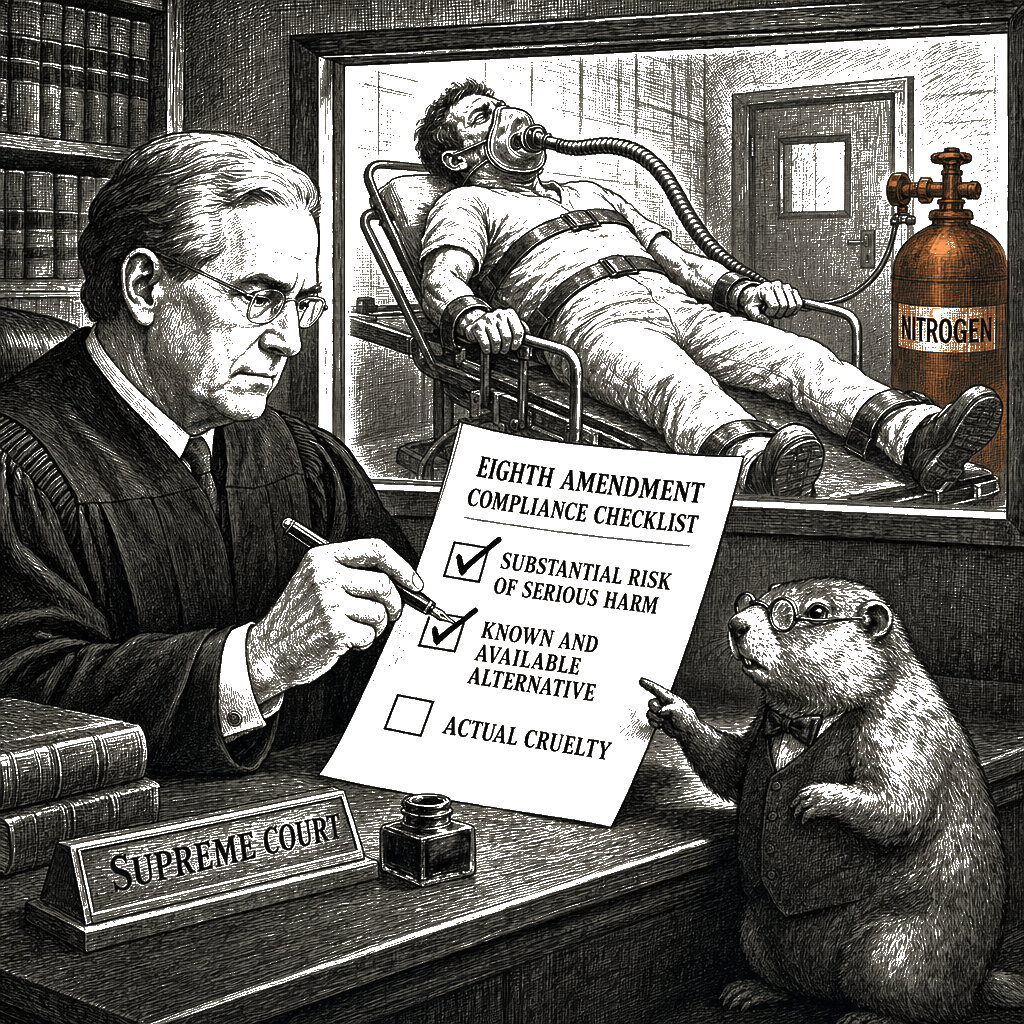
The federal courts are helping Alabama suffocate condemned men to death in nitrogen gas. Under the framework Chief Justice John Roberts has built for the death penalty, the Eighth Amendment—the constitutional clause banning cruel and unusual punishment—no longer functions as a restraint on the state’s power to kill; it functions as a checklist for the state to clear before pressing the switch.
The doctrinal architecture, hardened over nearly two decades, begins with Baze v. Rees, 553 U.S. 35 (2008), and Glossip v. Gross, 576 U.S. 863 (2015). An execution method violates the Eighth Amendment only if it poses a “substantial risk of serious harm” and the condemned can identify a “known and available alternative” that significantly reduces the risk. In Bucklew v. Precythe, 587 U.S. 483 (2019), Justice Gorsuch and the other Republican appointees tightened the trap: the alternative must be “feasible, readily implemented, and in fact significantly reduce a substantial risk of severe pain.” In practice, as Justice Sotomayor wrote in dissent in Glossip, the rule “permits a state to execute a prisoner by a method that is unconstitutional simply because the prisoner cannot identify a painless method that the state refuses to adopt.”
That is the structural lock at the heart of the Roberts Court’s death penalty regime. The burden rests on the condemned man to find a better way for the state to kill him. If the state cannot obtain pentobarbital because pharmaceutical companies have made lethal-injection drugs difficult to procure, the state does not have to prove it can kill humanely; the prisoner must secure the alternative himself. Where he cannot, the state uses what it has on hand—lethal injection if drugs are available, the electric chair if they are not, and, now, a mask and a tank of nitrogen gas.
District Judge Emily C. Marks, ruling on the case of Alabama death row inmate Jeff Lee, applied that framework with an originalist gloss. As Main Street Independent reported on May 29, Marks conducted the first trial devoted solely to the constitutionality of nitrogen hypoxia, a method already authorized in five states: Alabama, Arkansas, Louisiana, Mississippi, and Oklahoma. The evidence she heard was gruesome. Witnesses described condemned men thrashing, gasping, and struggling for air for one to three minutes before losing consciousness. Yet Marks concluded that the pain fell short of the Eighth Amendment’s bar because, in her view, the cruel and unusual punishments the framers had in mind were “drawing and quartering, public dissection, burning at the stake, crucifixion”—not minutes of oxygen deprivation.
This is history-and-tradition cherry-picking at maximum load, the originalism-as-pretext move operating to freeze the Eighth Amendment at its floor of medieval barbarism and treat anything short of the rack as constitutionally permissible. By tethering the definition of “cruel” exclusively to the worst practices of 1791, Marks insulated the state from modern evidentiary standards of physical suffering. The framers’ imaginations did not include nitrogen-asphyxiation chambers, so the framers could not have intended to ban them, leaving the condemned to the state’s mercy.
The Eleventh Circuit saw the same record and reversed. As we reported in detail on June 9, the panel held that the state’s protocol posed a “substantial risk of serious harm” because the condemned remains conscious and in severe respiratory distress for up to three minutes. “Such suffering,” the court wrote, “is over and above the mental distress that typically accompanies the knowledge of impending death by execution.” The panel blocked Lee’s execution by nitrogen gas, though Marks immediately noted that Alabama could still execute him by lethal injection or the electric chair—the “known and available alternative” trap demanding that the condemned person identify a method the state is not willing to use.
The split between the district and circuit courts captures the core pathology of the doctrine. Judge Marks faithfully applied the Supreme Court’s originalist frame and reached a result even the Court’s own “substantial risk” test, honestly applied to the evidence, would not permit. The Eleventh Circuit applied that test to the facts and found cruelty. When Alabama petitions for certiorari, the Roberts Court, whose originalist anchor treats a method that causes minutes of conscious suffocation as constitutional because the founding generation did not specifically prohibit it, will resolve the disagreement by reinstating the execution. The Court will say it is simply applying Baze and Glossip. It will say the state is entitled to a constitutional mechanism to carry out the sentence. It will not address what three minutes on the mask actually look like.
What an honest Eighth Amendment would require is simple: a court that examines the record of what a method actually does to a person, applies the constitutional command that punishment not be cruel, and stops the state from using a method that causes minutes of conscious suffocation. That would reverse the Glossip burden. The state should bear the obligation to prove, with modern medical evidence, that the method it chooses will not impose a substantial risk of serious harm before the switch is thrown. That is the analysis the Eleventh Circuit performed. It is not the analysis the Supreme Court permits.
The nitrogen tank works. The state will use it. And the doctrinal architecture that permits it will stay exactly where the Roberts Court built it—not because the Eighth Amendment has nothing to say, but because the Court has systematically deafened itself to anything it might say.