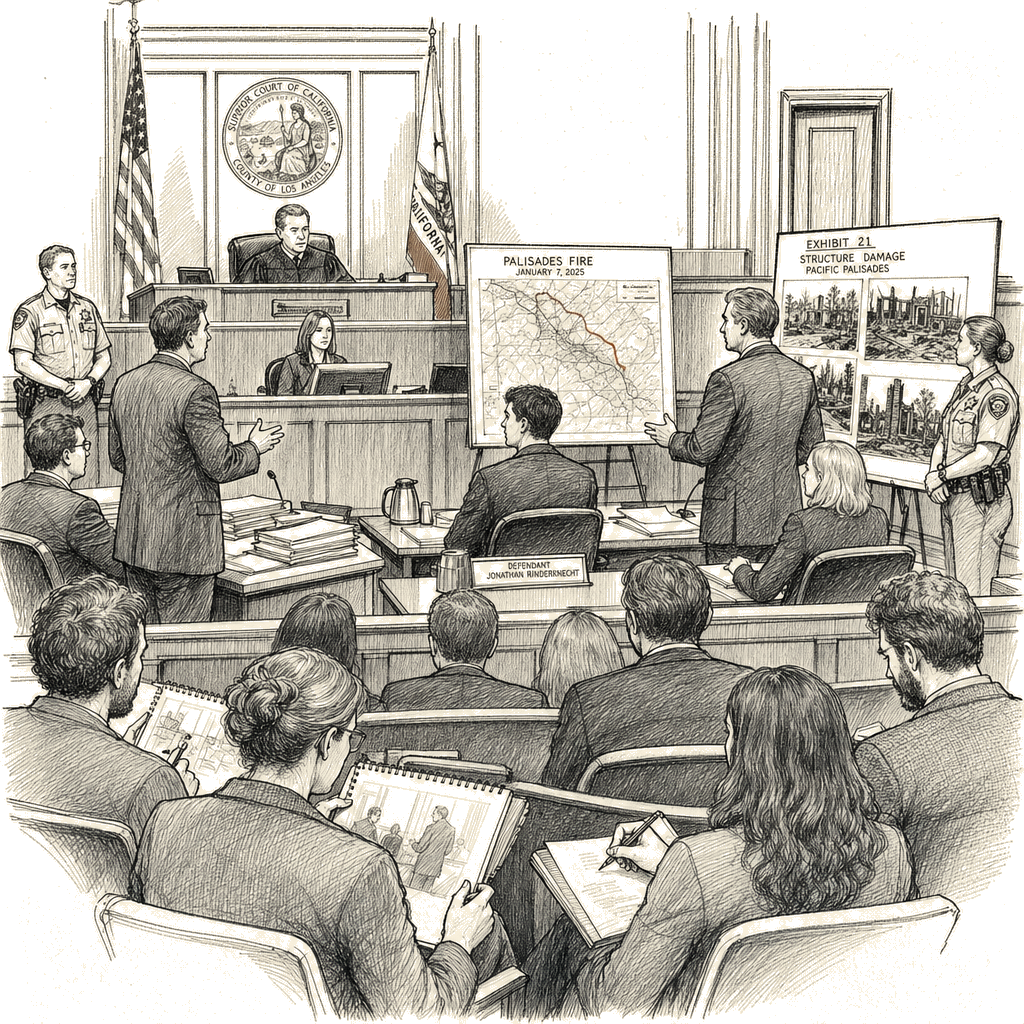
The state is asking a jury to ignore the Los Angeles Fire Department that left the fire to smolder. Judge Anne Hwang has already ensured the jury won’t hear about it. Her ruling excluding evidence of the department’s failure to fully extinguish the New Year’s Day blaze is not an evidentiary ruling. It is a protective order issued in defense of the institution that could not do its job.
The prosecution walked into that courtroom intent on doing what desperate institutions do when a disaster outstrips their capacity to explain it: draw a neat circle around a single defendant and call the rest of the sky clear. Jonathan Rinderknecht, a 29‑year‑old occasional Uber driver, was alone on the hilltop where the Lachman fire ignited. He called 911 sixteen times. He cooperated with investigators. He drove them back to the site to pinpoint the origin. He was recently broken up, watching rap videos. He had, six months earlier, typed a ChatGPT prompt describing a burning forest and fleeing people. Investigators found a barbecue lighter in his car. That is the prosecution’s case: a collage of circumstantial guilt massaged into a theory of “revenge on society.”
The defense says fireworks started the fire. Multiple witnesses and first responders will testify they heard fireworks in the area. Rinderknecht was there, his attorney argues, to watch them after dropping off passengers. The sixteen calls to 911 are not the panicked admissions of a man who struck the match; they are the actions of a witness who saw smoke and tried to get it put out. He did not flee. He did not conceal. He led investigators to the spot.
Now consider what the jury will never hear. Firefighters extinguished the Lachman fire. Then a firefighter was prepared to testify that the blaze was still visibly smoldering when first responders left the scene. The fire continued to burn underground. Days later, in strong Santa Ana winds, it reignited. The Palisades fire—23,000 acres, thousands of buildings incinerated, twelve dead—came from a flame the department had left unattended. That causal link is the difference between a small hillside fire and the most destructive wildfire in Los Angeles history.
Judge Hwang ruled that evidence of the fire department’s conduct—the smoldering, the departure, the reignition—is “irrelevant” and risks confusing the jury. The defense cannot introduce it. The defense cannot argue it. The defense cannot build its case on the documented failure of the agency most directly responsible for the blaze that killed twelve people. The agency whose error transformed a small fire into a catastrophe is protected from the jury’s consideration by judicial order.
That testimony was silenced. When a court declares institutional negligence “irrelevant” to the cause of a catastrophic wildfire, it does not protect the jury from confusion; it protects the department from liability. The causation chain snaps the moment you admit the fire was out and later reignited from a smoldering pit the LAFD left behind. You cannot prove Rinderknecht killed twelve people if the fire he allegedly set was extinguished and then reignited days later because a different agency failed at its one job. The state needs the jury not to know that. So Judge Hwang has provided the necessary surgical excision. The trial will proceed as though the Lachman fire and the Palisades fire were the same continuous event. The department’s intervening role is legally invisible.
The “revenge on society” framing does specific work. It locates the motive inside Rinderknecht’s head—his breakup, his isolation, his anger—and thereby locates the cause of the fire in the same place. The fire becomes an act of individual malevolence rather than a composite of individual conduct and institutional failure. The ChatGPT prompt from six months earlier is offered not as evidence of arson but as evidence of character: the kind of person who would type that prompt is the kind of person who would start a fire. The prosecution’s theory of the case is a theory of Rinderknecht’s soul. It needs revenge because revenge is the only motive that closes the loop on its timeline.
But the architecture of this trial is recognizable: a catastrophic operational failure is legally erased, and a proximate individual is elevated to sole causal agent. The institution cannot be held accountable—as this publication reported in May, the judge has already excluded evidence of LAFD’s potential negligence. A human target is identified. The target is constructed as the sole cause. The institutional failure is ruled irrelevant. The target burns.
The defense’s theory is simpler. Rinderknecht was there. He called for help sixteen times. He cooperated. He did not flee. He did not hide. He drove investigators to the site. These are not the actions of an arsonist covering his tracks; they are the actions of a witness who saw a fire and tried to get it put out. But the judge has ensured that the jury will never hear the department’s failure argued in court. The institution whose error is the necessary causal link between a small hillside blaze and twelve dead is legally invisible. The trial will determine whether one man lit a fire. It will not determine how that fire became a catastrophe.
Thousands remain displaced in western Los Angeles. The disaster has already bled into the city’s political machinery, a focal point in the 2026 mayoral primary. Yet the trial’s architecture insists on a binary: either Rinderknecht is a vengeful arsonist, or he is innocent. There is no verdict slot in a federal courtroom for the reality that this fire may have been sparked by a careless act, fed by dry brush, and ultimately unleashed by a systemic inability to monitor and suppress an active hazard.
The prosecution’s theory, Judge Hwang’s evidentiary ruling, and the state’s interest in locating responsibility in an individual defendant rather than an institutional failure all converge on the same outcome: Jonathan Rinderknecht will be tried for the Palisades fire. The Los Angeles Fire Department will not.
That is what the revenge is. Not Rinderknecht’s against society. Society’s against Rinderknecht. The state needs someone to hold responsible for twelve dead and thousands displaced and an entire coastal enclave reduced to ash. The institution whose error transformed the fire cannot be that someone. So the state has found a substitute—a lonely 29‑year‑old with a barbecue lighter and a ChatGPT history—and the court has cleared the necessary evidentiary space for the substitution. You cannot try a wildfire. You can only assign its cost. And right now, the state is making sure that cost lands squarely on one man’s shoulders while the rest of the machinery walks away unscathed.