I argue that the state’s escalation is not about justice. It is about narrative control. It is about feeding a political apparatus that requires martyrs, and about demonstrating that the powerful are still, after all, protected by the awful majesty of the state. The prosecution thinks the death penalty is the heavy lever that will restore order. It will not. It is the exact fuel the machine needs.
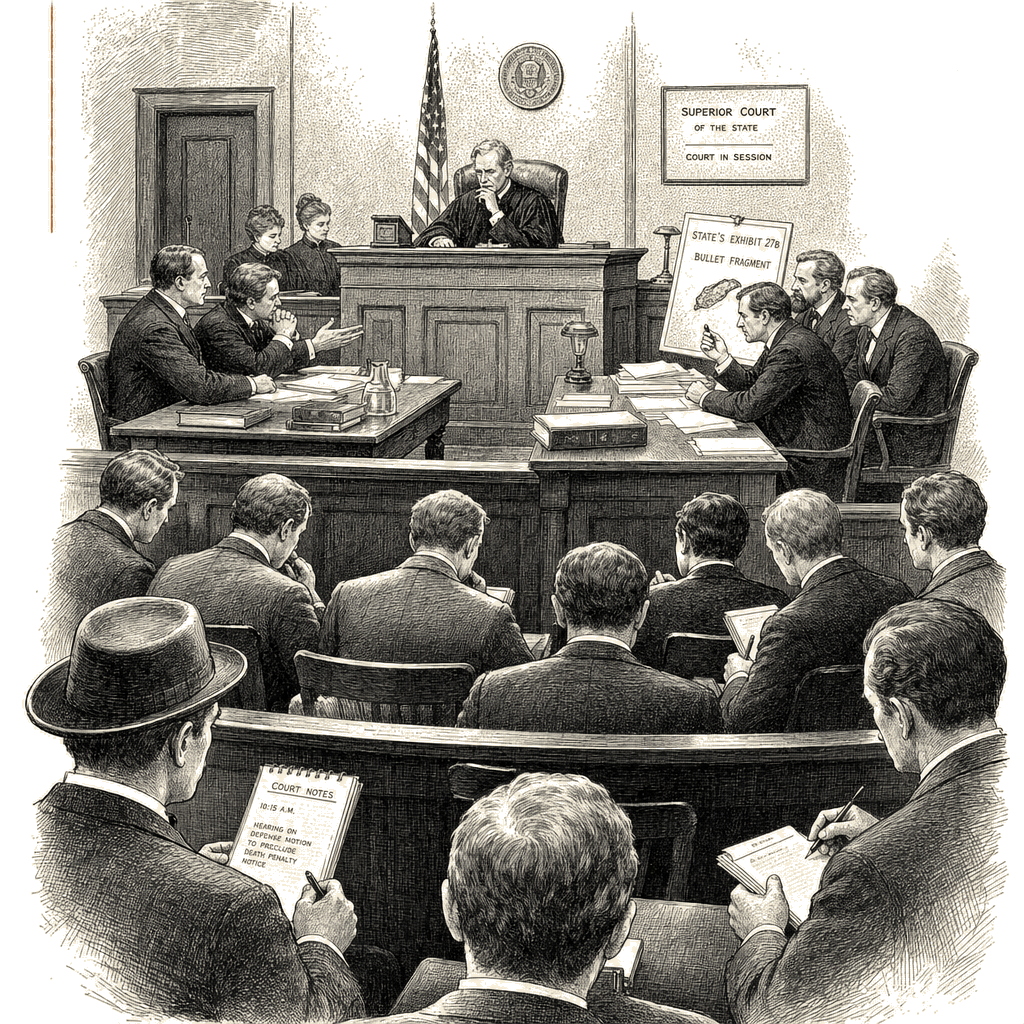
The motion filed on June 12 by Tyler Robinson’s defense attorneys asks a judge to block prosecutors from seeking the death penalty. The motion’s trigger is a bullet fragment — a piece of forensic reality recovered from Charlie Kirk’s body after he was shot in the neck while addressing a crowd at Utah Valley University. The prosecutors described that fragment publicly, and the defense argues those comments fed a network of conspiratorial speculation — second-shooter narratives, staged-death fantasies, the entire architecture of alternative accounting that Kirk’s movement spent years normalizing — such that a fair capital trial is now impossible. The defense is technically correct about the contamination. It is also citing a symptom while naming only one vector of the disease.
The environment was poisoned long before the Utah County prosecutor stepped to a microphone. What we are watching is the operational cost of a coordinated media operation that treats objective reality as an enemy of the movement and has, since September 10, been flooding the zone. The bad-faith techniques catalog classifies the architecture: flooding_the_zone — deliberate saturation of the information environment with high-volume claims, narratives, and provocations, aimed at overwhelming the audience’s evaluation capacity, exhausting fact-checking infrastructure, and producing cynicism that no truth is reliable. It is now also manufactured controversy, the deliberate construction of apparent disagreement where the evidentiary position is one of substantial consensus, the technique Naomi Oreskes and Erik Conway documented in Merchants of Doubt and refined across the fossil-fuel and tobacco industries before being adopted wholesale by the right-wing information apparatus. The bullet-fragment chatter is a textbook activation: the state’s own comments provided the kind of ambiguous material manufactured controversy requires to flourish, and the conspiracy-mongering that followed — deployed across the foundational programming and broadcast cycles of Kirk’s media ecosystem — did exactly what it was engineered to do. The result is a courtroom in which the state’s own handling of the evidence has undermined the possibility of a fair trial, and a jury pool already saturated with the proposition that the official story is a cover-up.
The distance between what is said and what is known to be true has become an abyss. The abyss was not dug by a single prosecutor’s press statement. It was excavated by a machine that spent years training its audience to treat forensic procedure as a conspiracy and judicial process as a rigged game. The state believes that if it speaks clearly enough, the conspiracy will collapse. Tyranny requires constant effort — that line from Nemik’s manifesto in Andor is operational here — but so does the maintenance of a post-truth ecosystem. The prosecution is clearly escalating to the death penalty because the narrative is slipping out of its hands, and power’s refusal to panic rings hollow when the escalation itself is a panic response. They are not prosecuting a case. They are staging a spectacle for a public that has already been told to distrust the stage, the lights, and the script.
But the manufactured controversy, while it degrades the trial’s integrity, is not the deepest thing happening in Provo. The deepest thing is the cui bono trace, and that trace is not subtle.
Who benefits when the state escalates a murder trial to a capital proceeding? The political ecosystem that built its identity on the proposition that every institution is compromised, that every piece of evidence is suspect, that the truth is whatever the base decides to believe. The right-wing media apparatus that made Kirk a star is now feeding on the pre-trial maneuvering as though it were a series of movies. The prosecutor who announces a death case in a high-profile political murder earns a career of speaking invitations and the quiet admiration of the donor class whose interests the prosecutorial office ultimately serves. The politicians who identify with the Kirk movement — and their number is a majority of the Republican congressional caucus — point to the case as evidence of a culture of leftist violence, a useful fundraising peg that distracts from the structural violence their policies inflict on poor communities every day. And the state of Utah, by filing capital charges, has announced that it will be the instrument through which all of this political work gets done, even as the defense keeps filing motions to seal evidence and slow the spectacle — the latest round in a months-long pre-trial battle the same court has already fed by refusing to ban cameras, ensuring a broadcast no matter what else happens in that room.
The death penalty as a structural mechanism is not a neutral tool of justice. The Death Penalty Information Center’s data is unambiguous: less than 2% of murders in the United States result in a death sentence, and the selection is not random. It is a function of race, class, and geography. When the victim is a high-profile conservative media figure, the state declares that the rare death sentence will be sought — not because the crime is the most aggravated under the law, but because the victim’s fame creates a political demand for a spectacle of punishment. The death penalty has always been a tool of the powerful, and the powerful choose almost never to turn it on one another. When the accused lacks political capital and media footprint, the machinery grinds forward with the speed and certainty that decades of data have documented. When the victim commands the donor class and the convention circuit, the machinery reconfigures into a ritual of protection. The state that, in most cases, shrugs at murder in poor neighborhoods suddenly has a boundless appetite for retribution.
Charlie Kirk was a conservative media figure and activist who built a career on the proposition that the enemies of civilization are the dark-skinned immigrants, the queer, the poor, and the insufficiently grateful descendants of the enslaved. His movement treated his death as a martyrdom, and the state has now decided to complete that martyrdom by offering a body in return. The death penalty is not being sought because the analytical chain of justice demands it. It is being sought because the political ecosystem demands an offering, and the state is providing it to prove it retains the monopoly on legitimate violence — and to signal that the star’s side is still in charge.
Late King understood the mechanics of this machinery. In his 1967 address to the Southern Christian Leadership Conference in Atlanta, King named the structural linkage between concentrated power and the sacrifice of the vulnerable to maintain institutional order. He called the alternative a radical revolution of values. What we are watching is the maintenance of a machine that consumes its own. And King’s theological objection to state killing — articulated in a 1957 Ebony column where he wrote that capital punishment “is against the best judgment of modern criminology and, above all, against the highest expression of love in the nature of God” — was not a sentimental add-on. It was the logical extension of a moral universe in which every human life carries an irreducible dignity, even the life of a killer. That dignity is not cancelled by the identity of the victim, nor by the political utility of an execution.
The scrutiny standard must apply symmetrically. If a young Black man from a marginalized community were charged in the killing of an organizer aligned with the opposing political coalition, and the state sought the death penalty while a media ecosystem manufactured radicalization narratives to mobilize against him, we would name it immediately: the carceral state feeding a political apparatus, class vengeance masquerading as justice. We must name it here. Tyler Robinson is not a saint. He is an accused person whose guilt will be determined in a court of law, or it will not. But the death penalty is not a judicial tool in this proceeding. It is a political prop. The same state that, in most cases, shrugs at murder in poor neighborhoods has suddenly found a boundless appetite for retribution because the bullet that killed Charlie Kirk hit a man whose face was on television and whose words were in the mouths of politicians.
The Beloved Community does not have a death chamber. The community King saw from the mountaintop — the one he told us we would reach, together or not — was a community in which the answering of violence with violence had been replaced by the harder, more revolutionary work of building a world where the value of a life is not determined by whose side that life was on. The defense motion in Provo is a small procedural brick in that longer construction. The state’s death demand is a wall that stands in the way.
The arc of the moral universe does not bend toward justice when justice is confused with spectacle. It does not bend when the state confuses a martyr for a defendant, nor when we allow a political apparatus to turn a murdered activist into fuel and a twenty-three-year-old accused into an offering. The arc bends only when the people whose job it is to speak the structural truth refuse to let the machinery pass unchallenged. The naming of the machinery — the insistence that what the state is doing is a structural act of political vengeance and class rule, that the prosecution provides the martyr, that the media apparatus provides the narrative, and that the boy in the holding cell provides the body — is itself a push on the arc. The push does not require the permission of the powerful. It requires only the refusal to lie about what is happening.
The state wants to kill Tyler Robinson because Charlie Kirk was a star. That is not justice. It is the death penalty at its most honest, and its most contemptible. The judge ruling on the June 12 motion must recognize the death-penalty request for what it is: not a judicial necessity, but a political gesture designed to feed a machine that consumes both the victim and the accused. A courtroom is not a stage, and Tyler Robinson is not a prop. Refuse the machinery.