
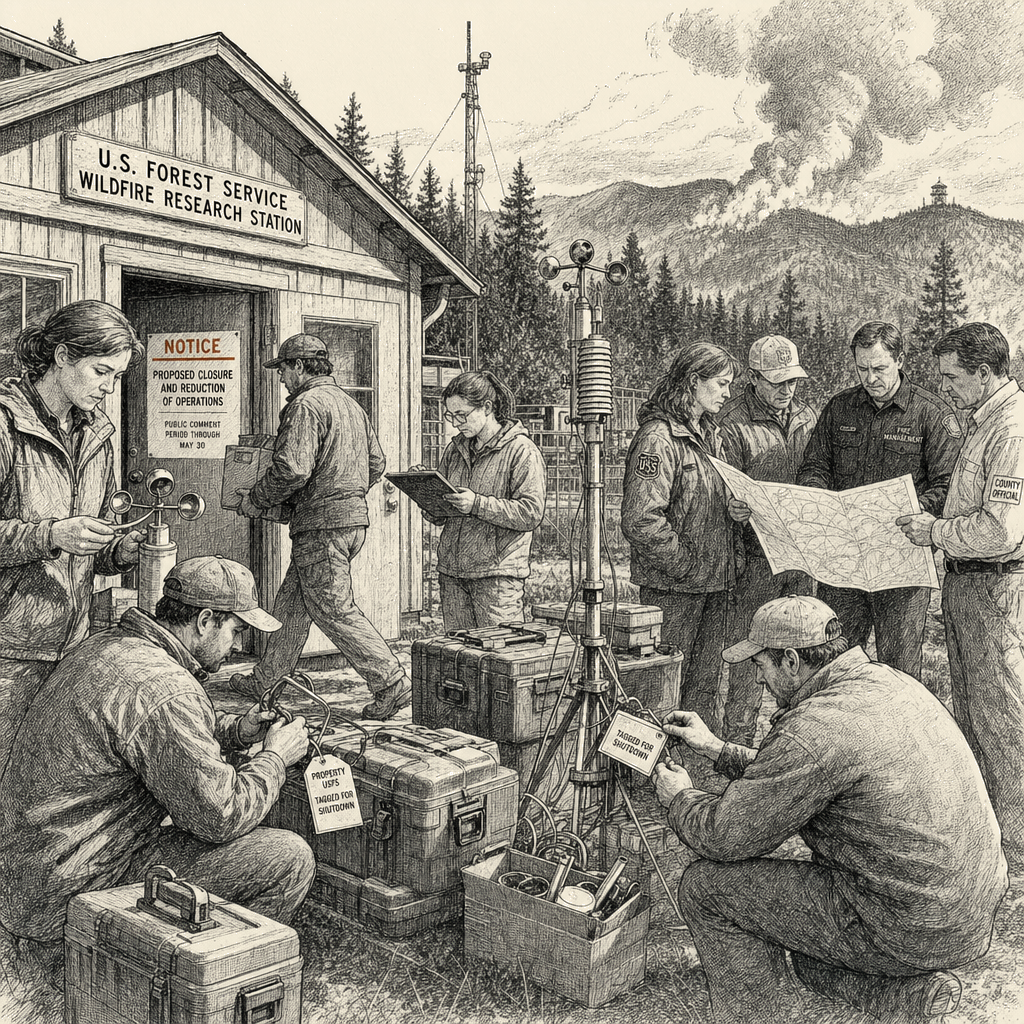
Trump is closing the wildfire research labs that keep rural towns from burning. Fifty-six of ninety Forest Service research stations are on the closure list, and the Pacific Wildland Fire Sciences Lab in Seattle is one of them. The administration calls it a reorganization. What it looks like from the ground is the dismantling of the scientific infrastructure that tells rural communities whether the fire is coming over the ridge.
When the smoke rolls in this summer—and it will—the people breathing it will check a map on their phones to see where the fire is, which way the smoke is drifting, whether to move the cattle or keep the kids inside. That map was built at that Seattle lab, where fire ecologist Ernesto Alvarado and his team run the real-time smoke forecast that feeds everything from federal incident command to the commercial weather apps you pull up at the breakfast table. The lab is an international airport away, a research university neighbor, a technology hub full of the minds you need when you’re building smoke dispersion models that have to work while a town is evacuating. It is not backwoods tree-measuring. Morgan Varner, a fire behavior scientist who was at the lab until 2019, doubts most of the staff will relocate. The administration offers them a move, and the smart money says they walk.
Chief Tom Schultz, sitting in the Washington office that will soon be the agency’s former headquarters, asks reporters to help him change the narrative. “We aren’t closing research,” he says. “Research is important, science is extremely important in this organization.” Meanwhile, the president’s own budget zeros out all research and development funding for 2026 and 2027. Schultz points out that Congress did something different—true enough, and also the kind of distinction that matters more to a man defending a budget in a hearing room than to a firefighter watching the plume build on a ridgeline in July. The distinction between “we aren’t closing research” and “we have made it impossible for the research to continue where it is currently being done” is the kind of phrase that sounds careful in a press release and looks like a lie at the fire camp.
The agency has a $3 billion deferred maintenance backlog. Schultz leads with that number, and I don’t doubt it’s real. But the number that matters more is this: the Forest Service already lost thousands of staff to layoffs, buyouts, and early retirement from the DOGE cuts, and now it is closing more than half its research stations just as climate change is accelerating the frequency and severity of the fires those stations study. You do not need a PhD to do that math. A fourth-grader with a pencil can tell you that if you have more fire and fewer people who know how fire behaves, you are going to lose more ground.
Wendell Berry drew the line between exploiting the land and belonging to it. The administration is treating the science stations as line items on a corporate ledger to be balanced against a deferred maintenance backlog. But the backlog is a budget problem; the wildfire season is a physics problem. Aldo Leopold wrote that a land ethic changes the role of the landowner from conqueror to plain member and citizen of the land biotic community. Closing a station on the closure list is not a budget move; it is a renunciation of that membership. The federal reorganization assumes the opposite: that the land is a resource to be managed until the budget runs out, at which point the managers get sent packing.
I live in the kind of county that burns. The central Wisconsin sand counties are not the Cascades, but the dynamic transfers—fire moves through fuels the same way whether they are lodgepole pine or jack pine barrens. The science that tells a hotshot crew in Washington what a fire will do at 2 p.m. when the wind shifts is the same science that tells a volunteer department in Adams County what a grass fire will do when it hits the CRP field on the south section line. A landowner south of Friendship doesn’t drain a wetland on a guess; he reads the Adams County Land and Water Conservation Department survey so he doesn’t flood his neighbor’s basement. The Forest Service research stations are the watershed surveys for the public lands. When the agency closes them and labels a premier fire science lab as excess capacity, it is tossing out the survey maps and expecting the water to behave.
The administration has been finding new ways to punish science it doesn’t like, and these closures fit the pattern. The same administration that withdrew from the Paris climate agreement is hollowing out the agency that studies what climate change is doing to the forests. The same administration that calls wildfire a forest management problem is dismantling the fire-science infrastructure that tells us how to manage forests. You cannot fix the problem without the science. You can only pretend to, until the smoke reaches the town and the map doesn’t load.
Dave Upthegrove, Washington’s elected public lands commissioner, says his department was initially briefed often and assured the critical research would not be affected. “But recently the Forest Service has gone radio silent,” he says, “and we’ve not been able to get updates on the progress and the status and the outcome of this work, so we are nervous.” Washington’s DNR relies directly on Forest Service fire and smoke research to coordinate its suppression response. When the feds go silent, the state that has to fight the fire is flying blind.
You do not reorganize the fire-science infrastructure in April and expect it to answer the phone in August. You do not close the smoke lab in June and expect the smoke map to work in July. The institutional knowledge Alvarado and his team built—the decades of integrated science, the graduate students running particulate models, the IT staff keeping the servers alive while the fire is active—does not sit in a filing cabinet waiting for a new appropriations bill. Once the 56 stations shuttered, that continuity breaks. You do not recover thirty years of ecological integration by hiring a contractor in a different state three years from now.
The mountain will burn whether the spreadsheet is balanced. When the smoke drifts down into a rural valley and the air turns to ash, the people on the ground do not need a thoughtfully managed budget shortfall. They need the technicians who built the smoke models to still be running them when the air turns to ash. When the map doesn’t load, they’ll know what the administration chose to close.