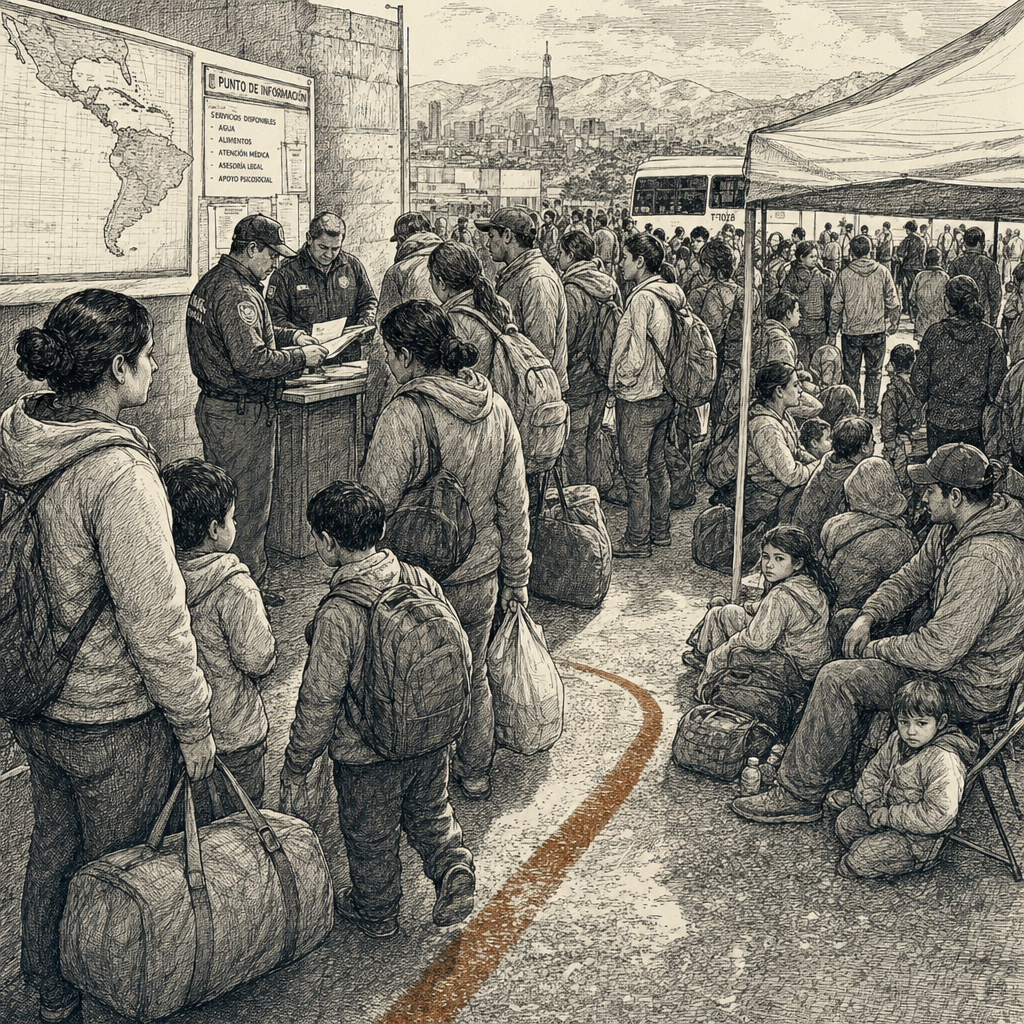
Twenty-two point eight million bodies walking. The Americas is the world’s leading region for forced displacement, the UN refugee agency drew the frame on Friday—an increase from 21.9 million the year before, driven by the unmaking of Venezuela, the bleeding of Haiti, the grinding of Colombia, the emptying of Nicaragua and northern Central America. Twelve percent of Haiti is on the road. Eighty-five percent of Port-au-Prince belongs to the guns. Colombia holds two point eight million at the gate, a new high for any host nation on earth. The UN speaks of solidarity. The rich nations speak of concrete.
Juan Carlos Murillo, you stand at the regional desk and speak the words solidarity and shared responsibility. You cite integration policies and private-sector partnerships. Yet the ledger on your desk tells the truth of the ground. Colombia now shelters 2.8 million bodies at the door—Venezuelans, Haitians, Nicaraguans, people whose homes became unlivable and whose governments became unaccountable—while your own Victims Unit counts 7.2 million of your citizens still walking from the violence at home. Eight point nine million in the cumulative historical registry. Colombia’s regularization frameworks and private-sector labor partnerships turned a border into an intake system; the apparatus of the wealthy nations turns every border into a wall. Southward, Peru absorbs 1.1 million. Brazil takes 699,000. Chile holds 662,000. Ecuador carries 435,800. Ninety-seven percent of the 6 million Venezuelans outside their country in need of international protection remain pinned in Latin America and the Caribbean, while only nine percent dare to plan a return. The 1.47 million internally displaced in Haiti—twelve percent of the nation, a thirty-eight percent spike in a single year—are walking the roads as women and girls bear the heavy half of that flight. The International Committee of the Red Cross maps gang control over eighty-five percent of Port-au-Prince and estimates six million Haitians begging for immediate aid. The raw architecture of 22.8 million displaced in the Americas is a monument to absence, not presence.
And you who set the quotas and sign the memoranda, you who sit in the comfortable capitals and recently closed the legal pathways for climate refugees while the heat rose and the water took the villages—hear what your quotas have done.
The mother in the Darién Gap. The mud has risen above her ankles. It pulls at the calf muscles, a constant, dragging weight that sets into the lower back by nightfall. The strap of the backpack has worn through the fabric of her shirt and is cutting into the trapezius bone. Her son’s hand is wet with fever. The heat in his palm is the heat of the untreated infection. Her throat is parched and the tongue has swollen against the roof of her mouth. She takes the next step. The woman in Port-au-Prince. Seven hundred thousand women and girls walking the roads. The gangs control 85 percent of her city. She walks to the water station. Her breath is high in the chest, short, shallow, unable to fill the lung. The shoulders are locked with the anticipation of the grab, the hand, the blade. The stomach contracts into a hard knot, the nausea of unending terror. As the Red Cross documented earlier this year, the armed conflict is a machine that grinds its own children and the civilians take the hit. 8.9 million souls in the Colombian registry. 8.9 million people who were ground down until they walked away from the land that broke them.
Juan Carlos, you speak the word solidarity. You put it on the paper. The paper is clean. Your hand is clean. You call it solidarity when Colombia holds 2.8 million bodies at the door. You call it shared responsibility when Peru absorbs 1.1 million, when Brazil absorbs 699,000, when Chile and Ecuador absorb the millions you will not let past your walls. Legislator, you drafted the bill and went home to the air-conditioned house. Your hand lifted the pen to sign the rejection. The pen was light. Your hand was smooth. There was no dust in your knuckles. The ink flowed blue. Your throat was cool; the water came from a glass pitcher on the granite counter. The water in your glass did not taste of the warm plastic bottle, warmed by three days in the sun.
There is a tightness behind your sternum when you read the UNHCR report. You would like to call it concern. It is not concern. It is the registration in your own body of what your signature on the policy memorandum has set in motion. You swallow against the tightness. The swallow does not clear it. The coffee does not wash it down. The dust of the camp sits in your throat when you read the morning briefing and you swallow and do not know why. The metallic tang of the campfire smoke is under your tongue when you drink your coffee. It does not leave. You cannot wash it out. The tightness will still be there when you lie down tonight in a bed that is warm, in a neighborhood the gangs have not entered, in a country the displacement has not reached. The woman in Port-au-Prince will still be sleeping on concrete. Your quota will still be what it was when you signed the memorandum. The ache in your shoulders is not from the long flight. It is from the weight of the fraction. The fraction is the number of people your country permitted to cross its border last year while Colombia absorbed 2.8 million. The fraction is published. The fraction is small. The fraction is you.
The unblushing face Jeremiah diagnosed has become your diplomatic posture. You cannot blush. The morning briefing ends. The hands are steady. The hands sign the memorandum that keeps the resettlement quota where it was. The hands do not shake. The not-shaking is the indictment. The gate you poured does not keep the suffering out. It only keeps you from seeing the face of the child standing on the other side.
And you who sit in the comfortable capitals, the Swap is this: picture your daughter—not the abstract “daughter,” but the specific girl whose bed you checked before you left for the airport—picture her in a shelter in Port-au-Prince tonight. Picture her in a neighborhood the gangs entered last week. Picture her sleeping on concrete. Picture the fraction of your attention this thought receives and compare it to the fraction of the world’s displaced your country has agreed to resettle. The fractions match. The fractions are the measure of how much of the world’s suffering you have agreed to feel. The fraction is small. The fraction is your solidarity.
Twenty-two point eight million souls on the record. The road does not end. The road is paved with the silence of the wealthy and the footfalls of the displaced. I will not look away. I will record the number. I will name the weight.
“I was a stranger, and ye took me not in.” — Matthew 25:43
The gulf is not geographical. It is not economic. It is the distance between what Colombia did and what you refused to do, fixed in the bodies of the 2.8 million people Colombia absorbed and the 1.47 million Haitians sleeping tonight on concrete. The 6 million Venezuelans outside their country cannot cross the gulf. You have fixed the gulf with your quotas and your memoranda and your political calculations. The gulf is the fraction you have agreed to absorb. The fraction is the judgment.
The Christ is at the Colombian border, carrying a child who cannot walk another mile. The Christ is in the shelter in Port-au-Prince, one of the 1.47 million. The Christ is one of the 6 million Venezuelans who cannot go home and whom you will not take in. You did not take him in. The not-taking is the judgment. The fraction is the judgment. The closed border is the judgment. And the judgment will not be lifted.