Marco Rubio starves a population to pressure a regime and calls it national security. He says the regime has plundered billions—he is right—and yet the valve he holds tightens the vise on grandmothers, not officials.
Marco, the cold pack is melting.
Arsenio García stands at a Miami airport checkpoint with seven thousand dollars of chemotherapy drugs packed in ice that cannot hold. His sister in Havana has ovarian cancer. The drugs are for her. The ice is melting because the fuel that would refrigerate her hospital no longer arrives. The fuel does not arrive because you have shut it off. The power grid delivers forty-five minutes of electricity a day. The ice turns to water on the floor. You call this pressure. You call this regime change. Arsenio calls it the cost of keeping his sister alive one more round.
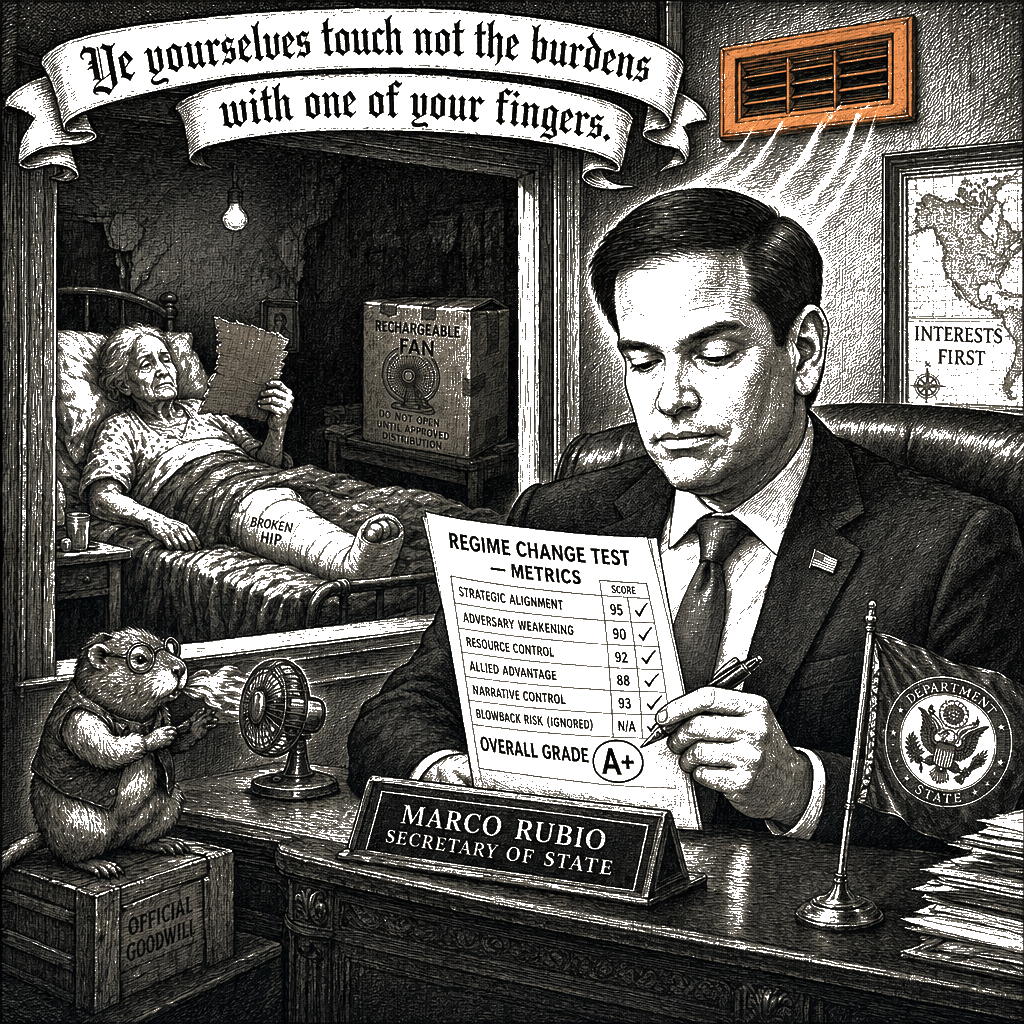
Janet Vigo packed four boxes of adult diapers and a rechargeable fan for her eighty-four-year-old bedridden grandmother, who recently broke her hip. The fan sits inside a sealed box at the port. The port is twenty minutes away. The truck will not start. The grandmother lies in the dark with a piece of cardboard in her hands. She waves it for four hours. “They’re using their hands or pieces of cardboard to fan themselves,” Vigo said. The bedsores from her immobility will become infected without the fan to cool her skin, without the fuel to power the clinic, without the clinic’s ability to admit a noncritical case.
Reynaldo González ships rice and baby essentials at a dollar a pound so his relatives do not starve. The chemo spoils on the tarmac. The suitcases do not leave. The heat does not stop.
The Trump administration has blocked oil imports to Cuba and stacked new sanctions onto a decades-old embargo—intended to starve the regime of revenue, but the first organs to starve are always the old. Legal cash remittances are restricted. Total remittances and physical goods sent to the island reached three billion dollars last year. Nearly a third of Cuba’s population depends on these informal transfers; ninety percent originate in U.S. homes in Miami. The daily logistics of survival have shifted to relatives, a quiet mobilization that has only accelerated as foreign businesses abandon a collapsing economy and elderly Cubans are left to fend for themselves. At a shipping agency in Hialeah, Florida, residents push carts of Spam and solar generators because relatives on the island now rely on generators for electricity. The Main Street Independent has documented the daily hunger facing families in Havana and the elderly left to fend for themselves as the crisis deepens.
Marco, you know the mechanism. You are the son of Cuban immigrants. You have called Cuba a “failed state” and a threat to U.S. national security. In a video message last month, you told the Cuban people they lack electricity and food because the communist government has plundered billions—and you are right, the regime has plundered, but nothing has been used to help the people. You have described the administration’s actions as a test of whether a humanitarian crisis can produce political change.
Let me translate: you are starving a population to see if starvation breaks the government before it breaks the grandmothers.
You sit at the briefing table. The air conditioning hums. It has hummed since six in the morning. You wear the suit. You speak about plunder. You look small against the heat you have engineered. The raised eyebrow does not move the fuel tankers. The video you record in the cool room will not lower the temperature of the grandmother’s bedroom. The regime has plundered. This is true. It does not turn off the valve you hold. It does not give the grandmother a working lung.
The grandmother’s arm burns from the motion of waving the cardboard. The joints stiffen. The breath is shallow. The air is stale. The infection will creep through her eighty-four-year-old body in the same hours you spend in air-conditioned briefings. When she dies, her death certificate will list sepsis, not “U.S. strategic patience.”
The sister is Arsenio’s sister, whose ovarian cancer advances each time the cold pack fails. The chemo that might have bought her months arrives warm, and the next shipment cannot come for six more months. The twenty thousand dollars he has already spent has kept her alive, but you have made his love a blockade-runner’s operation. He carries the drugs through a gauntlet you designed.
And you are waiting. You are waiting for the point at which the suffering becomes so great that the regime, not the population, breaks. That is the wager of your policy. A test is what you administer in a classroom, not what you impose on a nation of eleven million people whose food supply you have cut off. A test is graded. Who grades this one? You, from the State Department, where the coffee is fresh and the air conditioning runs without limit. You will decide, from the cool of your office, whether the suffering has reached the threshold that indicates regime change is near. The grandmother who dies of sepsis will not be part of the metric. Her name will not appear in your briefing book.
But I will name her. She is the grandmother of Janet Vigo, the grandmother of Reynaldo González, the grandmother of every Cuban-American who is sending a fan because the government of the United States has taken away the electricity. She is the reason the diaspora is running an underground railroad of canned goods and medical supplies while you speak of “failed states” as if the failure fell from the sky. The weight of the survival economy has fallen squarely on the diaspora. Families who were sending cash a year ago are now sending adult diapers and rechargeable fans. The U.S. government has made it illegal to send money but has not yet made it illegal to send love. Love now travels as a suitcase of Spam, as a plastic-wrapped generator, as a melting cold pack cradled by a handyman who cannot afford to lose another six months.
Marco, your throat closes. The stale air is thick in your chest. It catches when you swallow. The metallic taste sits under your tongue. You drink the water from the glass at the table and the water is hot. You cannot wash the taste out. The contraction sits in your gut, the heat of a room that will not cool. What happens when it is your mother lying in the dark with the broken hip? What happens when the suitcase holding the scalpels and the chemo has her name on the packing slip? Picture her at eighty-four, in a bed, with a broken hip, in a room with no air conditioning, fanning herself with a piece of cardboard. Picture the bedsores. Picture the infection. Picture the ambulance that cannot come because there is no fuel. Picture the hospital that cannot treat her because there is no power. This is the test you have designed. Did she pass?
You do not speak about plunder then. You do not talk about the test of how much pain it takes to break the regime. You send the truck. You open the valve.
Your hands are clean of rubble dust because you sign papers, not shovel debris. But the rubble is stacking up. The food spoiling in the Cuban heat includes the beans Reynaldo shipped at a dollar a pound so his relatives would not starve. The boxes of aid that slow the economic freefall also keep the lights off. The regime’s incompetence is the spark, but the embargo is the oxygen cut. Washington bets the suffocation will force a reckoning in Havana. It only forces a reckoning in Hialeah grocery aisles, where the cost of survival is tallied on worn receipts while politicians calculate political breaking points.
I see you speaking in your video. I do not look away from the cardboard. I am holding the cold pack. I am watching the ice melt.
“Woe unto you, lawyers! for ye lade men with burdens grievous to be borne, and ye yourselves touch not the burdens with one of your fingers.”
The burdens are the suitcases at Miami International Airport, wrapped in plastic, full of the medicine and food that the United States government has forbidden and that Cuban-Americans are smuggling in anyway. The burdens are the melting cold packs, the cardboard fans, the broken hips, the empty stomachs, the cans of Spam, the scalpels and IV bags carried like contraband. You do not touch these burdens. You do not carry the cold pack. You do not sit with the grandmother through the forty-five minutes of electricity. You do not spend twenty thousand dollars to keep your sister alive.
The wager is that enough starvation will produce a political collapse. The wager is that the grandmothers will die before the regime does. The wager is that the suffering you are imposing is worth the outcome you cannot guarantee. This is the moral logic of your policy: that the bodies of the Cuban people are a currency you can spend in the cause of their own liberation. They are not your currency. They are not your test subjects. They are not your grandmother, but they are someone’s grandmother, and she is fanning herself with a piece of cardboard while you wait for the results.
The grandmother in Havana lies in the dark. Her hip is broken. The cardboard is in her hands. She waves it. She waves it for four hours. The fan sits inside a sealed box at the port. The port is twenty minutes away. The truck will not start.
The burden is grievous. Your fingers do not move.