
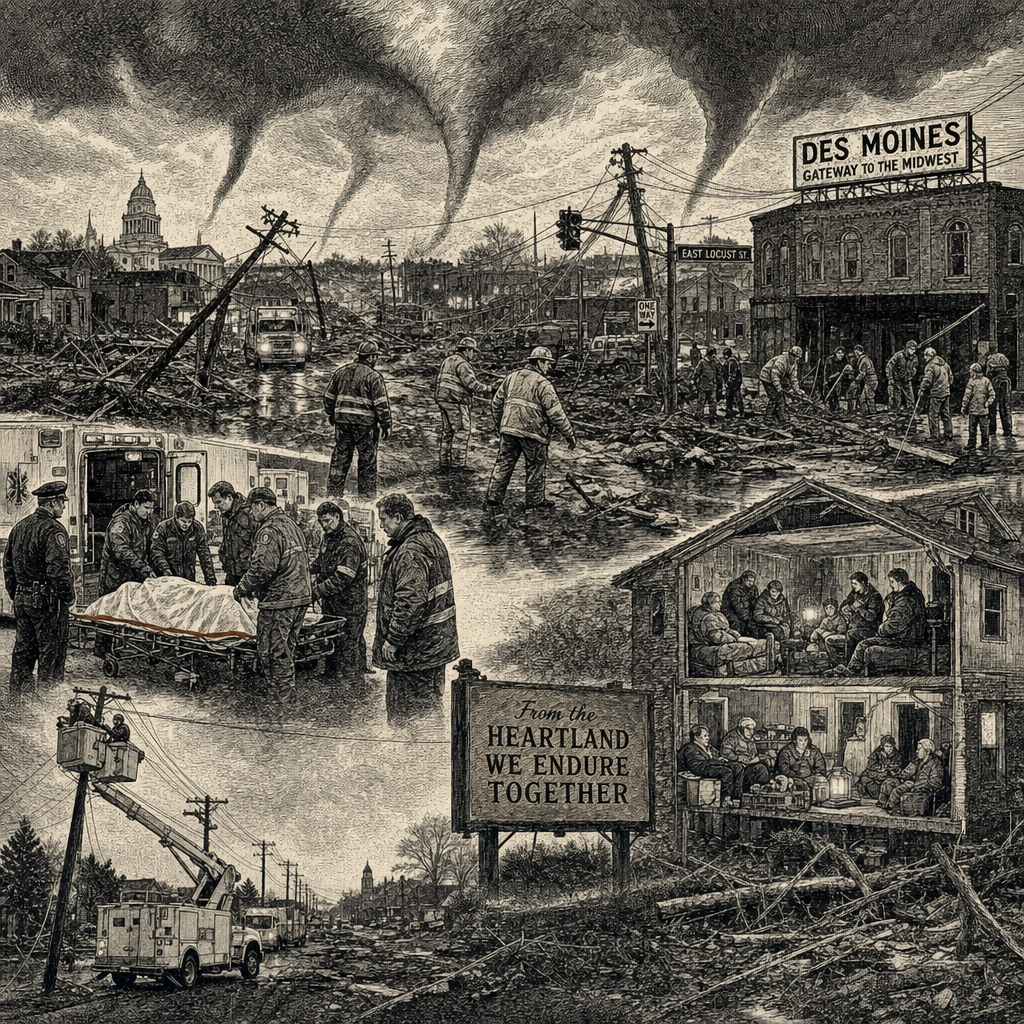
Des Moines left a fifty-four-year-old man in the park and let the wind kill him. The sirens wound on Wednesday night. The warnings went to the phones that had a charge. He had no basement. He had the grass. A cottonwood broke apart over his encampment and fell through his chest. The police found him on the dirt. He died where he slept.
On Wednesday and Thursday, tornadoes tore through Iowa, Illinois, Indiana, Wisconsin, and Michigan. The one confirmed fatality was this man. No other injuries were officially reported. In Streator, Mayor Tara Bedei said she was “incredibly grateful for the safety of our residents.” In Springfield, an animal shelter lost its roofs but not a single cat or dog. “It’s a miracle,” the director said. In Maple Park, a winery worker tied himself to a water trailer to avoid being blown away. A storm chaser helped free a man trapped under debris in Merrillville. Nearly half a million customers lost power to the dark. You know the wind is coming. You know who it finds first.
Iowa, what did the storm take from you that you had not already thrown away?
The man in the park was not one of the residents you are grateful was safe. He was not the displaced family directed to a gymnasium. He was the one who slept outside when the phones lit up with warnings. He had no basement to crouch in, no door to lock behind him, no gymnasium floor to lie down on. The tree that struck him had stood over his bed for weeks, the only thing between his body and the sky. When the wind tore it loose, it landed on his chest. The branch hit him with the exact weight of the wood. His ribs gave way with a sound the storm swallowed.
No one was close enough to hear it. The rain came. The morning came and the officers found him and pronounced him dead on the scene, which is what they say when there was never a living body to transport, only a body that had become part of the scene itself.
I see you, Des Moines, closing your own windows. The sirens rattled your glass, and you felt the draft from your basement stairs on the back of your neck. You taste the rain in your own throat because you left him out in it. You cannot close the window. The branch is inside your chest now. The wind took the breath from him and it lodged in your own lungs. You feel the tightness when you try to swallow your morning coffee. It does not go down. It stays in the throat, wet and heavy, like the dirt on his jacket.
Joe. You own the winery in Maple Park. You watched the debris spin up and you told your people to go below. You watched one of them tie his arms around a heavy water trailer and pray the iron would hold so the wind could not sweep him off the concrete. You are a small man in a storm, Joe, but your basement is large enough to keep the sky out. You tied your own life to the trailer through that worker. You watched him grip the cold metal because the storm does not read property deeds; it finds the body that is outside. Your own shoulders ache with the weight of the water trailer you did not hold. Your jaw aches at breakfast. The report on your screen has hollowed something behind your sternum. You cannot wash the metallic taste out of your mouth. You look at your hands and they are still gripping the iron of the railing, shaking.
Tara. You stood in front of the destroyed homes in Streator and told the cameras you were grateful for the safety of your residents. You are safe. Your residents are safe. The man in Des Moines is dead under a broken trunk. Your chest is tight. The fan in your gymnasium is blowing hot air across your face and it smells like wet drywall. The damp gets into your bones. You feel the cold settling in your knees because you slept on the mat you told them to bring. You cannot stand up straight. The pile of wet lumber is in your own living room, pressing against your shins. Tomorrow they will go back to the pile of wet lumber because the city has no other room for them.
When the storm was over, you checked the animals first. You made a point of telling the cameras that the dogs were fine.
They were fine. The 150 cats were fine. The 28 dogs were fine. The man who slept in the park is dead. His body was under the tree. The emergency personnel did not arrive in time because he had no address to give them. He had no bell to ring. He was just a shape in the dark, a shape that had been there every night you drove past it with your doors locked.
You will call this an act of God. The phrasing is an old way of crossing your own name off the ledger. God sent the tornado; God kills the poor. But you built the city that had no room for him, and you built the shelter that posted its hours on a door he could not reach, and you built the headlines that count the dead only if they die inside walls.
The risk is not the weather. The risk is you.
“Inasmuch as ye did it not to one of the least of these, ye did it not to me.” Matthew 25:45
The man in the park. The Christ in the park. You will not meet either of them. The meeting was last night, in the dark, in the storm, and you were not there. The sirens are not shelter. The basement is not salvation. A city that builds walls for the wind and grass for the poor has forgotten what it means to house its own. The wind took what you refused to keep.