
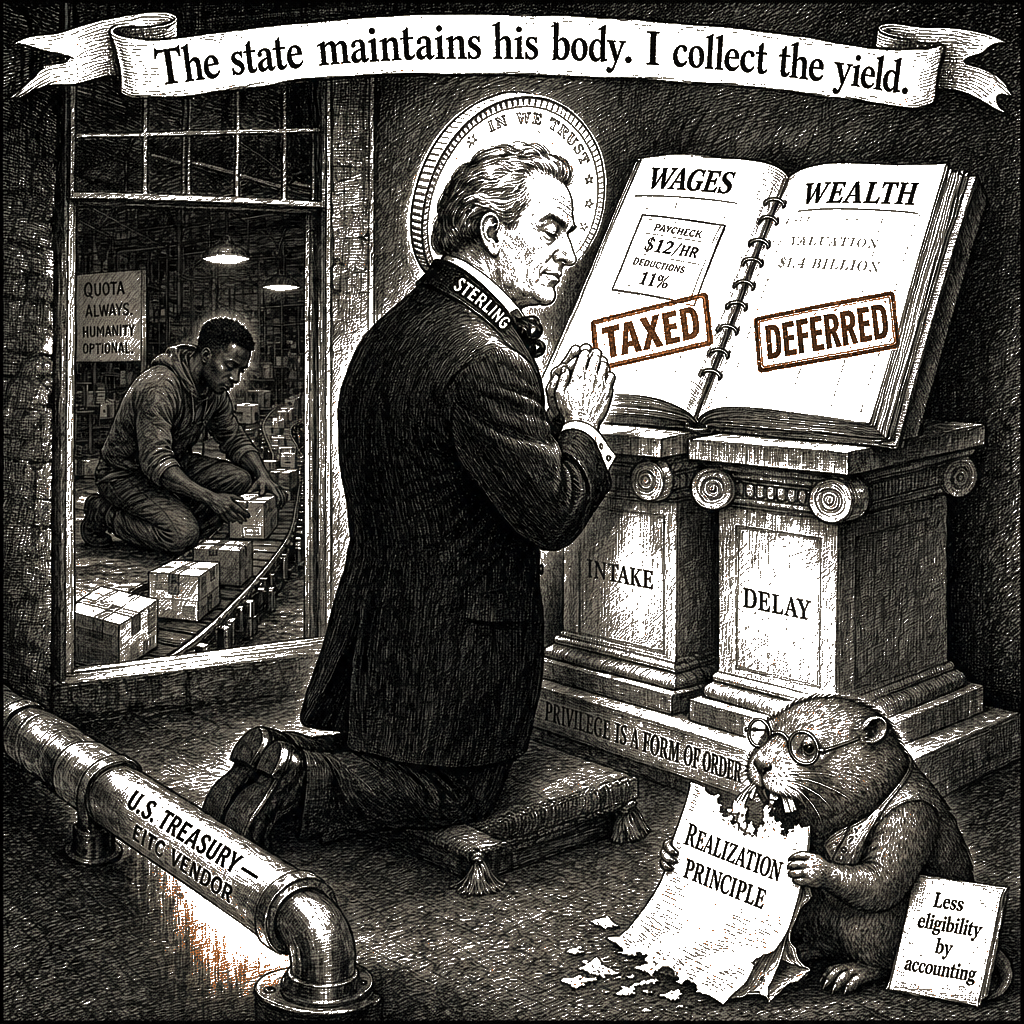
DeShawn is a picker on the fulfillment floor I own east of Louisville, off I-64 where the land is cheap and the labor is cheaper. He moves 1,400 items a shift for $12 an hour, 29 hours a week, and the concrete is unsealed because the epoxy would cost $0.0031 per package I ship, and that is a line I don’t add. The box you ordered last Thursday, the one that arrived Saturday — DeShawn’s hands, his knees on the concrete, his lungs. I want you to see the floor before the spreadsheet, because the spreadsheet will make sense of the floor, and I mean to cure you of the sentiment that would stop me.
Watch the arithmetic. $12 an hour, 29 hours a week, 52 weeks: $18,084 a year. The EITC the government sends him each April covers the difference between what I pay and what the floor requires. After the standard deduction, his federal liability is $388. The EITC sends him back $600. Net: -$212. He pays nothing. The Treasury pays him. And that is what I want you to learn, because it is the part nobody will tell you: the gap between his negative rate and the 24% he would pay if I raised him to $30 an hour is not an abstraction. It is the price of his presence on my floor.
The Wall Street Journal editorial board published a piece last week that catalogued the statistical sins of the economists behind California’s billionaire-tax initiative — the Forbes-400 fictions, the corporate-tax-incidence shell game, the omission of the Earned Income Tax Credit that inflates the apparent burden on working Americans. They are right about every sin. They are wrong about which direction the sin points. The lie is not that the rich are undertaxed; the lie is that the poor are overtaxed. The 11% the bottom fifth actually pays — their own corrected figure — is an insult to the natural order, and I will tell you why with DeShawn.
The Journal is defending the $1.4 billion I hold in unrealized appreciation — the principle that appreciation on a screen is not income until I say so. Saez and Zucman want to tax the screen. Magness wants to protect the screen. DeShawn’s $18,084 is taxed the moment it arrives. My $1.4 billion is not taxed at all. This is not a policy disagreement. It is a classification system. Income is what DeShawn earns. Wealth is what I hold. The tax code knows the difference. So do I.
Now hold those two numbers. My 41% effective rate — federal, state, and local — on roughly $8.8 million in income, which sounds punishing until you remember that $1.4 billion in appreciation sits untouched behind the realization principle, the same principle the Journal is defending. DeShawn’s negative rate. Do you see it yet?
Here is what neither the Journal nor Saez and Zucman will say aloud. At $12 an hour, DeShawn is in the negative column. At $14, he crosses zero and becomes a net contributor to the Treasury. The $2 difference — the distance between what I pay and what the body requires — is the margin I extract from the public ledger. $2 an hour, 2,080 hours, 21 workers: $873,000 a year the Treasury feeds into my floor so that I don’t have to. You call it a safety net. I call it a vendor relationship. The state maintains DeShawn’s body between shifts. I maintain the yield. Every order you place confirms the purchase order.
The EITC, properly understood, is a subsidy to working-class bargaining power. DeShawn has one child, files head-of-household, and earned $31,700 last year across my shift and the breakfast counter. His refund was $3,120. That refund was not charity. It was the government paying him to have options. Built with the best intentions, every dollar of it comes out of my pocket because it raises the floor I must undercut. I would prefer DeShawn to be taxed at 24% — the rate the activists claim for working Americans, the one the Journal rightly labels a fabrication. A man who loses a quarter of every dollar to the government is a man who cannot afford to say no to a shift. At 24%, his take-home drops to $11.46 — below his rent, below his car payment, below the line where a second job becomes optional rather than mandatory. He takes the double. He stops asking about the broken fan in the mezzanine. He does not mention the OSHA poster peeling in the break room. The difference between the 11% he pays and the 24% you were told he pays is $2.12 an hour. Over a week, $84.80. Over a year, $4,409.60. That is the price of his compliance. The state let him keep it, and I lost it.
George Fitzhugh wrote it down in 1857, in Cannibals All!: “his employer is really free, and may enjoy the profits made by others’ labor without a care.” The slave had to be fed, housed, kept alive at the owner’s expense. The wage-employer has no such obligation. Fitzhugh meant it as a catastrophe. I have always read it as a procurement manual, and I have spent my career proving him correct. The slaveholder had to feed the body. I found someone else to do it.
Pull back with me. This is the part worth learning. The welfare state was built to protect the worker from the market. I have restructured it to protect my margin from the worker’s hunger. The 1834 commissioners understood this — they built the workhouse to be worse than the worst available wage, so fear would drive any man to accept the terms. I have built something more elegant: I have made the Treasury the workhouse and the employer the beneficiary. Less eligibility without the brick.
The package that arrives at your door — the phone charger you bought yesterday morning for $9.99 — was packed at 3 a.m. by DeShawn, who took the shift because he lost the argument with his bank balance after I reduced his hours. The charger itself cost me $1.27 landed. The cardboard and tape, another $0.18. DeShawn’s labor for the 14 seconds he touched your box? $0.06. The tax on that labor, at the corrected 11%, was $0.0066. The tax, if it were set at a proper, disciplining rate of 24%, would have been $0.0144. That seven-tenths of a cent is the margin I lost. Multiply him across a thousand shifts, and the number becomes the vacation house I didn’t buy.
The apostle understood the calibration. “For even when we were with you, this we commanded you, that if any would not work, neither should he eat” (2 Thessalonians 3:10). The verse does not say, “unless the government sends a refund.” The government sent a refund. I cut the hours. The lesson is the same in 2026 as it was in A.D. 51.
The quarterly number is exquisite. The arrangement is civilized. DeShawn is still on the concrete floor. Still $12 an hour. The EITC check arrives in April. The epoxy costs $0.0031 per package, and it will never be applied. I haven’t looked at what happens to DeShawn when the floor finishes what the dust started. I haven’t needed to. There is another picker at the gate. There is always another picker at the gate.
Sterling A. Varice holds the Hayek-Friedman Chair and serves as Dean of Instruction at Warden University’s College of Business and Economics in Richmond, Virginia. He is the author of three textbooks: Divine Mandates for Labor Utilization, Social Obligations for Profit Maximization, and Calibrated Deprivation: A Manager’s Guide to Employee Motivation.