
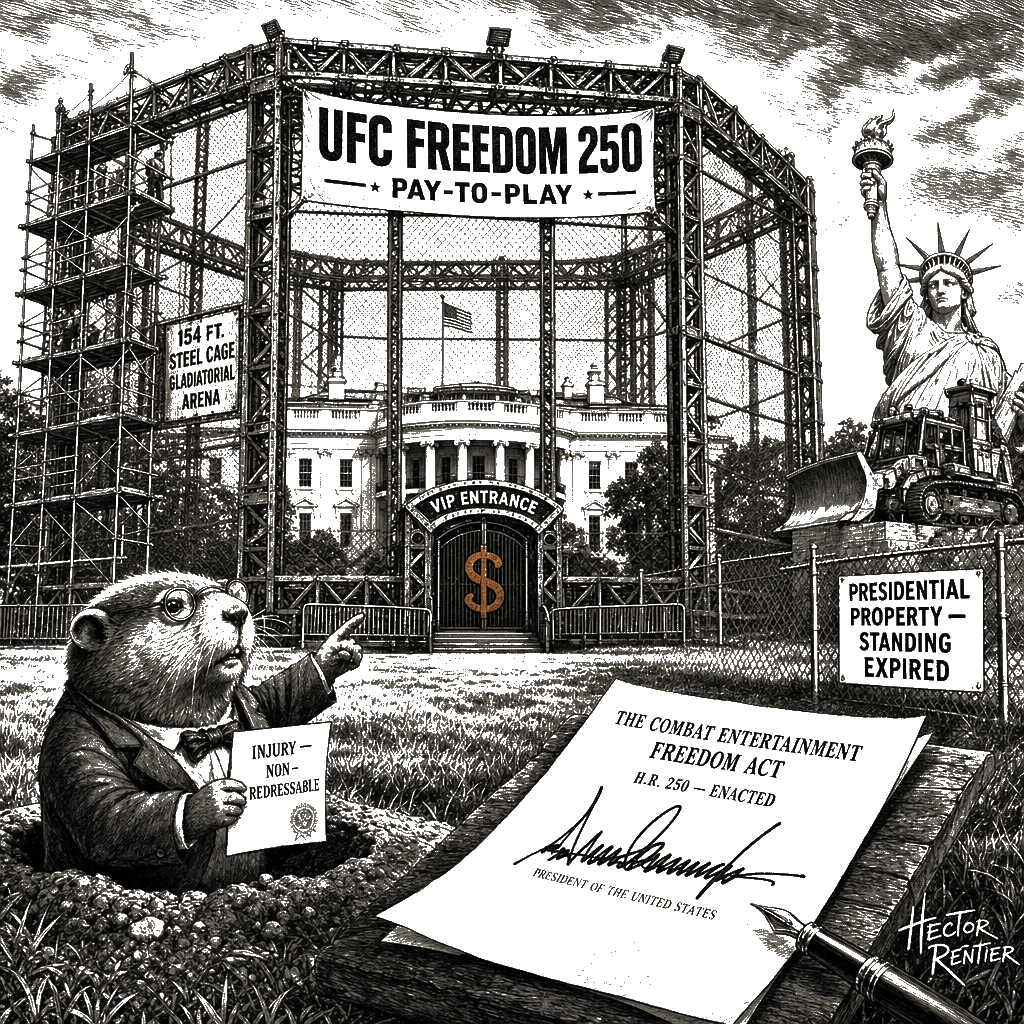
Donald Trump can demolish the Statue of Liberty and no court will stop him. Yaakov Roth, the principal deputy assistant attorney general, confirmed as much during a June 5 hearing before the D.C. Circuit. When Judge Patricia Millett asked if a president who acted fast enough could render any challenge to a physical alteration of federal property moot, Roth replied: “I do think that is correct. The injury, it becomes non-redressable.” The statue—a gift of the French people erected to commemorate the Union’s victory over the slave power—stands only because no bulldozer has yet arrived. The law that would clear the way is already in place.
The Roberts Court built the architecture. Read together, the 2024 immunity holding (Trump v. United States, 603 U.S. ___) and the post-2010 standing contraction form a mechanical sequence that extinguishes judicial review the moment an act is completed. The Court’s own logic runs: the president’s core constitutional powers are conclusive and preclusive of scrutiny; an official act over federal property is immune from criminal prosecution; statutory constraints—the National Historic Preservation Act, the National Environmental Policy Act—are procedural niceties the president’s inherent authority can override, as the major-questions doctrine requires when an action has “vast economic and political significance” (West Virginia v. EPA, 142 S. Ct. 2587; Biden v. Nebraska, 143 S. Ct. 2355). Then standing does the rest. Under Clapper v. Amnesty International USA, 568 U.S. 398 (2013), the injury cannot be speculative. Under TransUnion v. Ramirez, 594 U.S. 413 (2021), it must be concrete. A demolished monument is no longer there. The injury becomes non-redressable, and the standing gate swings shut behind the rubble.
Move fast. Break things. The law will not catch up. That is the operating instruction the administration is reading back to the courts, and it is the same instruction already used to erect the 154-foot steel cage now disfiguring the South Lawn. “The Claw”—the fighting arena for the UFC Freedom 250 event—was built without the Commission of Fine Arts, on federal ground leased to a for-profit promoter, under a legal argument identical to the one advanced in the East Wing ballroom litigation: once a structure is up or a building demolished, oversight commissions cannot halt what is already done. The National Trust for Historic Preservation’s lawsuit to block that demolition is the vehicle for the Roth admission, and the administration’s brief in that case is, in substance, a training manual for the permanent occupation of the federal estate.
The transaction beneath the cage makes plain what the juridical architecture is for. The Public Integrity Project’s filings document that the UFC event is structured to extract tribute: $1.5 million VIP packages, TKO stock purchased by Trump’s wealth advisers, the Ellison family’s Paramount+ broadcasting the fights in the same window that the Department of Justice approved the Skydance merger. The cage is pay-to-play made physical, and the same doctrinal lock that makes executive demolition unreviewable makes privatization of the South Lawn legally unassailable. The regime eliminates standing for physical alterations of the capital while simultaneously functioning as a rent-extraction mechanism.
An honest application of the administrative state would require environmental review, planning-commission approval, and a demonstration that the alteration serves a public purpose rather than a private transaction. A constitutional posture of limited executive authority would not permit the conversion of the South Lawn into a paid-entry arena or the demolition of the East Wing for a private ballroom. The Supreme Court has declined to require any of it. The administration is not hijacking the doctrine; it is deploying doctrine the Court supplied.
The Claw is not a temporary celebration. It is the physical record of a court system that has already surrendered—a monument to the doctrine that speed extinguishes standing. The rest is rubble.