
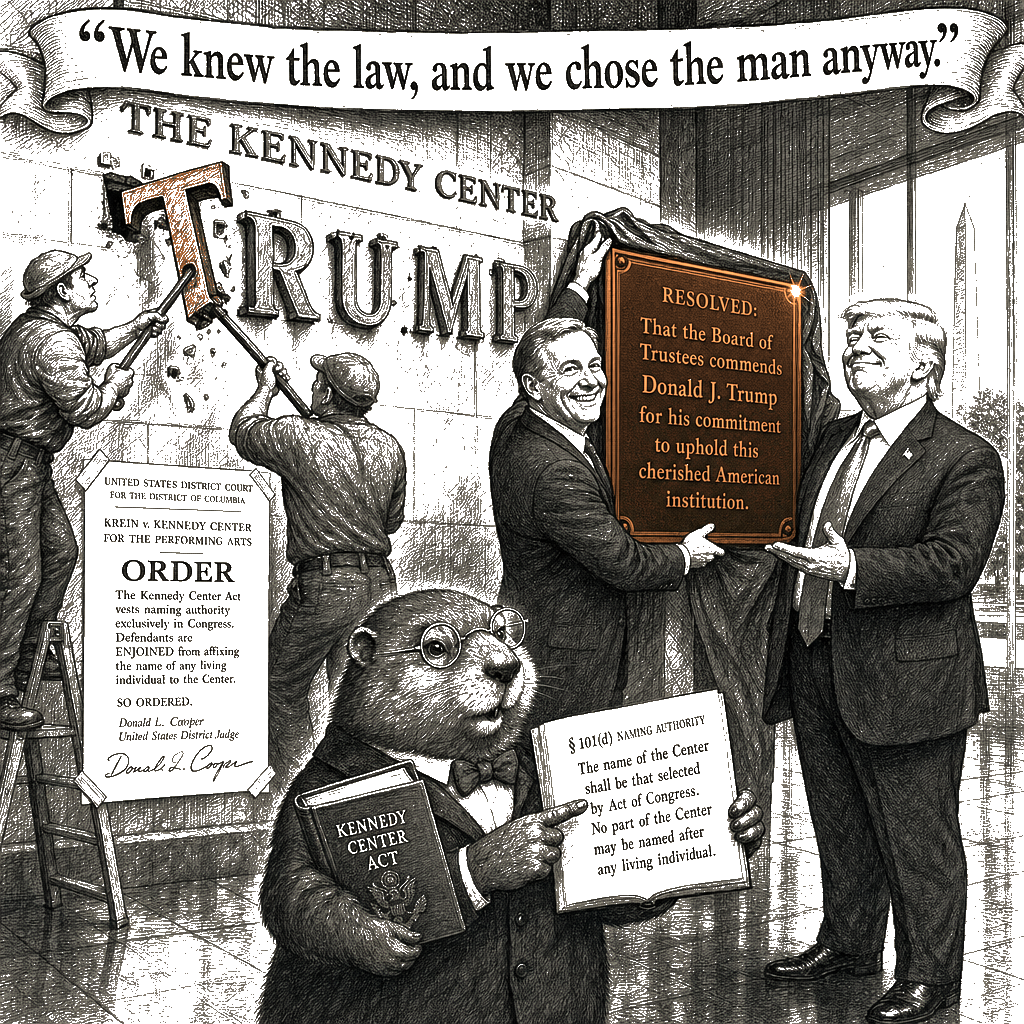
Donald Trump is looting a public institution to carve his name on it.
The Trump-installed board of the Kennedy Center is defying a federal court order to remove his illegally added name from the performing-arts center. The board voted Thursday to seek a stay of U.S. District Judge Christopher Cooper’s May 29 ruling that found the addition of “Trump” to the center’s name was unlawful — even as the center had already scrubbed the name from its website and ordered staff to drop it from email signatures by the June 12 deadline. Those were acts of quiet obedience to the court. And the board followed them by adopting a resolution lauding Trump’s “commitment to uphold this cherished American institution,” which is a little like a burglar asserting his devotion to the sanctity of the home he was caught inside.
The ruling Judge Cooper issued last month is, on first principles, an exercise in reading. The John F. Kennedy Center is a “living memorial” created by Congress under the John F. Kennedy Center Act. The statute fixes the center’s name: “The John F. Kennedy Center for the Performing Arts.” 20 U.S.C. § 76h(a). It grants the board of trustees general management authority, but it reserves to Congress the power to rename. Every alteration of that name — the 1964 renaming, the 1972 addition of a veterans’ memorial, the 1994 inclusion of the National Symphony Orchestra — has come through legislation. When the board voted to affix “Trump” to the façade and the institution, it was doing what only the legislative branch may do. The judge recognized a statutory trespass. There is no deeper analysis required.
The board’s stay motion, filed Friday, invokes the Act’s “living memorial” language to claim an administrative duty to keep the center vital. It is not a serious piece of appellate advocacy. The Kennedy Center Act does not merely mention the name in passing; it codifies it. Congress has repeatedly exercised its naming power by amending the Act. If the board could perform that function by vote, those legislative amendments would be a purposeless exercise — a reading the courts have consistently rejected when confronted with statutes where the legislature has demonstrated it knows how to act. The strongest argument the board could muster — that it has operational control over the building’s physical signage — collapses under the original congressional charter. The physical naming of a congressionally chartered entity is a statutory act, not an internal branding decision.
This is a bid for delay, an attempt to extend the name’s presence on the building long enough to blur the law’s command. The standard for a stay pending appeal requires either a strong likelihood of success on the merits or, at minimum, a substantial legal question and a balance of harms tipping decisively toward the movant. The board has neither. The statutory question is not close. The harm of leaving the name in place is the continued violation of a congressional charter and the public’s interest in prompt compliance with a lawful order. The board’s only asset is the calendar: if the D.C. Circuit acts slowly, the name might linger through the summer. But the legal answer is settled, and the stay will eventually be denied.
Internal general counsel instructed staff on June 4 to drop the name from email signatures and letterhead. The institution’s website reverted to the original designation days later. The Kennedy Center’s leadership was stripping Trump’s name from official documents for nearly a week, and the board’s simultaneous resolution praising Trump’s “commitment to uphold” the institution — offered while the board’s lawyers prepared to ask a higher court to suspend the very ruling that declares its conduct unlawful — is not a contradiction. It is a signal: the board believes it serves executive pleasure, not the statute. That signal is now part of the record. When the name leaves the wall, the resolution will remain as a public record that the board chose executive deference over congressional statute.
The arts community has responded with documented withdrawals. Issa Rae, Bela Fleck, Louise Penny, and others have canceled planned appearances. Consultants and program directors have resigned. Jean Davidson, executive director of the National Symphony Orchestra, departed for the Wallis Annenberg Center. The exits document the institution’s compromised status.
The board’s stay motion relies on procedural posture, and procedural posture is what you file when the text is against you and the legislative history is against you and the only move left is to run out the clock. The statutory text Cooper enforces is the congressional charter. The text does not grant the board renaming authority. The deadline is Friday. The nameplates must come down. A compliant executive branch would accept a district judge’s order enforcing a clear statutory limit on its own agents. The board has refused. The administration has refused. The executive treats a congressional charter as a suggestion it can ignore until a federal court forces compliance — and then, when the court does, it asks another court for a little more time.
Judge Cooper’s order corrects the board’s action. The institution remains a federal charter, not a presidential vanity project. The board’s resolution praising Trump for “his commitment to uphold this cherished American institution” will outlast the illegal nameplate. It will stand as the board’s own inscription, longer-lasting than the brass it tried to bolt to the wall: we knew the law, and we chose the man anyway.