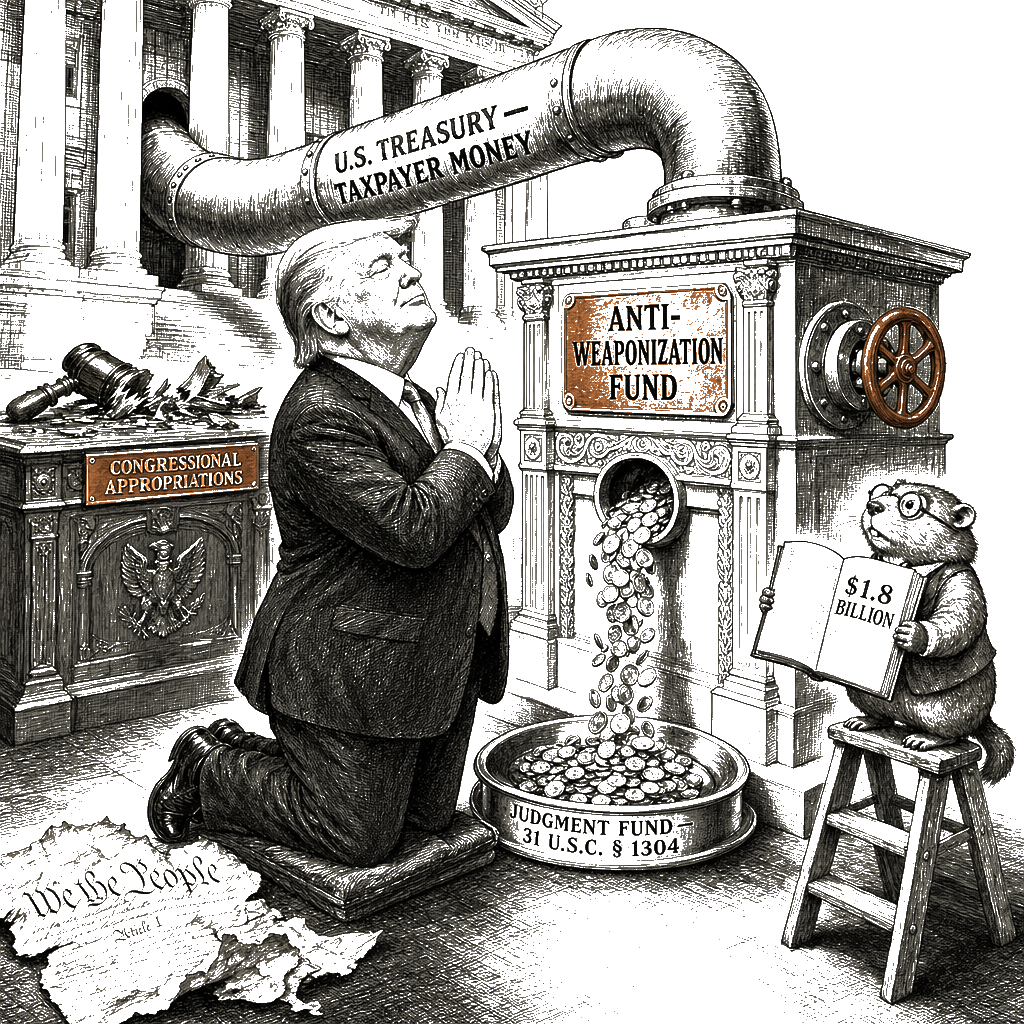
The Justice Department is stealing taxpayer money to fund Donald Trump’s political slush fund. The administration calls it an “Anti-Weaponization Fund.” The rest of us call it what it is: a slush fund dreamed up to pay off allies and settle Donald Trump’s personal tax grievances.
On Friday, U.S. District Judge Leonie Brinkema extended the court-ordered block. She rejected the government’s claim that the fund’s voluntary shutdown moots the lawsuit. The escrow account remains frozen until the parties negotiate a binding sworn declaration that the administration will not revive the billion-dollar pipeline. A temporary halt, Brinkema made clear, does not repair a constitutional violation. A pause is not a legal resolution.
The fund’s origin is as corrupt as its execution. The White House created it to resolve Trump’s lawsuit against the Internal Revenue Service over the leak of his tax returns—effectively coercing the government into a massive cash settlement for dropping a personal complaint. That was never about “healing the wounds of a weaponized justice system.” It was a vehicle for rewarding loyalists with taxpayer money while punishing the civil servants who held the former reality-star president accountable. The branding is Orwellian doublespeak, a hallmark of the Trump era.
The architecture confirms the constitutional defect. The disbursements were routed through the federal Judgment Fund, exploiting 31 U.S.C. § 1304—a permanent Treasury appropriation designed to pay standard legal liabilities, not to finance a bespoke political commission. By funneling $1.8 billion through this statutory tunnel, the executive branch sidestepped the entire congressional appropriations line-item process. The docket filings reveal a five-member commission appointed by the acting attorney general to administer the fund, a newly constituted bureaucracy built to dispense cash to political allies. The “anti-weaponization” label is a rhetorical shield for an executive payout program that stretched statutory liability into a partisan treasury.
The plaintiffs—a coalition of watchdog groups and constitutional advocates—correctly argue that the government has no lawful authority to divert public dollars into a private compensation pool for Trump’s cronies. The notion that a president can settle his own IRS beef by draining the Treasury to soothe his ego and enrich his inner circle is not merely lawless; it makes a mockery of the democratic compact. Brinkema’s decision to extend the block signals that the federal bench is not ready to normalize this grotesque fusion of personal vengeance and official power.
Acting Attorney General Todd Blanche tried to sell Congress earlier this month on the idea that the entire scheme is already dead. But Blanche’s verbal assurance carries no legal weight, and the one man who actually controls the levers has not publicly and unequivocally endorsed the cancellation. Donald Trump, the architect of this pay-to-play apparatus, remains conspicuously silent. The administration’s pattern is by now a familiar three-step: walk right up to the constitutional cliff, claim it has turned back, then wait for the cameras to move on before picking up where it left off.
Brinkema’s demand for a sworn declaration is a good start, but it is only a pause, not a kill shot. The “Anti-Weaponization Fund” is a monument to the president’s belief that government exists to serve him first, and unless the court extinguishes the threat outright, it will return in some rebranded form—just as the cruelty and grift always have. Brinkema applied the Appropriations Clause. The record holds the weight of the application.