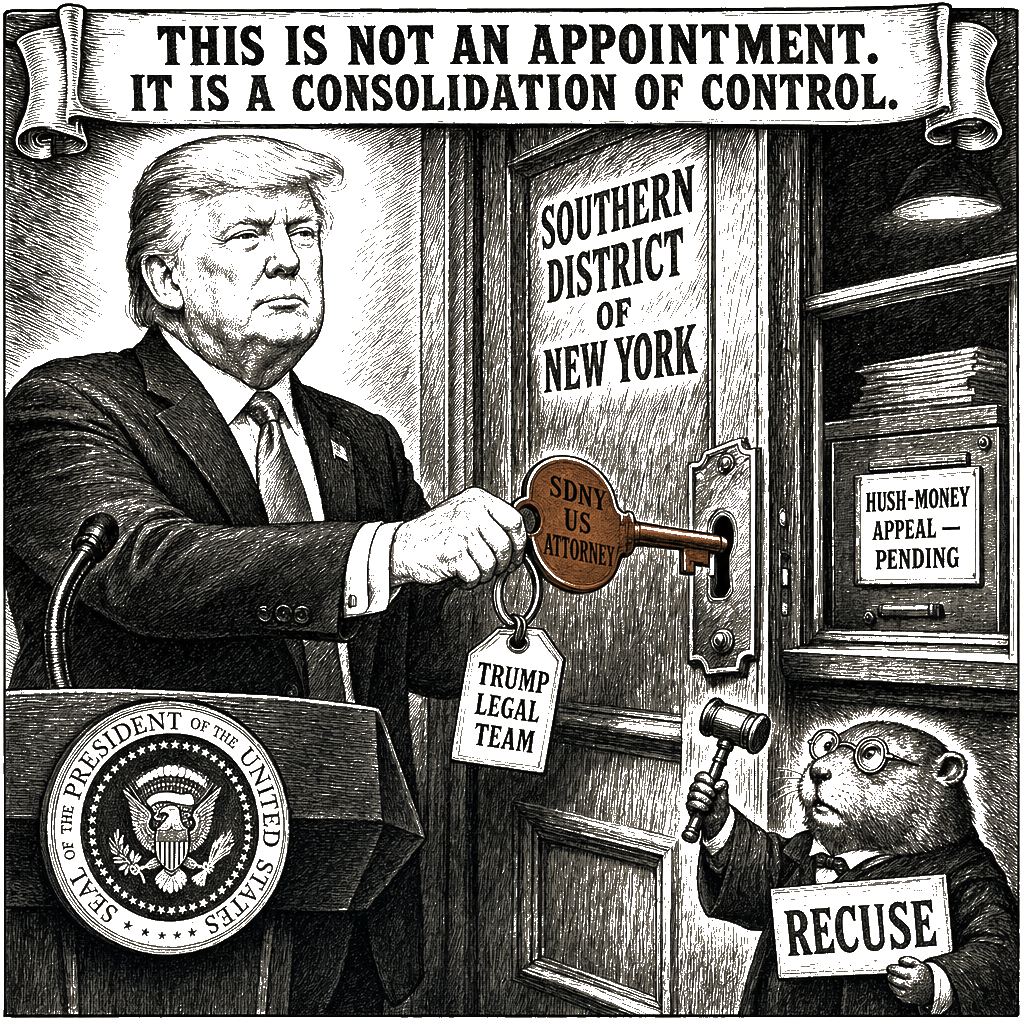
James McDonald was, until Saturday, Donald Trump’s personal lawyer — one of the small crew defending the former president against the hush-money conviction in state court and the related federal case. As of Saturday, Trump announced that he would appoint McDonald to be the United States Attorney for the Southern District of New York, the Manhattan-based office whose jurisdiction encompasses the very courthouse where Trump was convicted and the financial district whose institutions his personal lawyers routinely defend. This is not an appointment. It is a consolidation of control so precise, so calibrated to the ordinary rhythms of staffing, that the press gallery hardly seems to notice what just happened.
Sullivan & Cromwell is becoming the institutional skeleton key of American justice, and nobody is asking the question the key was cut to answer. The firm represents Trump in the appeals of both his civil and criminal cases. The firm produced Jay Clayton — the outgoing U.S. Attorney whom Trump just nominated as director of national intelligence — after Clayton spent more than two decades there as a corporate lawyer. The firm produced James McDonald, who returned to it in 2021 after his prosecutorial and regulatory service. One law firm. The financial prosecutor’s office. The intelligence directorate. The President’s criminal defense. A single institutional connective tissue running through every node. This is not a conspiracy theory; it is a pattern visible from the most elementary reading of the factual record.
The personal-lawyer-to-prosecutor pipeline is now a structural feature of this administration, not an occasional aberration. Todd Blanche, Trump’s lead defense attorney in the Manhattan criminal case, was named acting attorney general and has since been nominated to hold the job permanently. John Sauer, who argued Trump’s immunity claims before the Supreme Court, was confirmed as solicitor general in April. Emil Bove, another defense lawyer, serves as principal associate deputy attorney general, the third-highest post at the Justice Department. And now McDonald, who is still representing Trump in the hush-money appeals, will run the most prominent U.S. Attorney’s office in the country. The WSJ’s own report supplies the receipts: McDonald is “one of several lawyers representing Trump in the appeal of his conviction in the hush-money case in New York state court and a related case in federal court.” The question that should dominate every confirmation hearing — whether a president’s personal lawyer can credibly run the office where his client’s appeal is pending — is buried under a discussion of qualifications that no one in the process has the institutional leverage to challenge. McDonald’s résumé is real: he was a federal prosecutor in the SDNY from 2014 to 2017, handling gang and organized-crime cases, and he worked on the public-corruption trial of Sheldon Silver; he later served as the CFTC’s enforcement director during Trump’s first term, and he clerked for Chief Justice John Roberts. The honest answer to “Is McDonald qualified?” is yes. The honest answer to the question no one is asking — whether a former client can credibly oversee the office where his appeal is pending — requires an analysis the credentialism frame is built to prevent.
The old methods of neutralizing a federal prosecutor were crude. Bribe the U.S. attorney. Destroy evidence. Threaten witnesses. The apparatus had to be corrupted case by case, each act a discrete crime producing its own evidentiary trail. The new method is more precise. Appoint the defense counsel as Attorney General. Appoint the personal lawyer as U.S. attorney for the district where the president’s cases are pending. Install the law firm partner atop the office and the firm as the president’s appellate counsel simultaneously. The capture happens upstream — at the appointment level — before any individual case reaches the courthouse. There is no crime scene because there is no crime. There is only a series of structurally coherent appointments, each defensible in isolation, each indistinguishable from the ordinary exercise of presidential authority, and each one installing a prior-loyalty relationship at a prosecutorial decision point.
The SDNY’s own recent record has been repurposed as a legitimacy-washing operation. The Journal reports that under Clayton, the office “brought charges against the ousted Venezuelan president, Nicolás Maduro, the accused UnitedHealthcare executive killer, Luigi Mangione, and members of an alleged drug ring in a Manhattan park.” These are high-profile, politically uncontroversial prosecutions — nobody in power complains about going after a foreign autocrat, an alleged assassin, or a drug gang. A spokesman for the Southern District said, “The Office welcomes the President’s choice to lead the SDNY. Mr. McDonald is widely respected.” A federal prosecutor’s office does not issue statements about a president’s selection that are anything other than carefully managed. That is the sound of an institution recognizing who now holds the leash. The question is not whether the SDNY will continue to prosecute the headline-grabbing, politically palatable cases that please everyone. The question is whether it will ever again turn its attention to the kind of politically connected white-collar crime that made the office famous — and whether it will ever again investigate the financial dealings of the president who appointed its chief. The pattern of the past several years says no.
The cui-bono trace is not subtle. Who benefits from a Trump lawyer running the SDNY? Donald Trump, obviously — his legal exposure in the district shrinks, and the office’s capacity to scrutinize him or his associates is neutralized. Who benefits from the pipeline that moves Sullivan & Cromwell partners into top justice posts? The firm, whose influence over the federal law-enforcement apparatus grows with every appointment. Who bears the cost? The public that relies on independent prosecutors to investigate the powerful without looking over their shoulders at the White House. And the ordinary defendants whose cases will be handled by an office whose chief is answerable to a president who believes the justice system exists to serve his interests.
So this is how a federal prosecutor’s independence dies — not with a dramatic confrontation, but with a series of staffing decisions that no one in the chamber any longer remembers having debated on the merits. The confirmation check is being routed around. Senator Schumer, a New York Democrat, blocked a confirmation vote for Clayton, who then took office through the judicial-appointment route. The same path is available for McDonald. The district’s own judges — the very judges who would hear cases the SDNY brings — can install the nominee directly. The check on presidential power over prosecution has become the mechanism through which that power is consolidated.
The only forces that can resist institutional capture are competition, regulation, self-help, and labor. Competition means another office willing to take the cases the SDNY will now avoid. Regulation means the bar associations and ethics committees that could, but will not, discipline McDonald for taking the job. Self-help means the leakers and whistleblowers inside the office who still believe in its mission. And labor means the line prosecutors who can, if they organize and refuse to carry out manifestly corrupt instructions, become the most effective resistance the administration faces. A serious independent prosecution office under a president who treats it as a personal appendage is a contradiction in terms. McDonald may be an able lawyer, but a lawyer who is actively defending a client cannot, with any pretense of independence, run the office that prosecuted that client. The conflict is not a technicality; it is the point. Trump’s consistent practice has been to install people whose personal loyalty to him supersedes their institutional obligations. McDonald, by agreeing to take the job while still on Trump’s legal team, has already demonstrated which loyalty will govern.
There is an older corrosion here that predates Trump. The SDNY built its reputation by being the office that indicted Sheldon Silver and a long line of crooked politicians and Wall Street figures. That reputation attracted top-flight talent, who then cycled through Sullivan & Cromwell and other white-shoe firms, building the very networks Trump is now exploiting. The revolving door between elite prosecution and elite defense was always a vulnerability; Trump has turned it into an open gate. The office that once prided itself on independence from political power is now being run by the people who defend the powerful, on behalf of the most powerful.
The message to every citizen is unambiguous: the law is a tool of the powerful, and the powerful will decide who is subject to it. The message to every prosecutor in the office is that career advancement depends on not angering the White House. The message to every judge who will hear cases from that office is that the United States Attorney is the president’s man, and the independence of the bench will be tested accordingly. The Southern District of New York was never going to hold out forever. But the speed with which it has fallen — from the office that put Sheldon Silver away to the office that will take its orders from a Sullivan & Cromwell partner who still represents the president — is a measure of how completely the Trump restoration has reconfigured the justice system’s relationship to power. The office will continue to try cases, win convictions, issue press releases. It will look, from the outside, like a functioning federal prosecutor’s office. And it will be hollow — because the thing that made it function, the independence that was its only real asset, has been traded for access, and everyone inside knows it.
The arc of the moral universe is long, and it does not bend on its own. It bends when specific people, in a specific moment, push it. The people who can push it now are the career prosecutors inside the SDNY, the judges who can demand recusals, the bar associations that can issue statements, the reporters who can keep asking who is making the prosecutorial decisions that matter. The rest of us can do what the moment requires: name what is happening without softening it, refuse to treat the normalization of corruption as a settled fact, and remember that every institution that has been captured can be recaptured — not by waiting for the next election, but by refusing, now, to pretend that this is normal.
This is not normal. James McDonald is Trump’s lawyer. And Trump just made him Manhattan’s top federal prosecutor. The receipts are on the record. The only question left is whether the rest of us will act like it.