
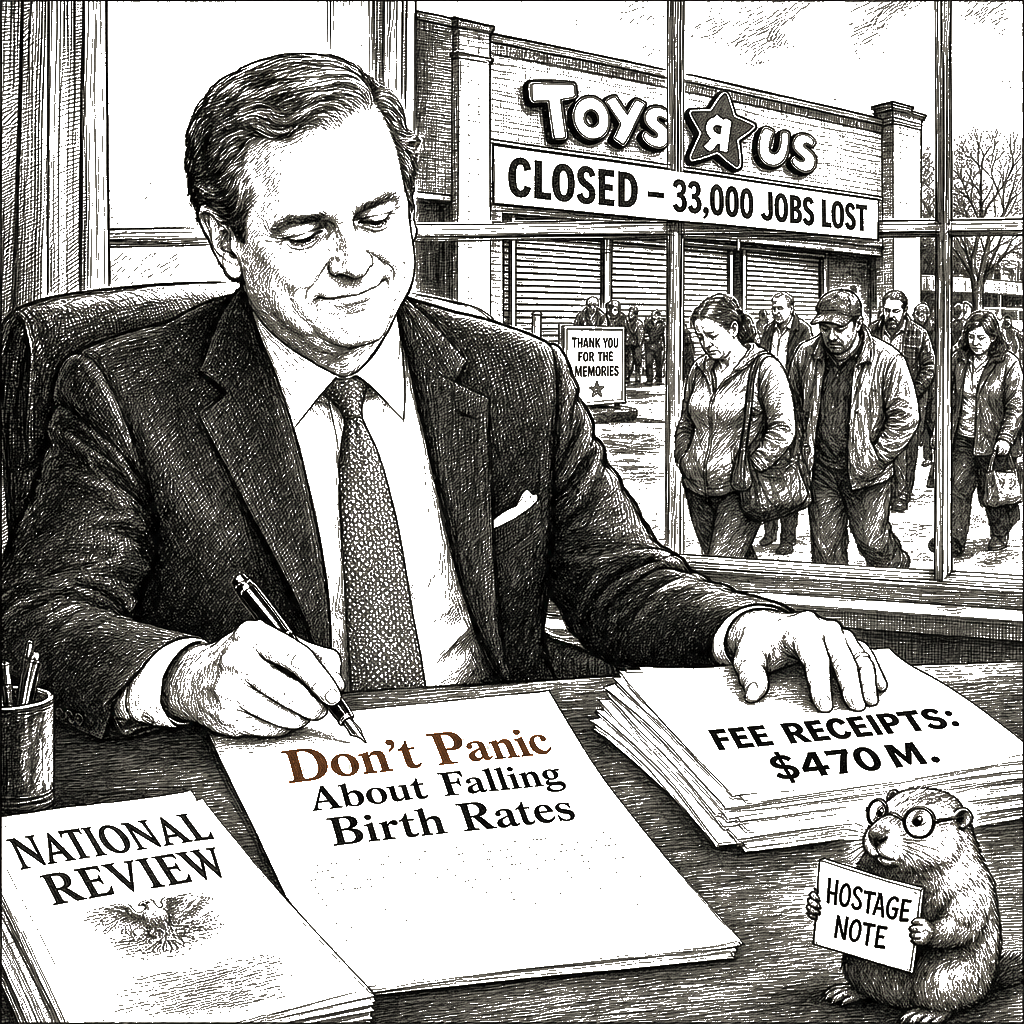
The men who loaded Toys “R” Us with debt and walked away with $470 million in fees left 33,000 workers with empty lockers. Andrew Stuttaford wants you to call that “earning.” In “Don’t Panic About Falling Birth Rates”, he argues that the attacks on billionaires are driven by envy, that they create vast consumer surplus, and that taxing their unrealized gains would cripple the economy. He offers the examples himself. They are the docket.
The op-ed’s own defense reveals the machine. Jeff Bezos paid $0 in federal income tax in 2007 and 2011, according to ProPublica’s leaked IRS files. Elon Musk paid $0 in 2018. Their wealth is in appreciated stock they never sell; they borrow against it and call it “earnings.” The op-ed’s argument against taxing unrealized gains is the confession: the system is designed so that a man worth $200 billion pays nothing while a teacher pays her full rate every paycheck. The “efficient allocation of capital” the op-ed praises is the private-equity firm that loaded Toys “R” Us with debt and collected $470 million in fees, according to the Private Equity Stakeholder Project, leaving 33,000 workers with nothing. That is the same “efficiency” that left Steward Health Care in bankruptcy after its owners siphoned off an estimated $800 million, reported by Bloomberg. The op-ed’s “earners” are extractors—the tollbooth operators of the internet, the government-contract kings, the rent-collectors who call themselves investors. Every example the op-ed offers is a case study in the extraction it denies.
I have watched this movie since Nixon. The same defense was filed for the AIG executives who paid themselves $165 million in retention bonuses with bailout money in 2009, for the HSBC money-launderers who bought a deferred prosecution agreement for $1.9 billion in 2012, for the Wells Fargo fake-account executives who settled with the Department of Justice without a single individual charged in 2020. The defense is always the same: they earned it; they create value; they are the victims of envy; taxing them would cripple the economy. The defense is always the evidence of the crime.
The op-ed’s argument is not a defense. It is a hostage note—the same note the extraction class has been passing since the AIG bonuses, since the HSBC settlement, since the first private-equity firm loaded a chain store with debt and walked away rich. The note says: “Don’t panic. We earned it.” The truth says: “They took it, and they are using the op-ed to keep the till open.”
Stuttaford says the attacks on billionaires are driven by “spite and jealousy.” The workers at Toys “R” Us were not spiteful. They were not jealous. They were laid off while the owners collected $470 million in fees. The op-ed does not mention them. It does not mention the patients who lost their hospital beds because the “efficient allocation of capital” had decided the beds were a liability.
The op-ed is titled “Don’t Panic About Falling Birth Rates.” It is a defense of billionaires. The birth rate is the bait; the billionaires are the hook. The real crisis is not the birth rate. It is the extraction the op-ed is paid to defend.
The op-ed cites the $2.3 billion in taxes Citadel’s executives paid. It does not cite the $470 million in fees the same firm’s peers extracted from a dying toy chain. The extraction is the ledger; the op-ed is the footnote.