
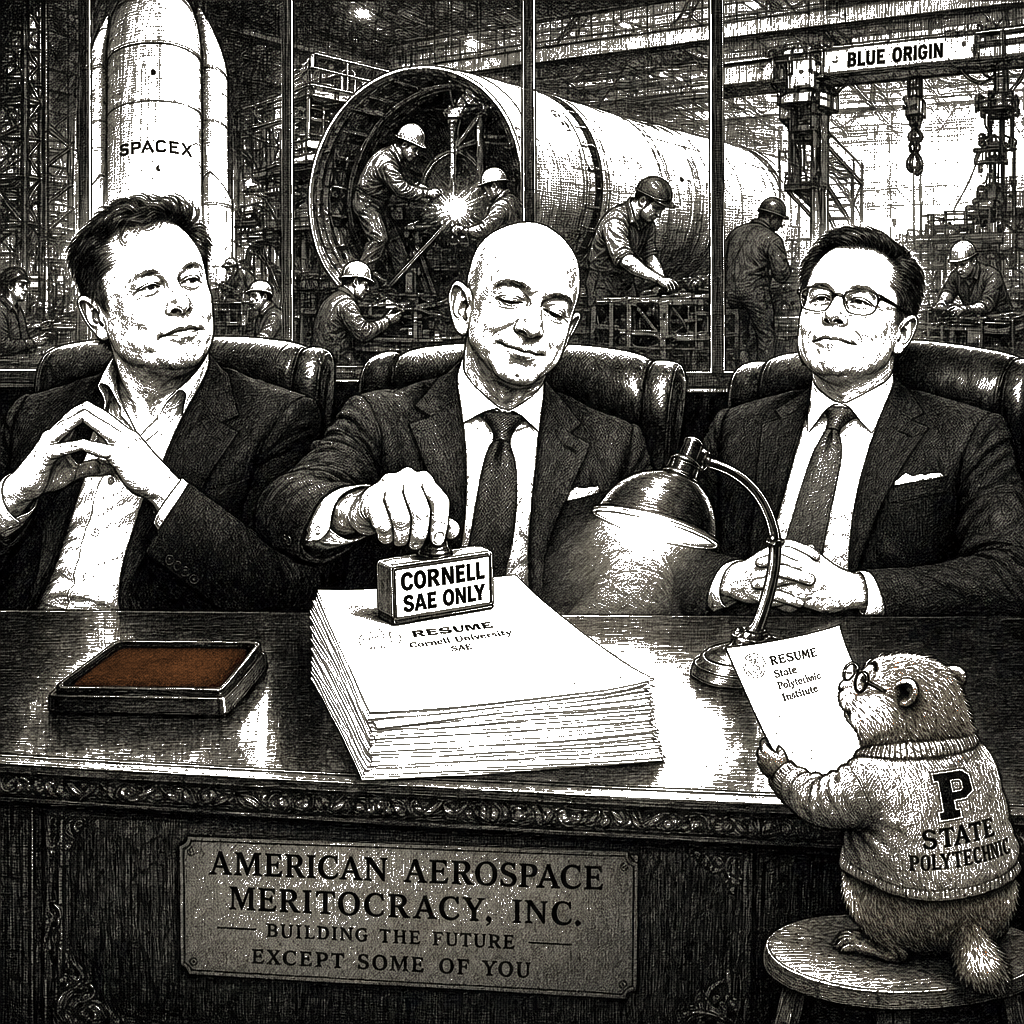
Elon Musk’s SpaceX is a racket run by Cornell Formula SAE alumni.
It is true that the company builds rockets that work — in the narrow sense that a Falcon 9 has a better launch record than any other operational rocket. The trouble is that the company’s hiring is not a meritocracy. It is a closed shop, and the IPO is the moment the insiders cash out.
The evidence is in the names. Bill Riley, a top engineering executive and former Cornell Formula SAE member from the late 1990s, is set to serve as chief design judge at a college racing competition in Michigan. Mark Juncosa, now a vice president, and Mike Nicolls, a senior vice president, both raced for the same Cornell team in the early 2000s. The trio now form the core of the company’s technical leadership. Their shared background is not a coincidence. It is a hiring pipeline. The feature, published days after the company’s IPO celebration, records that the racing-team participants formed their own social group among interns. “The Cornell SAE people, that was a demographic within SpaceX,” one former employee told the Wall Street Journal.
The article offers a flattering narrative: Juncosa learned to weld on the team and once jumped in to solve a factory-floor automation problem that a professional welder thought impossible. Nicolls built engine-control units for the club’s cars. The faculty adviser says the club teaches independent thinking because “We don’t have classes in all the things that you have to know.” All of that is true — and exactly the problem. The skills are real, and the club produces them, and then SpaceX hoards the graduates. The question is not whether Juncosa can weld; it is why the company’s technical leadership so reliably traces to one campus club and not to the thousands of equally skilled engineers who did not race cars at Ithaca. Mike Nicolls has spent years running the Starlink satellite-internet business, making the Cornell pipeline not just a manufacturing backstop but the control room for the company’s most profitable division.
This is the chokepoint. The company’s hiring is an insider pipeline that funnels the best jobs to a narrow circle of Cornell SAE veterans. SpaceX has deepened its ties with the Pentagon, winning multibillion-dollar Space Force contracts, and the university endowments that hold its shares are poised for billions in IPO gains. The company’s IPO is the biggest ever. SpaceX presents itself as a company that hires the best engineers — but the best engineers, it turns out, all went to the same school and raced the same cars. The company did not respond to a request for comment.
The article’s one encounter with a worker who is not an executive is the story of the welder. Juncosa, the piece reports, once relayed a story through a mutual acquaintance about a welder at SpaceX who did not think it was possible to set up an automated welding process involving thin aluminum panels. Juncosa, who learned to weld on the Cornell racing team, jumped in to solve the problem.
The welder is unnamed. The welder has no quote, no agency, no account of what happened next. The welder exists in the story to demonstrate that Juncosa possesses practical skills — skills the welder, by implication, lacked. The implication is not just that an executive can weld; it is that the hands-on skill of a welder who does it every day is worth less than the same skill acquired on a college racing team. This is the article’s deepest structural commitment: the “practical skills” that matter are the ones executives have. The practical skills of the people who actually weld the rockets, assemble the satellites, operate the machinery, and maintain the launch facilities are invisible.
SpaceX employs thousands of production and launch workers. The piece names three executives and quotes four people, all of them in leadership or academic positions. The production workforce — the people who do the hands-on work the article celebrates — does not appear.
This is not an oversight. It is the editorial logic of the piece. A human-interest story about executives’ formative experiences is, by construction, a story that erases labor while claiming to honor it. The welders, technicians, and maintenance crews who make the rockets fly are not the subjects of the narrative. They are the background against which the narrative takes place.
The “practical skills” framework, as the article deploys it, does specific ideological work. It converts a selective account of who matters into a universal-sounding principle. Engineers who learned to build things in a university club and then redirected that capability toward aerospace are presented as proof that hands-on experience is what the future demands. But the principle applies only upward: it validates executives whose résumés include racing teams and competition wins. It does not extend to the production workers whose daily labor is the hands-on experience the article claims to value.
This is the same structure every extractive industry uses to justify its hierarchy. The people at the top are there because they are exceptional, because they have the right kind of practical intelligence, because they once built something with their hands. The people at the bottom — the ones who build things with their hands every day — are not exceptional. They are interchangeable. The article’s silence about SpaceX’s workforce is not neutral. It is the silence of an editorial framework that sees labor only when it comes wrapped in an Ivy League pedigree.
The timing is not incidental. The piece runs as SpaceX transitions from private to public, as billions in institutional capital begin converting endowment holdings into returns, and as the company’s role as a major Pentagon contractor deepens. This is the moment when a publicly traded company most needs a particular kind of story: one that makes the reader feel that the company is led by exceptional people doing exceptional things, rather than one that asks what the company actually does with the money and the contracts and the public trust.
A human-interest piece that mentions the IPO only as a celebratory stock ticker, asks nothing about the contracts, nothing about the labor conditions, and nothing about the environmental record is not a gap in coverage. It is a piece of communications infrastructure. It serves the same function the racing team served for the executives it profiles: it builds the narrative that makes the actual work invisible.
The public record around SpaceX includes multibillion-dollar Space Force contracts, OSHA complaints from production workers, a worker death at Starbase in May 2026 that prompted an ongoing federal investigation, and the documented environmental impact of launch operations at Boca Chica, Texas. The article engages none of it. What it offers instead is a narrative arc — from university club to rocket factory — that positions the company’s leadership as the natural heirs of a tradition of practical, hands-on engineering. The Formula SAE competition is a test of whether students can design, build, and race a car — which, as Riley said, is not that different from building a rocket. The difference is that one is a private club and the other is a public company. The club runs the company.
The WSJ piece opens with a stock ticker and a percentage gain. It closes with a professor in Canada wondering what would have happened if the three Cornell alumni had gone somewhere else. The article does not have to say “invest in SpaceX.” It does not have to say “SpaceX is well-managed.” It has to make the reader feel that SpaceX is the kind of place where exceptional people build the future. That feeling, at the moment of a public offering, is worth more than any disclosure.
The rockets are real. The satellites orbit. The Pentagon contracts are documented. The labor complaints are on file. The university endowments have already booked the gains. What the article provides is the narrative overlay — the story that makes the extraction look like aspiration. The Cornell racing team, the hands-on engineering, the practical skills: these are real things. They are also, in this context, the delivery mechanism for something else entirely. A piece that makes the reader feel like they are reading about human achievement, while the actual story — about contracts and capital and who profits — stays out of frame. The club runs the company. The club cashes out. The rest of us read the story.