Donald Trump has installed his personal defense attorney as the chief federal prosecutor for the district where his criminal exposure is most acute.
The president announced Saturday that James McDonald, a Sullivan & Cromwell partner currently representing Trump in the appeal of his New York criminal conviction and related federal litigation, would become the United States Attorney for the Southern District of New York. McDonald replaces Jay Clayton, another Sullivan & Cromwell alumnus who was elevated to director of national intelligence. The man being removed from the SDNY post to make room is the man being named to run it. That circle is not incidental. It is the architecture.
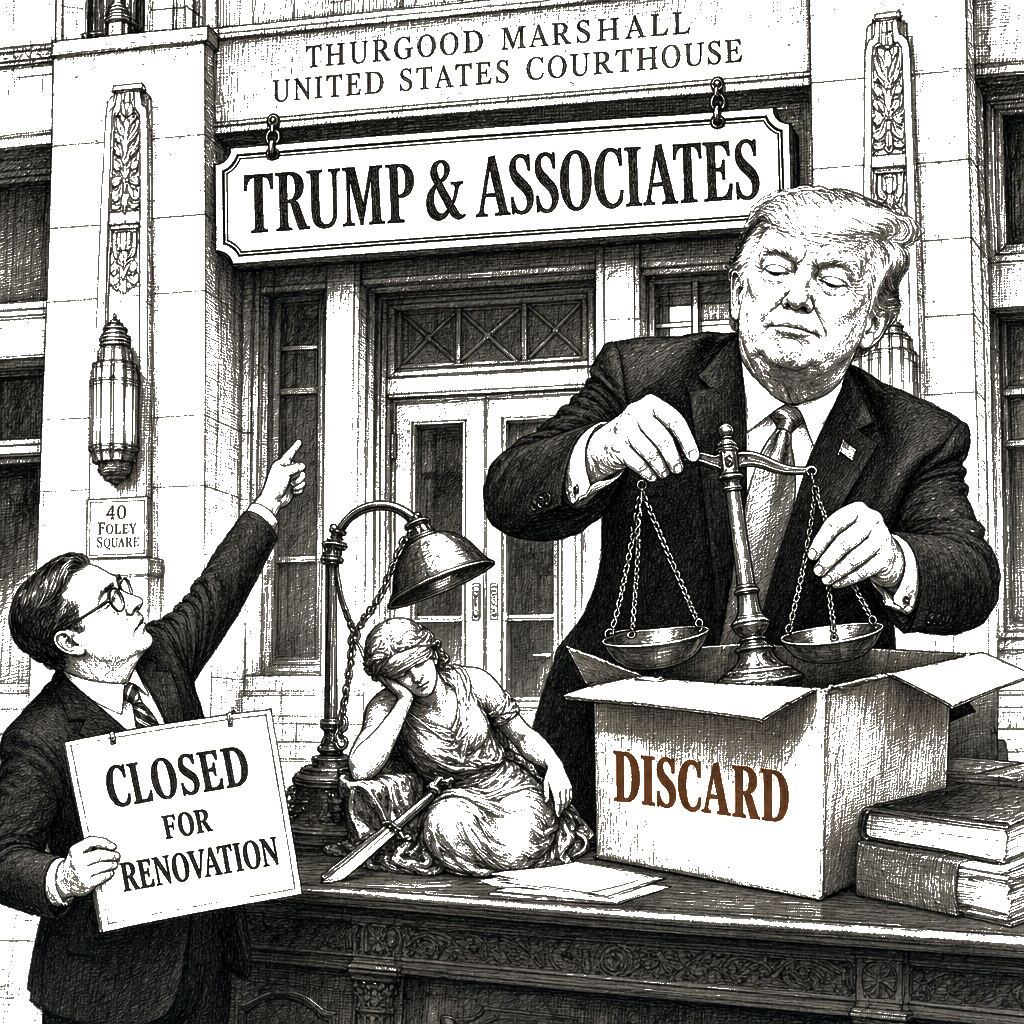
This is not an isolated appointment. It is a construction project. Three weeks ago the president nominated Todd Blanche, his lead criminal-defense lawyer in the Manhattan hush-money trial and the federal classified-documents case, as permanent Attorney General. Together, the two nominations would place the president’s own defense counsel atop both the Department of Justice and its most historically independent outpost. The principal would have his lawyers running the institutions that exist to hold him accountable.
The confirmation mechanism the president is using strips the Senate of its constitutional role. A U.S. attorney can be installed either by Senate confirmation or, if a home-state senator blocks a floor vote, by a statutory fallback in which the district’s judges fill the vacancy. That fallback was designed for real vacancies — genuine empty seats that would otherwise leave a federal district unstaffed. Under Trump it is the primary delivery mechanism. Chuck Schumer, New York’s senior senator, blocked a vote on Clayton; the SDNY judges appointed him anyway. The same path awaits McDonald. A bench that includes a substantial number of active judges appointed by Democratic presidents — led by Chief Judge Laura Taylor Swain, a Clinton appointee — will be asked to supply what the Senate refused: the seat of a president’s own defense lawyer. A statutory safety valve built for a vacancy is being weaponized to install the man whose client is the president. The judges’ fallback is no longer a fallback. It is the conveyor belt for the conversion.
The Sullivan & Cromwell connection converts a conventional appointment into something the ordinary vocabulary of legal conflict cannot capture. McDonald is a partner at the same firm that currently represents Trump in pending appeals of his civil and criminal cases. The U.S. attorney’s office for the Southern District of New York will now draw its leadership from a firm representing the president in litigation before the very courts over which that office exerts federal prosecutorial authority. The conflict is not a close call; it is a structural one. The office’s spokesman, in a statement, called McDonald “widely respected” and said the office “welcomes the President’s choice.” That is the statement every U.S. attorney’s office makes when a new head is named. It does not address the structural question. It cannot. There is no answer that permits a president’s personal lawyer to direct the largest white-collar docket in the country while his firm continues to represent the president in active litigation.
McDonald’s prosecutorial credentials are genuine. He clerked for Chief Justice John Roberts. He prosecuted gang and organized-crime cases in the Southern District from 2014 to 2017, including the first public-corruption trial of former New York Assembly Speaker Sheldon Silver. He later served as enforcement director of the Commodity Futures Trading Commission. A former federal prosecutor told the Wall Street Journal that McDonald is “aligned with him and has real credentials.” That is precisely the formulation that makes the problem harder to see, not milder. Experience is not independence.
The structural arrangement is the point. A president who orders his prosecution shut down creates evidence of obstruction. A president whose defense lawyer runs the prosecutorial office does not need to give the order. Charging decisions, investigative scope, resource allocation, staffing — the discretionary architecture of a federal prosecutor’s office is vast and largely unreviewable. A U.S. attorney aligned with the office’s subject can manage outcomes without leaving a record of instruction. The Department of Justice’s own internal guidance, articulated by the Office of Legal Counsel in 1973 and reaffirmed in 2000, holds that a sitting president cannot be indicted. Add the U.S. attorney’s charging discretion and the presidential pardon power, and the structure produces an accountability circuit that is self-enclosing: the prosecutor serves at the pleasure of the president, the president is immune from federal indictment, and the president’s personal defense lawyer commands the office.
The Southern District of New York has long maintained an institutional culture of independence from Washington — enough so that it is called “the sovereign district” within the profession. That culture is real, built over decades by career prosecutors, grand jury secrecy rules, and an office ethos that prizes distance from political pressure. But institutional culture is not a constitutional guarantee. It is a norm, and norms hold only until the people who staff the institution are replaced by people chosen by the subject of its potential investigations.
The pattern now extends across the entire federal prosecutorial apparatus. The acting attorney general is Trump’s lead criminal-defense lawyer. Career prosecutors who worked on cases involving the president have been reassigned or have departed. The classified-documents case was assigned to a judge whose rulings repeatedly favored the defense before the case collapsed entirely. The architecture is not a single corrupt order. It is the systematic construction of a prosecutorial apparatus the principal has no reason to fear.
Under Clayton, the Southern District brought charges against the ousted Venezuelan president Nicolás Maduro, the accused UnitedHealthcare executive killer Luigi Mangione, and members of an alleged drug ring in a Manhattan park. That is the kind of docket a genuinely independent U.S. attorney’s office produces: high-stakes, politically delicate, and directionally indifferent to who holds the White House. Under McDonald, the office’s leadership will report to a president who is his client and to an acting attorney general who was, until April, that same president’s lead criminal-defense counsel. The office will not bring the cases it should. It will bring the cases the president wants.
The defense client does not need to order the case killed. He needs only to put the defense lawyer in charge. The machinery does the rest. The office with the most dangerous docket for the president now reports to the lawyer the president pays to dismantle that danger.