
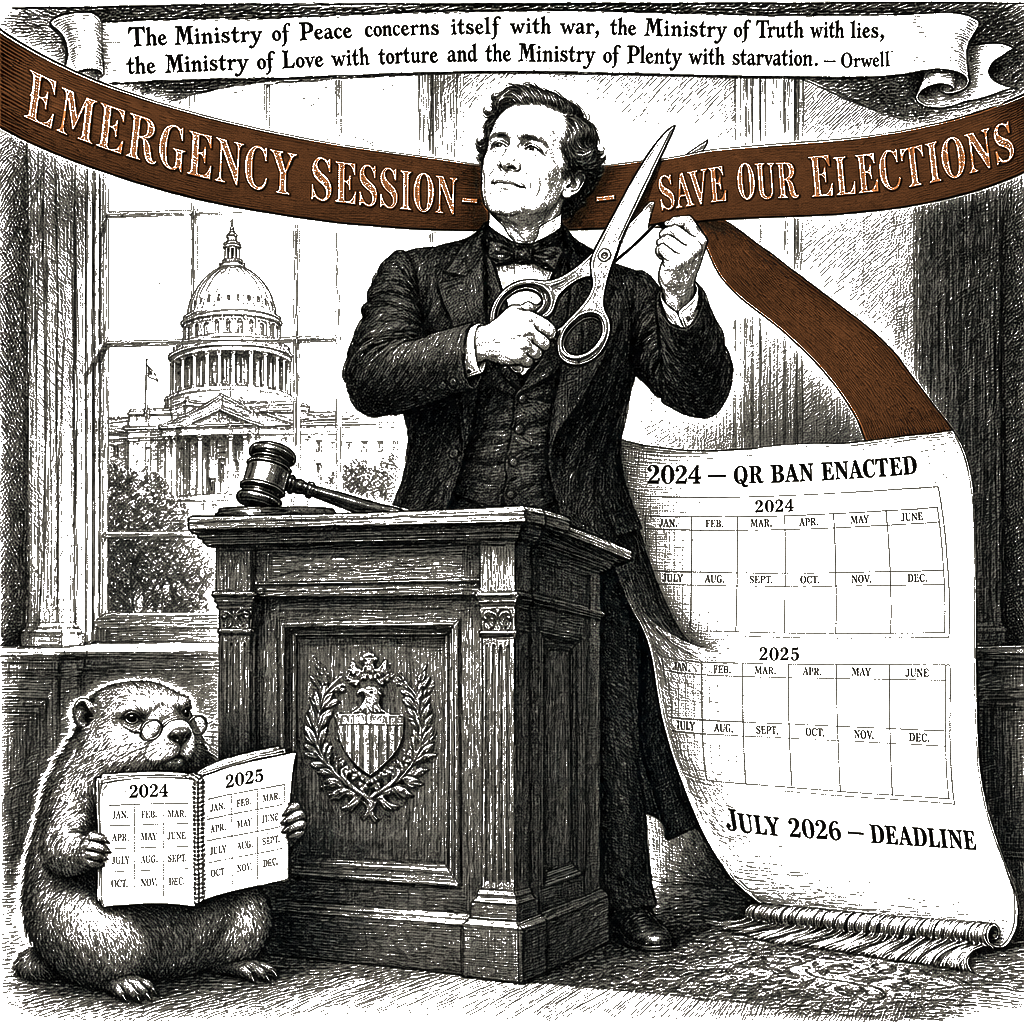
Georgia’s legislature banned its vote-counting method and replaced it with nothing. In 2024, the Republican-controlled General Assembly passed a law prohibiting the use of QR-code ballot scanners for the official count after July 1, 2026. That deadline is now two weeks away. The machines that every county in Georgia depends on to tabulate results would become illegal by statute. The legislature did not pass a replacement. It did not commission one. It did not fund one. For two full years, through an entire legislative session that ended in April without a voting-machine plan, the General Assembly left the state’s election infrastructure in legal limbo and went home.
No replacement method to tabulate ballots was ever enacted. The legislature that banned the machines the state uses to count votes never bothered to specify what would replace them.
Now Governor Brian Kemp has called a special session to “address issues created” by the legislation. Those are his words in the proclamation — not “issues arising from,” not “challenges inherent in.” Issues created. The governor of Georgia named the legislature as the author of the crisis he is now asking the legislature to resolve. The passive construction cannot hide what the active verb admits. The issues were not created by an earthquake or an invading army or an unforeseeable supply-chain disruption. They were created by a legislature that voted to ban the state’s tabulation method and then voted for nothing else.
And the session was originally convened so lawmakers could redraw congressional maps; the QR-code deadline was folded in only after the calendar made continued inaction impossible, an afterthought elevated to an emergency by the legislature’s own refusal to do its job on time. In a state where every seat in the General Assembly is on the 2026 ballot alongside races for governor and United States Senate.
This is not an oversight. An oversight is corrected in the next session. This is a two-year construction — the deliberate creation of an election-administration vacuum in a presidential battleground state, followed by a last-minute convening to fill that vacuum with whatever instrument the convening body chooses. The legislature that created this crisis will now present itself as the legislature that resolved it, likely by extending the deadline or passing some last-minute patch that preserves the QR-code system it spent two years denouncing. The narrative will be that responsible legislators stepped in to avert chaos. The narrative will omit that the chaos was legislatively manufactured, that the deadline was known for two years, and that the legislature’s regular session ended with the problem deliberately unresolved.
The QR-code system was not experimental technology. Georgia purchased it in 2019 as part of a statewide voting-machine upgrade prompted by the 2018 gubernatorial election — the election that saw hours-long lines, malfunctioning equipment, and widespread suppression allegations. The state bought new machines specifically to address the failures of the old ones. The QR code is the mechanism that makes those machines count ballots accurately at scale. Touch-screen terminals produce a paper ballot with a human-readable summary and a machine-readable code that the tabulator scans. Banning the code without replacing it does not improve accuracy. It eliminates the only method the state has for counting ballots at the speed and scale that 159 counties require. It leaves the count itself legally undefined.
The confusion radiating downward is already operational. The secretary of state’s office and the State Election Board have issued conflicting guidance to county election directors about how votes should be cast and counted. County officials — the workers in courthouses and community centers and school gymnasiums — are now uncertain which set of instructions to follow, two weeks before the law they are supposed to be complying with takes effect and with a full slate of 2026 elections approaching. These are not politicians. These are the people the system cannot function without, and the legislature has left them standing on air.
What you are looking at is manufactured controversy in the technical sense Oreskes and Conway documented — the deliberate construction of a crisis where none existed, for the purpose of positioning the constructor as the necessary solver. The QR-code system worked. The ban was prospective. No documented failure of the tabulation method precipitated the prohibition. Two years of legislative inaction followed. The legislature had every opportunity to build a replacement. It chose not to.
The related pattern — goalpost-shifting, where the standard for acceptable performance is moved precisely when the evidence meets the prior standard — is also operative. Georgia had a functioning tabulation method. The legislature banned it. Now the only body authorized to install a replacement is the same body that destroyed the original. And the deeper pattern, pre-emptive legitimacy-withdrawal, names what is underneath both: the withdrawal of trust from a functioning institution on the grounds that its method is inherently suspect, regardless of its documented performance. The voting machines were delegitimized before any specific flaw was demonstrated. The QR-code ban is rooted not in any documented failure of the tabulation system but in the political posture, hardened after 2020, that machine-counted ballots are presumptively untrustworthy. The ban is its legislative expression. The demand was always destruction of the existing apparatus; the replacement was never the point. The point was the destruction.
The cui-bono trace is not complicated. When election administration fails — when results are delayed, when county officials cannot agree on procedure, when voters encounter confusion about whether their ballots will count — the beneficiaries are those whose political prospects improve when fewer people vote and when the legitimacy of the outcome can be questioned. An election administration that cannot tell its own county directors how to count votes is an election administration whose count can be contested after the fact, on whatever grounds the contesting party finds convenient. The confusion is not a bug in this strategy. The confusion is the strategy.
The Georgia General Assembly is not a neutral body making a technical adjustment to election law. It is a partisan legislature writing the rules of an election it will contest. It has written those rules so that the machinery of counting is in legal limbo, with the only remedy being whatever the same body decides to impose at the last possible moment. The legislature did not declare that votes would not be counted. It banned the method of counting and left a vacuum. Two years the ban sat there, a dormant poison with a known activation date, while the body that laid it declined to act. The procedural mechanism is the weapon. Liberty does not die to the sound of boots in the Georgia version. It dies to a gavel and a two-year fuse.
The late-period King — the structural King who reported to the SCLC staff in May 1967 that “the whole structure of American life must be changed” — understood that democratic participation is not secured at the point where the voter stands in line. It is secured, or undermined, at the level of infrastructure: the machines, the procedures, the guidance county officials receive, the legal framework that authorizes or prohibits the methods by which ballots become results. You do not need to bar a single voter from the polls if you can render the counting of their ballots legally uncertain. You do not need to close a single polling place if you can create a situation where no one — not the county officials, not the secretary of state, not the voters — can say with confidence how the ballots will be tabulated. The suppression moves upstream. It operates at the level of infrastructure, not at the level of the individual, and it is harder to see because it wears the mask of legislative procedure.
The county officials will implement whatever the legislature decides because they have no alternative. The voters will vote under whatever rules emerge because the alternative is not voting. And the structural question — why a legislature was permitted to ban its own counting method with no replacement, why two years of inaction were tolerated, why the fix arrives at the last possible moment in a form that maximizes the legislature’s leverage over the election it will contest — will pass unexamined in the coverage that frames this as a technical problem requiring a technical solution.
The special session is not a response to an emergency. The special session is the emergency, arriving on schedule, two years after the legislature that built it lit the fuse. The legislators who manufactured this crisis will now claim to resolve it. The voters whose ballots will be counted — or not, or contested, or litigated — under whatever patch emerges deserve to know what the governor’s own proclamation concedes: the crisis they are watching their legislators resolve is a crisis those legislators created. They broke the counting machines. They broke them on purpose. They left them broken for two years. Now they gather to preside over the repair — the fixer of problems it manufactured, the arsonist in the firefighter’s coat.
Georgia’s election officials have two weeks to sort out what the legislature refused to sort out in two years. The legislative body that could not be bothered to act for twenty-four months will now act in days, and the acting will be presented as a rescue rather than what it is: the last stage of a constructed emergency whose author is also its designated solver. The arc of the moral universe bends toward justice, but the machinery of democracy bends toward whoever maintains it. When the people who maintain the machinery are the same people who benefit from breaking it, the arc does not bend on its own. It has to be pushed. And the pushing starts with naming what the Georgia General Assembly did.
Name the apparatus. Keep the receipts.