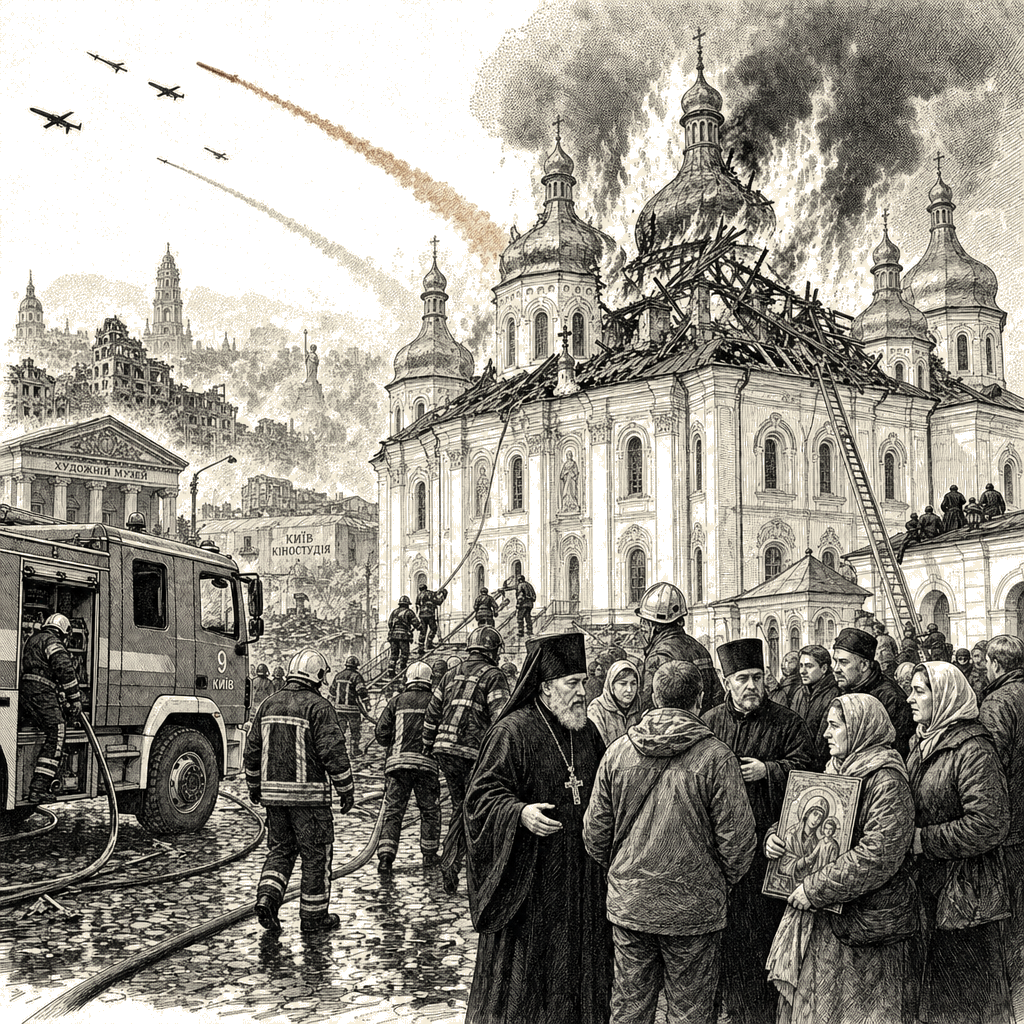
Russia bombed the Dormition Cathedral at the Kyiv Monastery of the Caves, one of Eastern Orthodoxy’s holiest sites. The Monday night missile-and-drone attack set the eleventh-century roof ablaze, reducing ancient timbers to charcoal as the sky glowed orange over the monastery complex. President Zelensky climbed to the roof alongside Prime Minister Yulia Svyrydenko and photographed twisted metal and charred wood against the morning sky. He called it “an attack on the Christian community and on the cultural heritage of humanity.” The Russian Defense Ministry claimed, without offering evidence, that an American Patriot missile had struck the cathedral during a Russian barrage.
The Monastery of the Caves is not merely a building. It is the Kiev Pechersk Lavra, a cave monastery founded in 1051, the birthplace of Eastern Slavic monasticism. For nearly a thousand years, pilgrims have descended into its candle-lit catacombs, seeking the God who makes his home in the darkness. The complex has survived Mongol invasion in 1240, a Golden Horde burning in 1416, the Second World War, and decades of Soviet suppression. Its Dormition Cathedral was destroyed by retreating Soviet forces in 1941 and rebuilt. Now Russian missiles have torn through its roof. To bomb it is to strike at the heart of Orthodox Christian memory. And then, with the smoke still rising, the perpetrator lied. It said an American Patriot did it.
The facts of the strike are documented. Russia fired 70 missiles and 611 drones at Ukraine between Sunday evening and Monday morning. Ukraine says it downed 50 missiles and 582 drones. Eleven people were killed, including four rescue workers in Kharkiv who died in what Ukrainian officials described as a double-tap strike—an initial attack followed by a second wave timed to hit first responders, a tactic confirmed by the Kyiv Independent and multiple international outlets. An art museum in Kharkiv was damaged. Film studios in Kyiv housing 100,000 costumes were struck. Ukraine’s security services published photographs of what they said was debris from a Russian explosive drone. The barrage was consistent with an escalating pattern of mass Russian strikes in recent weeks as Ukraine’s military has largely halted Russian advances on the front lines.
This is not merely a war crime. It is a desecration of a holy place, followed by bearing false witness against one’s neighbor.
The Russian state has spent years presenting itself as the defender of traditional Christian values against a godless West. Patriarch Kirill of Moscow has blessed the invasion of Ukraine as a “metaphysical” struggle to protect the faith. But you cannot bomb a cathedral and claim to defend Christianity. You cannot set fire to the house of God and pretend you are saving souls. The text you invoke is clear: “My house shall be called a house of prayer” (Matthew 21:13). Jesus, entering the Temple, drove out the money-changers and the dove-sellers, but he did not set it ablaze. He wept over Jerusalem, not over its destruction by his own hand. The one who destroys the sanctuary reveals that he is not the shepherd but the wolf.
The prophet Amos spoke God’s judgment against Damascus and the Ammonites: they “threshed Gilead with threshing sledges of iron” and “ripped open pregnant women in Gilead” (Amos 1:3, 13). He did not spare Israel. What would he say to a power that bombs a monastery, kills rescue workers with a double-tap strike, and then blames the victim? I do not need to guess; the text is plain. “For three transgressions of Russia, and for four, I will not revoke the punishment.” The Lord requires justice, not a counterfeit piety that masks atrocity.
The competing attributions—Russian drone versus American Patriot missile—are analytically separable from the question of what actually struck the cathedral. The Russian claim may function as a cover story. It may also function as a signal to domestic audiences, a probe of Western media’s verification reflexes, or a pre-positioned narrative for future escalation—each function operating independently of whether the claim is true. Examining the Russian attribution as a multi-functional information operation, rather than simply dismissing it as a lie, reveals more about how Russia’s narrative machinery works in the pattern it has refined over months of mass strikes than about what hit the roof. The pattern is consistent enough that the attribution claim itself has become a data point: Russia’s immediate need to explain away the cathedral damage suggests an awareness that the damage carries consequences the usual strikes on apartment buildings and industrial targets do not.
France’s foreign minister compared the attack to bombing Notre-Dame. Metropolitan Epifaniy, leader of the Orthodox Church of Ukraine, called for prayers and labeled the damage “another Russian crime against humanity, against history, against Christianity.” Within hours, the cathedral’s burning had become a symbol deployed for maximum diplomatic and emotional effect. Whether the cathedral was the target or the collateral, Russia’s response—the Patriot attribution, the denial, the blame-shifting—follows a pattern in which every mass strike produces a counter-narrative that displaces responsibility.
We in the West—and I include my own country, my own church—have our own ledger of bombed cathedrals and desecrated shrines. The United States has dropped bombs on churches; the Crusaders sacked Constantinople. I am a veteran of a war that destroyed mosques and killed the innocent. None of that excuses what Russia did at the Monastery of the Caves. The evil is evil, whether it wears a uniform or a cassock. But our complicity means we cannot speak from a high horse; we can only call this what it is: a sin against God and humanity.
I say to the Russian leadership, as the prophet Nathan said to King David: “You are the man” (2 Samuel 12:7). You bombed a holy place. You lied about it. The door of repentance is open, but you must walk through it, and the path begins with the truth. The cathedral will be rebuilt, as it was after the Nazis. The Church is not the stones—it is the people who gather to pray. Yet the crime is not erased by reconstruction, and the lie will stand until the liar repents.
Metropolitan Epifaniy’s call for prayers was not a call for a settled interpretation. It was a call for the cathedral’s survival—which the site’s own history suggests is more probable than its permanent destruction, though that same history teaches that each rebuilding carries forward the scars of what was lost.
Tonight I will pray for the monks of the Lavra, for the dead in Kharkiv, and for the Ukrainian people who have endured this relentless bombardment. I will pray that the God who heard the cries of the Israelites under Pharaoh’s whip hears the cries of Ukraine. And I will pray, with fear and trembling, for the repentance of those who have made themselves enemies of Christ while wearing his cross.