
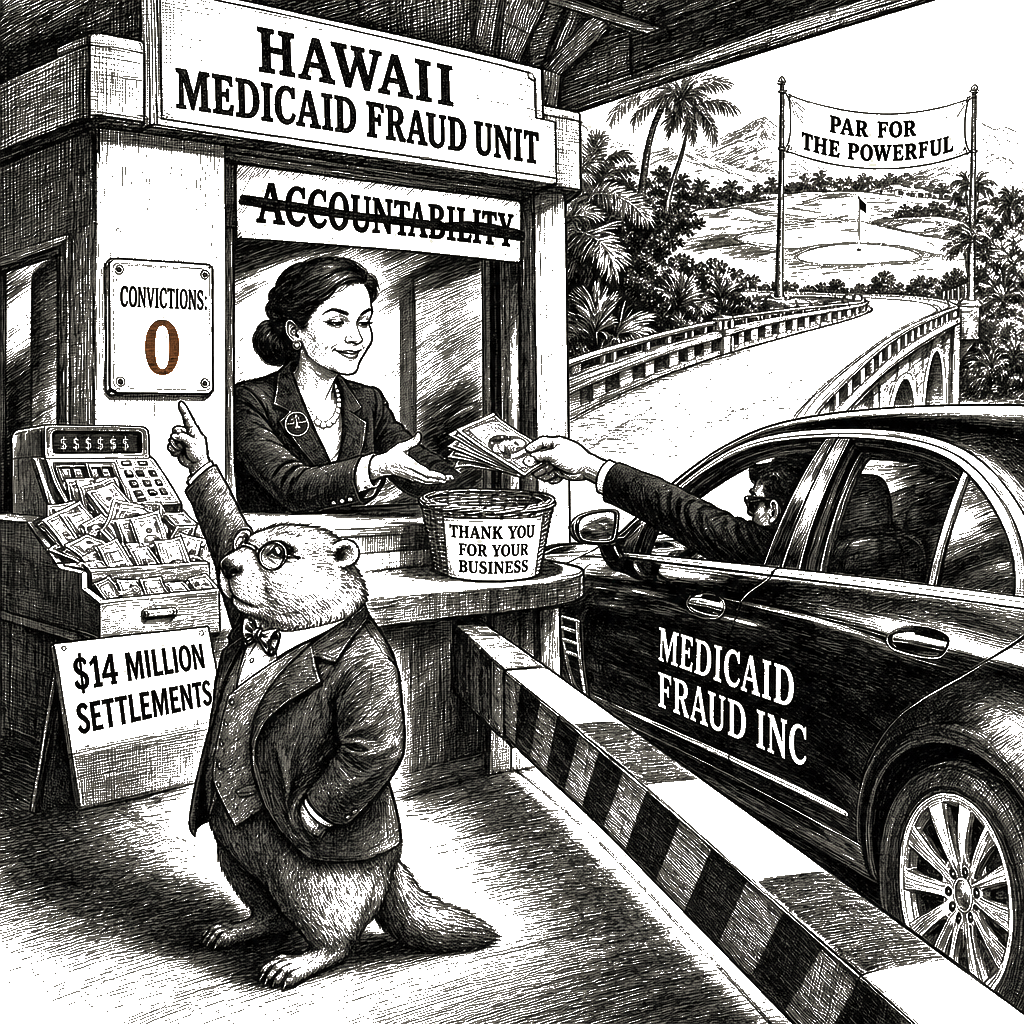
Vice President JD Vance said in mid‑May that Hawaii had gone four years without a single Medicaid fraud conviction and accused the state of giving crooks “free rein.” Attorney General Anne Lopez fired back with a written statement: “We welcome accountability, but we will not allow the work of this unit to be mischaracterized as doing nothing.” The unit’s proof of work, offered in its own defense, was $14 million in settlements. Roughly $13 million of that came from one case that was already a decade old when it finally closed in 2023. So the “work” was one old settlement inherited from the last administration, and the convictions are still zero. The Vice President had the arithmetic right.
The Associated Press and Honolulu Civil Beat examined the figure. The AG’s office has not provided a breakdown of how many cases the unit opened, closed, or referred for prosecution during the four years in question. It has not said whether the zero‑conviction record reflects cases that produced no charges or cases that are still “under investigation.” The work has been defended with a number, not a docket. That is the tell. A dollar figure is not a record of work; it is a number. When the number is the answer to the question of who has been held accountable, the number is an alibi for the absence of accountability.
The settlement collectors know the trick because they watched the federal government run it for decades. The settlement is the shape white‑collar enforcement takes when the enforcer doesn’t want to enforce: a check from a corporate treasury, a press release with a large number, no admission of wrongdoing, and nobody on the dock. The state gets to claim it secured $14 million without having to prove a case in court. The entity that wrote the check treats it as a cost of doing business — cheaper than a trial, cheaper than a conviction, cheaper than changing the conduct that produced the fraud in the first place. The unit’s business was supposed to be putting crooks in front of a jury, and in four years it didn’t do that once.
I have watched this play since the savings‑and‑loan crisis of the late 1980s, when more than a thousand executives actually went to prison. Wells Fargo opened millions of unauthorized accounts and the $3 billion deferred‑prosecution agreement said, on its own page, it was reached “with the bank itself, not with any individuals responsible for the fraud.” HSBC laundered money for Mexican drug cartels and sanctioned regimes, admitted the violations, and paid $1.9 billion. No individuals were prosecuted. Senator Charles Grassley said the bank “has quite literally purchased a get‑out‑of‑jail‑free card.” Purdue Pharma pleaded guilty twice over its OxyContin marketing; the Sacklers, who extracted billions, were never criminally charged. General Motors knew its ignition switch was deadly for a decade and paid $900 million; one hundred twenty‑four people died; no individual was charged. The settlement is the get‑out‑of‑the‑docket‑free card for the powerful, and now a state anti‑fraud unit is wielding it as proof of diligence.
The Hawaii Medicaid fraud unit is the latest docket decorator to run the same play. The pattern is not new: Vance has spent the spring putting states on the same hot seat — Ohio, Minnesota, and now Hawaii — and the under‑enforcers have produced the same alibi in each. The mechanic is identical. Present the dollar volume, decline to present the convictions, and call the silence accountability. A press release that reads like a quarterly earnings call — top‑line number, no unit cost, no breakdown, and an earnest request that you stop looking at the bottom line.
The people on the other end of that alibi are Hawaii’s Medicaid recipients. Their benefits are paid for with their neighbors’ taxes and stolen by the fraud the unit was built to chase. They are the ones the law is supposed to bind the fraud against, and against whom, by this record, the law has not been moved. Lopez’s office owes the public a different figure: open cases, referred cases, charges, convictions, or a stated reason for their absence. Anything else is dollar volume as a substitute for the work. Call it what it is. The unit didn’t catch a fraudster and make him face a judge. It collected a toll on a bridge someone else built. Four years, zero convictions. The work speaks for itself.