
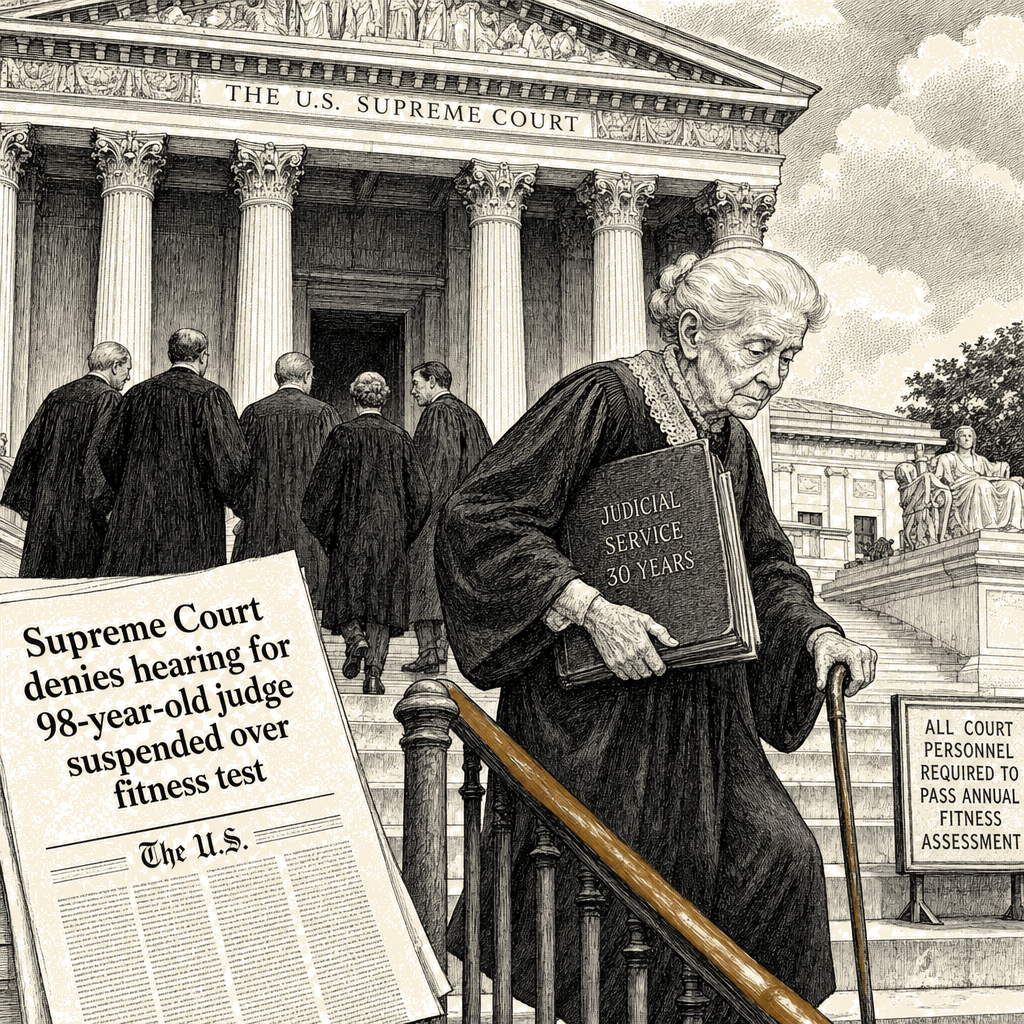
The Supreme Court is helping the Federal Circuit force a 99-year-old judge off the bench without due process. On Monday the Court declined to hear Judge Pauline Newman’s appeal from an indefinite suspension that has now lasted three years. There was no explanation. There is now no external review.
Pauline Newman has been on the federal appellate bench since 1984, appointed by Ronald Reagan. She is the oldest active federal judge. She has written more than three hundred dissenting opinions—earned the title “the Great Dissenter.” She turns ninety-nine this week. She has not been permitted to take a new case since September 2023.
The process began after Newman experienced health incidents in 2021. She fainted following an argument and was unable to walk. Chief Judge Kimberly Moore initiated the internal machinery. Moore and a two-judge special committee ordered Newman to submit to neurological and neuropsychological testing and to surrender medical records. Newman provided expert reports from two physicians attesting to her fitness. The committee rejected those reports and recommended that she be suspended. The full Federal Circuit approved the suspension in September 2023. Newman refused to submit to the neurological testing she argues was constitutionally unauthorized. For that refusal—for insisting that her colleagues were not entitled to dictate the terms of her examination—she has been barred from the bench ever since. Moore told her she could retire or take senior status.
Newman has had no adjudicatory hearing, no cross-examination of her accusers, no neutral fact-finder. Her petition to the Supreme Court, as reported by UPI, argued that the case “presents questions concerning crucial constitutional and statutory aspects of lifetime tenure and judicial independence, especially the availability of judicial review for intra-branch infringements on judicial service.” The Court declined to answer. That refusal is itself the most significant event in this case, because it means the Federal Circuit’s internal discipline process is now unreviewable from outside. The Federal Circuit decides, the Federal Circuit suspends, and the Federal Circuit is the only tribunal that could reverse itself. The Court’s silence makes that arrangement permanent.
Some will call this responsible self-governance—a court protecting litigants from an impaired colleague. That reading collapses the moment you ask whether any independent tribunal checked the committee’s work. None did. No independent medical expert evaluated Newman outside the institution’s own process. No judge on any other court examined whether the rejection of her two expert reports was justified. The Federal Circuit’s internal committee reviewed, the Federal Circuit’s internal court approved, and no external tribunal reviewed the decision at any stage. Lifetime tenure under Article III means a judge cannot be removed except by impeachment. Indefinite suspension without external review is not impeachment. It is something else entirely—something the Constitution does not name and no court has examined.
The comparison to other judicial discipline cases exposes the system’s operating logic. As this publication has reported, a federal judge caught having sex in his chambers with a subordinate and lying about it under oath received a private reprimand. Newman, who submitted two expert medical reports and refused testing she argued was unconstitutional, faces indefinite removal from the bench with no path to reinstatement except the approval of the colleagues who removed her. Meanwhile, as this publication reported, the government actively intervenes in judicial conduct when it chooses—at this moment the Justice Department is demanding that a federal judge recuse from a Georgia election case. The machinery of judicial accountability operates when the institutions with power find it useful. It does not operate for a ninety-nine-year-old judge whose colleagues want her off the bench.
And so the pattern holds: the federal judiciary will shield its own when the offense is moral and embarrassing; when the offense is being old and inconvenient, and especially when the target is a notorious dissenter who has spent a career disagreeing with her colleagues in published opinions, it will close ranks and purge her. By refusing to hear the case, the Supreme Court ensures that this purge proceeds without a single outside court ever examining its constitutional defects. The Federal Circuit’s procedure—chief judge initiates, internal committee investigates, court votes to suspend, no external court reviews—is now the last word on intra-branch judicial fitness. Without external review, the stated reason for a suspension is unverifiable. The institution’s discretion is the institution’s accountability. Newman’s suspension is indefinite, renewable, and built on a process that would not survive a minute of independent review. The Supreme Court has seen to it that no such review will occur.