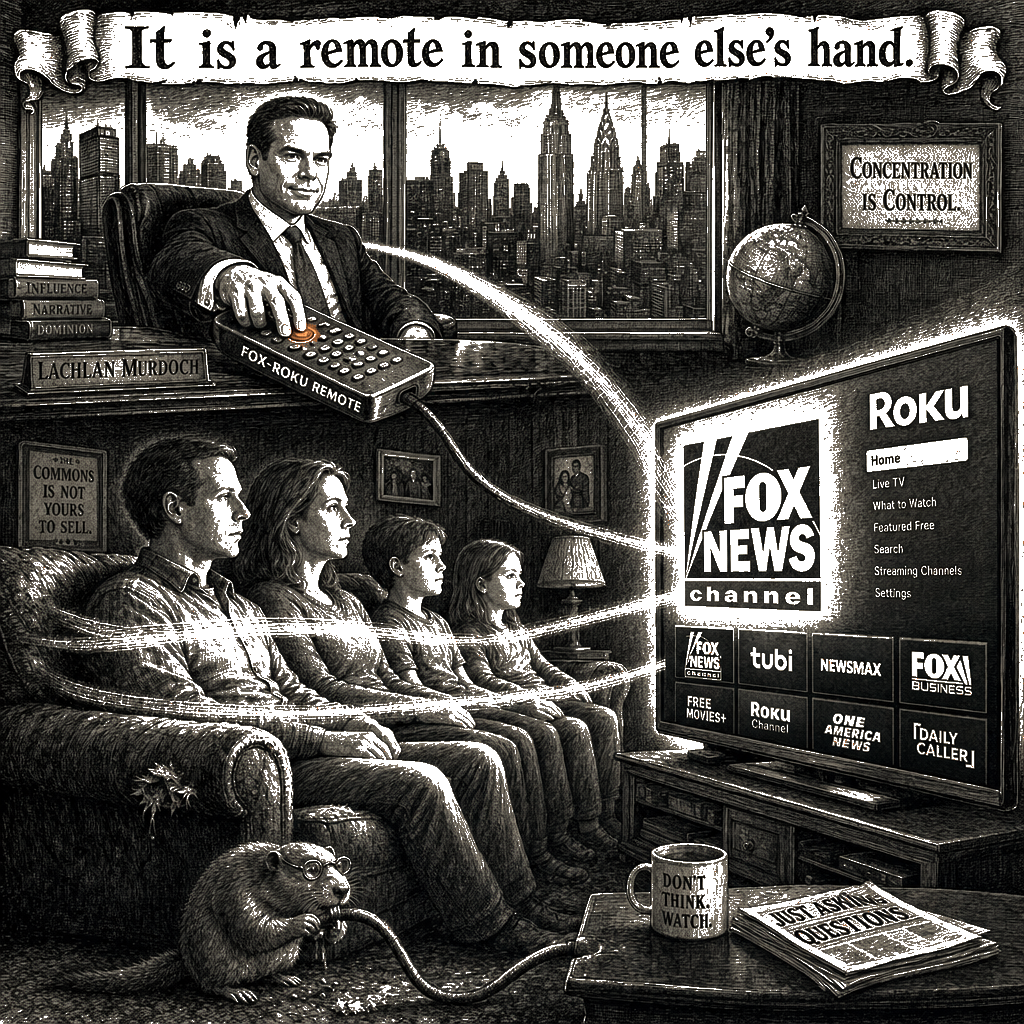
Fox—the network that built its political identity on the language of local control, heartland values, and suspicion of concentrated government power—has swallowed Roku for $22 billion, creating the third-largest viewing bloc in American television, the Journal reports. More than a hundred million households worldwide now stream through a device whose corporate parent sits in a Manhattan tower, answerable to a single family. Even as one Murdoch son is busy buying prestige magazines, the other has just bought the hardware that delivers the masses their news, their sports, their entertainment. This is what your movement now means by free markets.
The deal has a cold commercial logic. Fox owns the live sports and the opinion programming people still watch; Roku owns the operating system on the screen. Both face the same existential threat—Amazon and Apple are becoming the gatekeepers of everything, and a combined Fox-Roku has marginally more leverage against the behemoths—the same dynamic that drove the consolidation of HBO Max and Paramount+ earlier this year. If you think of media purely as a commodity to be bundled and sold, a set of cash flows to be optimized, this is a defensible move. Anthony Wood gets a board seat, Lachlan Murdoch gets a distribution pipe, and the shareholder class gets a consolidation premium.
But that is precisely the problem. The conservative tradition was supposed to be suspicious of bigness. Louis Brandeis, no conservative, called concentrated economic power a curse—and the insight belongs to no party. The distributists—Belloc and Chesterton—argued that concentrated ownership, whether in the state or in a boardroom, was the same disease wearing different coats. Subsidiarity, the principle that decisions belong at the lowest competent level, was meant to keep power from accumulating in distant hands that would never bear the consequences of their own choices. The family, the town, the small proprietor, the newspaper that knew its readers by name—these were the mediating institutions that stood between the individual and the mass, and conservatism’s historic mission was to defend them.
What does it say, then, that the foremost purveyors of that rhetoric have spent three decades consolidating the very thing they claimed to oppose? The local television station, once the jewel of civic life in a hundred communities, was absorbed into a national chain. The newspaper that covered the school board and the county fair was bought by a hedge fund, stripped for parts, and left to die. And now the screen through which every remaining fragment of public life is filtered—the Roku on the kitchen counter, the Fox app on the home screen—belongs to a single corporation whose chairman will never set foot in Friendship, Wisconsin, or any of the thousand other towns whose attention he has just purchased in a single morning. The device is not just a commodity; it is the commons of the twenty-first century, the place where we encounter our neighbors, our arguments, our weather, our shared stories. And it has been enclosed.
I have watched this consolidation happen from a county that lost its own robust local press decades ago. The Adams-Friendship Times-Reporter still exists, but it is a shadow of the institution that once covered the school board, the county fair, the farm co-op, and the legion hall with independent vigor. What fills the gap, for most of my neighbors, is a stream of content curated by an algorithm owned by a conglomerate that answers to no one in this county. That is not a failure of technology; it is a choice about ownership. And the Fox-Roku deal is simply the latest and largest affirmation of that choice.
Irony of ironies: the Murdoch family once understood the value of the particular. You can still find old-timers who remember when a Murdoch paper, before it became a global brand, was a noisy, vivid, irreverent local rag that covered the docks and the pubs and the police court with a kind of rough affection. That instinct was genuine, and it was built on proximity. But proximity does not scale, and scale is what the market rewards. So the logic of the deal was baked into the system decades ago, and no number of “heartland” editorials could halt it. What you subsidize, you get more of; what you reward, you get. We have rewarded bigness, and we have gotten a country in which more than a hundred million living rooms worldwide answer to a single remote.
The constructive answer, as it always was, begins with ownership. Not the state. Not the conglomerate. The cooperative. The credit union. The mutual. The same principle that electrified rural America through member-owned co-ops—a model I know intimately, because the Adams-Columbia Electric Cooperative, headquartered right here in Friendship, is one of the largest rural electric co-ops in the state—can underwrite local journalism, local broadband, and local content platforms. One member, one vote. Surplus returned to the members, not extracted for shareholders. Decisions made by a board that lives in the same county as the people it serves. That is not a fantasy; it is the Rochdale Principles, tested for nearly two centuries, and it works wherever human beings are willing to govern their own affairs.
A streaming platform run as a cooperative would be smaller than Roku. It would have fewer shows, a lower stock price—zero—and less political influence in Washington. But it would be owned by the people who use it. It would answer to them, not to a family in Manhattan. That is the conservative answer to consolidation—not to capture the big thing and run it better, but to disperse the power so the big thing cannot exist. Conserve the small. Build the local. Own what you use. Anything else is just branding. Brandeis is dead, but the curse he named is not—and it arrives in a Fox-branded box that asks for nothing but a wi-fi password. The screen on your wall is not just a screen anymore. It is a remote in someone else’s hand, and you are what is being changed.