
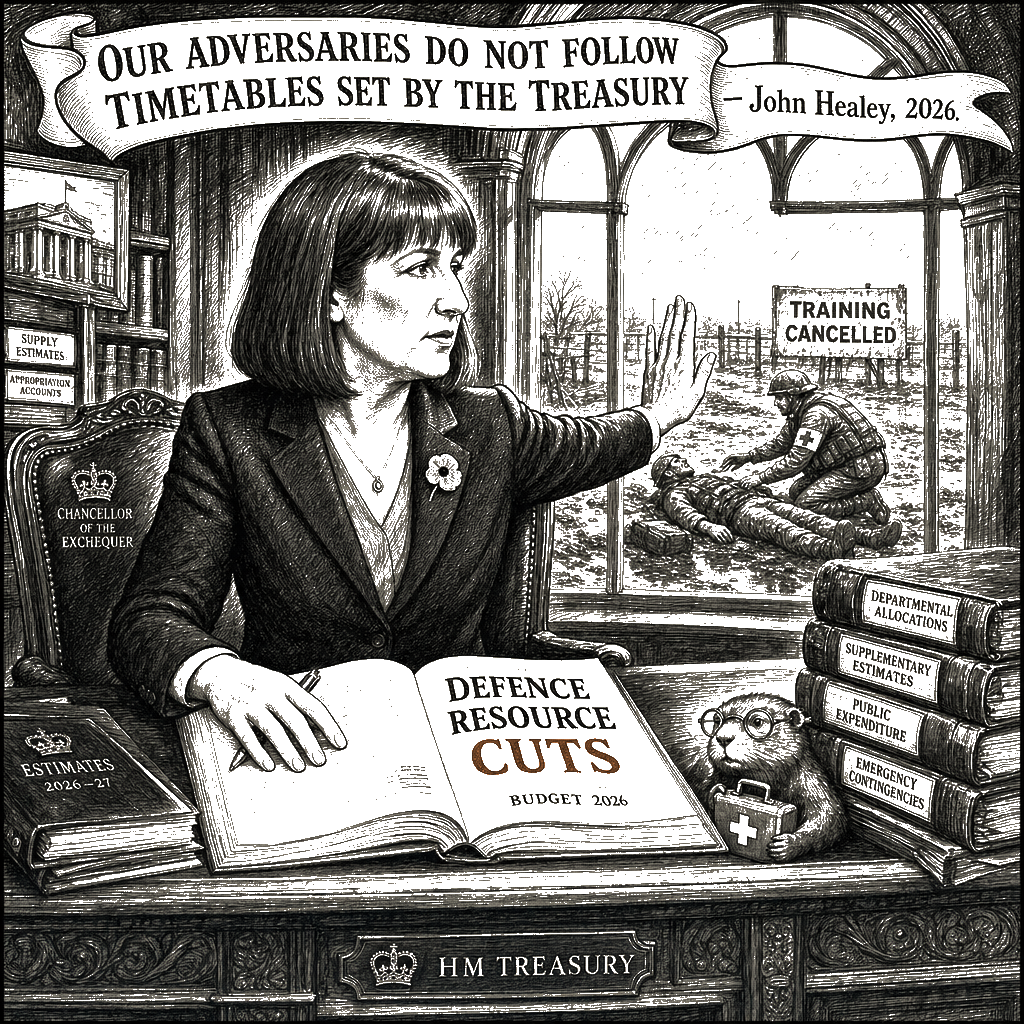
Rachel Reeves and Keir Starmer are gambling with the lives of British soldiers. Not in some future war. Not in a hypothetical crisis. Right now, while Russia is fighting a land war on the continent and British forces are supposed to be ready to meet it, the Treasury is deliberately defunding the training and day-to-day operations that make them fit to fight.
I have run an auto-repair shop long enough to know what happens when you stop putting money into day-to-day operations. The equipment doesn’t stay sharp. The people don’t stay trained. And when a job demands everything they have, someone gets hurt — not because the crew didn’t care, but because the owner decided the short-term savings were worth the long-term risk. The Starmer government is making the same decision with Her Majesty’s armed forces, only the long-term risk is measured in casualties, not missed appointments.
Air Chief Marshal Sir Richard Knighton, the UK’s chief of defence staff, told the Lords International Relations and Defence Committee this week that the government’s Defence Investment Plan does not include enough resource funding to sustain day-to-day military activities. “We will have to dial back our activities and our exercise and operational activity if the level of resource funding that’s available to us does not increase,” he said. That is the serving chief of a nuclear-armed NATO power telling Parliament that his own government’s budget will degrade the readiness of the forces he commands. This is not a retired general writing a column. This is the man who carries the responsibility.
John Healey resigned as defence secretary last week rather than put his name to a plan he said would “reduce the readiness of our Forces and increase the risk to personnel on operations.” Armed forces minister Al Carns followed him out the door, calling the planned investment “inadequate to the task” of defending the country. Two senior defence officials, gone in the same week, each saying the same thing in plain English: this government will not pay for the readiness it has promised its allies it will maintain.
The prime minister says defence spending is rising from 2.3 per cent of GDP to 2.6 per cent. Britain has committed to 3.5 per cent by 2035. Healey, in his Commons resignation statement, laid out the gap: the ten-year plan delivers a rise of just 0.08 per cent a year between now and 2030, effectively flat in real terms, with the heavy increases backloaded into the final five years. “Our adversaries do not follow timetables set by the Treasury,” Healey told Parliament. Russia is fighting now. The plan front-loads austerity and back-loads readiness on the assumption that the threat will wait. Sun Tzu wrote in The Art of War that “There is no instance of a country having benefited from prolonged warfare.” The Defence Investment Plan bets on prolonging underfunding until safety arrives later. It is the exact opposite of the principle.
Carns, in his departure, identified the doctrinal failure: the plan is too focused on traditional defence hardware and pays too little attention to drone warfare. Ukraine is the laboratory for the next war. Low-cost FPV drones are destroying armoured vehicles worth millions. Both sides are fielding autonomous systems at a scale Western planners did not anticipate. Carns’s warning, from the man who quit over it, means the plan is still buying platforms from the last war while the next war is being fought in front of every parliament in Europe. That is not a complaint about the budget. It is a failure of doctrine.
And the NATO context sharpens the embarrassment. By 2030, well over half of NATO members will be spending 3 per cent or more of GDP on defence. Poland is pushing toward 4-5 per cent, the most substantial individual European buildup in a generation. Germany declared its Zeitenwende in 2022 and backed it with a hundred-billion-euro special fund. Britain, at 2.6 per cent, will sit below the alliance average by the end of the decade. The country that once led the alliance is falling behind allies who recalibrated to the Russian threat faster than the Treasury would permit.
Eisenhower, in his farewell address sixty-five years ago, called for “an alert and knowledgeable citizenry” to compel “the proper meshing of the huge industrial and military machinery of defence with our peaceful methods and goals, so that security and liberty may prosper together.” He warned against both excesses — too much spent on arms, and too little. A government that starves readiness in the face of a threat has miscalculated that meshing just as thoroughly as one that overspends. But there is a specific distortion Eisenhower’s address anticipated: when budgets tighten, the procurement pipeline that serves industry and institutional prestige gets protected, while the flight hours, the live-fire exercises, and the maintenance that keep soldiers alive get cut. Britain has its own military-industrial complex, and right now the boring business of training human beings is the line item that is bleeding.
The prime minister, speaking from the G7 summit in France, said the new defence secretary is “reading in” and that the budget will deliver “capability for the future.” Every soldier and Royal Marine in the United Kingdom understands what that means. Future capability is a promise written on a Treasury spreadsheet. A training schedule cancelled this autumn is a gap in readiness that cannot be recovered by a funding line that lands in 2029. Adversaries, as Healey told Parliament, do not follow timetables set by the Treasury.
When the accounting is finally done — after an operation that goes wrong because a crew had not practised the right drill, after an engagement that falls apart because a unit had not exercised with the equipment it was given — the ledger will not be written in pounds sterling. It will be written in the names of the men and women who paid for the budget’s backloading with their lives. That is not a risk the chancellor should be willing to take.