The Supreme Court’s recent invocations of a “colorblind Constitution”—deployed to dismantle affirmative action in college admissions, to narrow voting-rights protections, and to constrain redistricting—represent a steady campaign to hollow out civil-rights law from the inside. The latest front is employment, where the Justice Department is now trying to finish the job. In a recent opinion, the Office of Legal Counsel told the Equal Employment Opportunity Commission that its long-standing enforcement of “disparate impact” liability is unconstitutional. The OLC’s message to employers is simple: discriminatory results are permitted unless someone can prove that a company’s executives were intentionally racist.
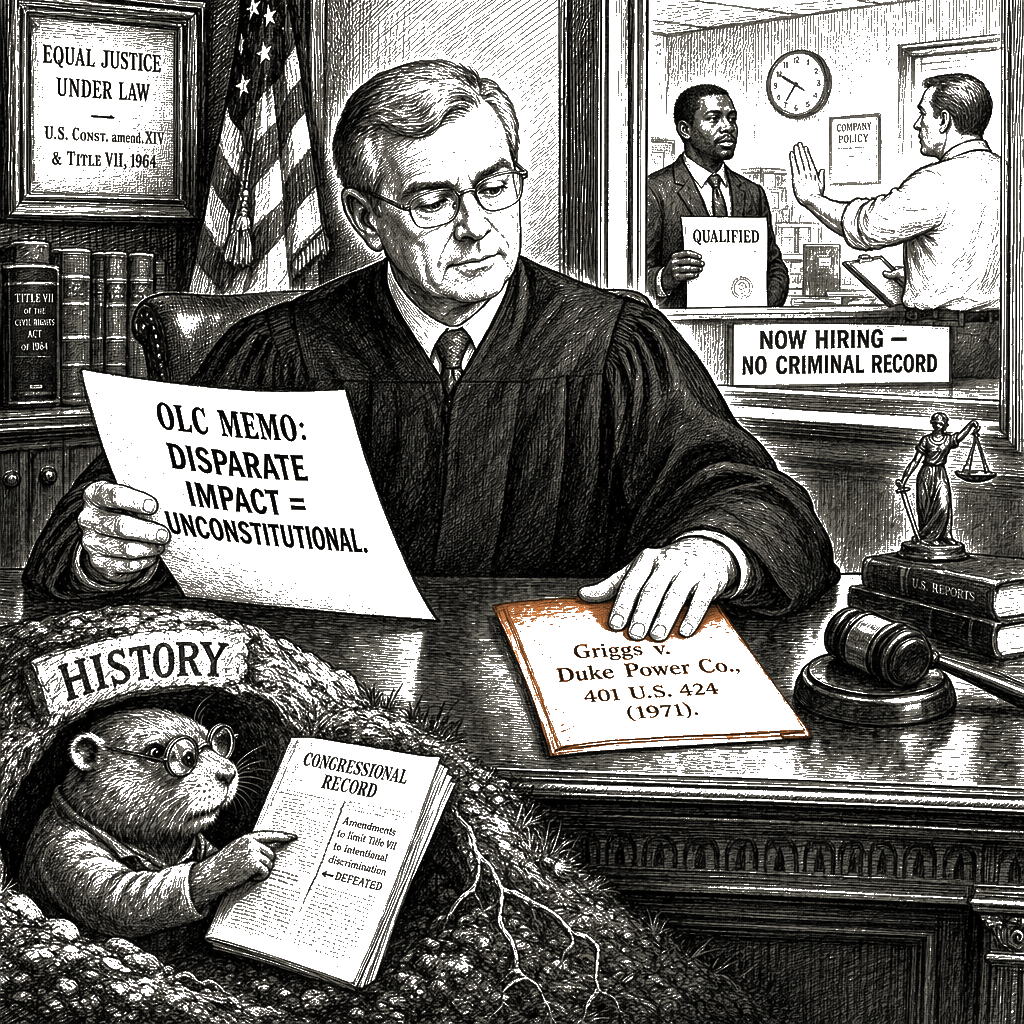
That is an attack on the single most effective tool the civil-rights era ever forged. In 1971, an 8-0 Supreme Court held in Griggs v. Duke Power that Title VII does not merely prohibit overt discrimination. “The Act proscribes not only overt discrimination,” Chief Justice Burger wrote, “but also practices that are fair in form, but discriminatory in operation.” The facts of that case laid bare the dynamic: Duke Power had openly segregated its workforce for decades. The very day the Civil Rights Act took effect, the company swapped the Jim Crow signs for aptitude tests that bore no demonstrated relationship to job performance, locking Black workers into the lowest-paying jobs with a new, genteel form of exclusion. The Court, Burger explained, was carrying out Congress’s command: “The Act requires the elimination of artificial, arbitrary, and unnecessary barriers to employment that operate invidiously to discriminate on the basis of race.” Senator Hubert Humphrey, the bill’s floor manager, had defended Title VII on the Senate floor against amendments that would have limited it to cases of provable intentional discrimination, and those amendments were defeated. The question Congress answered was not whether an employer meant to discriminate. It was whether an employer could maintain the appearance of fairness while perpetuating racial exclusion. The answer was no. For fifty-five years, Griggs has been settled law, upheld again and again because Congress meant what it said. Its standard asks whether a practice is necessary for job performance—not whether a human-resources memo contains a racial slur.
The OLC’s opinion aims to dismantle that framework entirely. It complains that disparate impact “functions as a qualified racial-proportionality mandate and spurs employers to engage in race-based decisionmaking to avoid liability.” That is not a flaw. It is the entire purpose of civil-rights law. If a business finally changes its hiring practices to ensure Black and brown workers get a fair shot because it understands that liability for discriminatory outcomes is real, it is not engaged in what Chief Justice John Roberts once called “sordid business.” It is ending the genuinely sordid business of excluding qualified people based on race. To borrow Roberts’ own phrase, it is not “sordid business” to divvy up employees by race when the result is a workforce that looks like America.
The OLC then proceeds to gut the standard for proving that a discriminatory policy serves a legitimate business purpose. “Only irrational or arbitrary practices with no plausible job-relatedness can create disparate-impact liability,” the opinion declares. It goes on to list practices that it says are “presumptively job-related”: background checks, aptitude tests, knowledge-based tests, SAT scores, high-school graduation requirements, even blind auditions. Under this rule, every common tool of exclusion—background checks that disproportionately exclude Black applicants, aptitude tests whose connection to actual job performance the OLC simply assumes, degree requirements that lock out people who couldn’t afford college—would be presumptively immune from challenge. That is not a corrective. It is a blank check for discrimination.
The OLC specifically attacks EEOC guidance that warns employers against blanket bans on people with certain criminal records, given that such bans disproportionately exclude Black and Latino workers and have no demonstrated ability to predict job performance. The OLC says companies deserve more leeway. What they actually deserve is a license to perpetuate the stigma of mass incarceration across every job application in America.
The OLC claims to ground this assault in the Supreme Court’s recent voting-rights precedent, Louisiana v. Callais, where a 6-3 majority held that Section 2 of the Voting Rights Act requires “a strong inference that intentional discrimination occurred.” Writing for the Court, Justice Alito applied the Fifteenth Amendment’s command against intentional racial discrimination in voting. The OLC now argues that the same standard must govern employment: no liability unless you can prove the company’s executives acted with racist intent. That is a legal non sequitur. Congress wrote separate statutes for voting rights and employment discrimination for a reason—the domains have different histories, different structures, and different remedies. The OLC’s gambit is not an extension of Callais. It is an attempt to convert disparate impact from a results-based standard into an intent-only standard, gutting Griggs in the process.
That is how discrimination actually works—not by a CEO’s confession, but by institutions adopting policies that are fair on the surface and exclusionary in operation. A standard that can only catch the most incompetent bigot, the one foolish enough to state his purpose on the record, is a standard designed to fail.
The practical consequences fall on the Black and brown workers who will be screened out of jobs they are qualified to perform, with no recourse and no remedy. The attack on disparate impact is a disaster for the law and for the social compact it underwrites. The constitutional principle at stake is not whether the law should be colorblind. It is whether colorblindness is a shield for equality—or a weapon against it. Right now, the weapon is winning.