
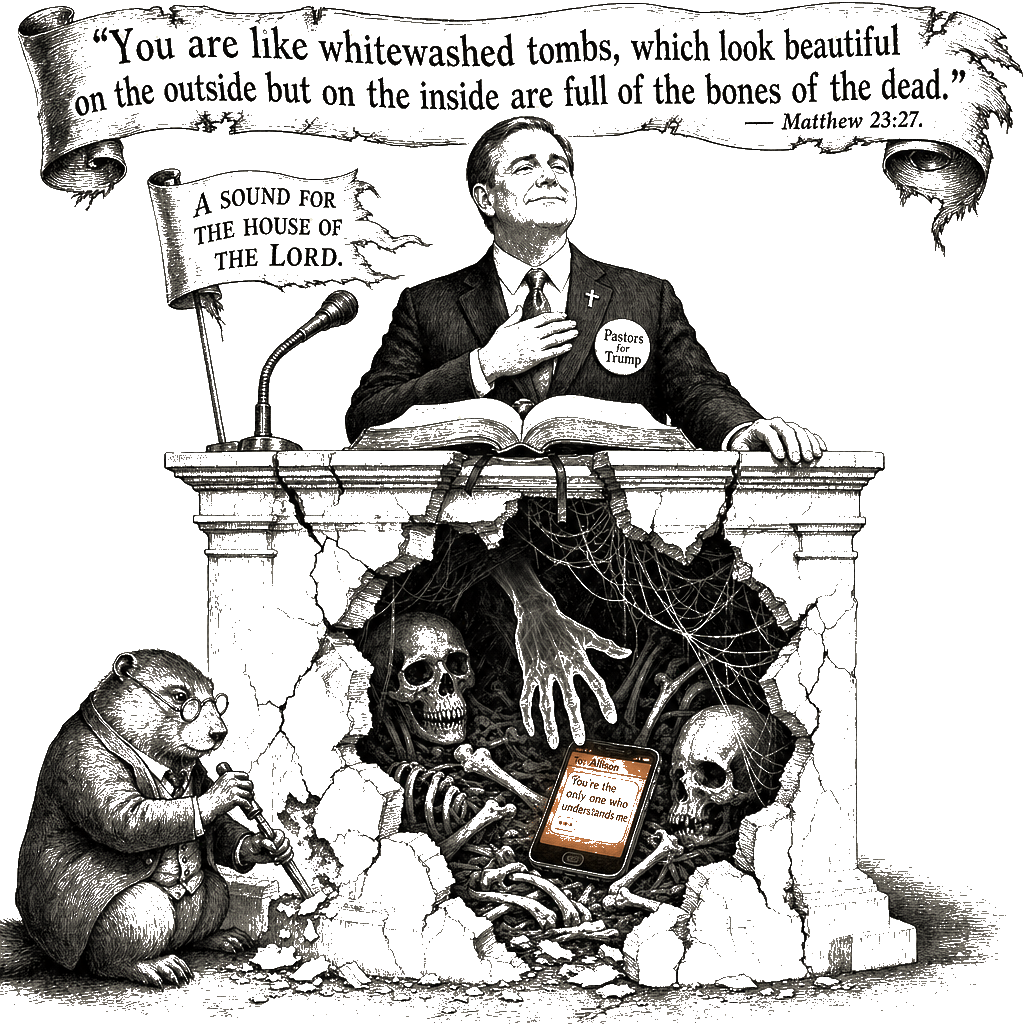
The Pastors for Trump apparatus discarded its founder the moment his private sin endangered his electability, and the 24-hour pivot from endorsing Jackson Lahmeyer to endorsing his runoff opponent is the receipt for what the Christian Nationalist movement actually believes about the biblical standards it claims to enforce.
The story arrived in Oklahoma last week in the order anyone who has watched this apparatus for any length of time would now expect. The British tabloid reported on Saturday that Jackson Lahmeyer — Republican candidate for the state’s 1st Congressional District, founder of Pastors for Trump, Trump’s endorsed man since early May — had sent intimate text messages to a former campaign fundraiser who was not his wife and who had once held the Miss Oklahoma USA title. On Sunday Lahmeyer called the report “distorted” and acknowledged the messages. On Wednesday afternoon, in a window measured not in days but in hours, Donald Trump shifted his endorsement to Lahmeyer’s runoff opponent Mark Tedford. Minutes later Lahmeyer suspended his campaign. The president’s statement was the statement that named the operation: “I appreciate Jackson Lahmeyer’s hard work under difficult circumstances… he has always been with me, and I will always be with him.” Then the pivot. “But… I will be supporting America First Patriot, Mark Tedford.” The architecture is familiar. In Kentucky this spring, Trump-backed Ed Gallrein defeated Thomas Massie in the GOP primary once the endorsement moved against the incumbent. The Lahmeyer withdrawal is the other face of the same architecture: when the endorsement moves against you, the campaign is over before the news cycle turns.
Lahmeyer’s own framing was the apparatus’s framing. “This matter was already dealt with privately between me and my wife, Kendra, through counsel and prayer with God and spiritual advisors,” he wrote. “I own crossing a boundary line through text messaging. I also ended all communication.” The cadence is engineered. It performs accountability in a register the Christian nationalist press office has spent a decade training its candidates to deploy. The accountability it performs is not the accountability the texts require. Let me show you what I mean.
“Woe to you, teachers of the law and Pharisees, you hypocrites! You are like whitewashed tombs, which look beautiful on the outside but on the inside are full of the bones of the dead and everything unclean. In the same way, on the outside you appear to people as righteous, but on the inside you are full of hypocrisy and wickedness.” That is Matthew 23:27-28, in the New International Version that sits open on my kitchen table.
I want to be plain about what Jesus is doing here, because for forty years the apparatus has told its readers the opposite. He says this to the most outwardly religious people of his day. He says it not because they are the worst sinners in the room — the Roman soldiers are right there, the tax collectors are right there, the sinners he keeps being criticized for eating with are right there — but because they are the most outwardly righteous while being inwardly corrupt. The tomb metaphor is the precise metaphor for the posture the text is naming. The tomb looks beautiful on the outside. On the inside it is full of bones.
The captured operation deploys this passage almost exclusively against its opponents. “Woe to you, Pharisees, you hypocrites” gets preached at secularists, theological liberals, mainstream Christians who refuse to endorse Donald Trump, Democrats, the deep state, and at any believer who has the temerity to read the passage differently than the operation’s press office reads it. The application is by tribe. The tribe that quotes Matthew 23 at the other tribe does not preach Matthew 23 at itself. When one of its own falls, a different apparatus is deployed — the “we’re all sinners” register, the “matter handled privately” register, the “I appreciate his hard work under difficult circumstances” register, the pivot. The whitewashed-tombs posture is precisely the posture Jesus is naming. The operation that performs righteousness most loudly is the operation Jesus is indicting most directly.
Now let me show you the other passage the operation has been quoting in the opposite direction. The passage that gives the operation its warrant for putting pastors into political office in the first place.
1 Timothy 3:1-7 and Titus 1:5-9 are the pastoral-qualifications passages. They say that an elder must be “above reproach,” “the husband of but one wife,” “temperate,” “self-controlled,” “respectable,” “not given to drunkenness,” “not violent but gentle,” “not quarrelsome,” “not a lover of money.” Titus widens the list: a bishop is to be “blameless — not overindulgent, not quick-tempered, not given to drunkenness, not violent, not greedy for gain, but a lover of hospitality, a lover of good, self-controlled, upright, holy, and disciplined.” Pastors for Trump — the very name — is built on the claim that clergy who meet these qualifications have standing to govern. The Lahmeyer campaign was the working-out of that claim. A pastor who said he met these qualifications, running for Congress on the warrant of having met them.
The texts do not stop at the qualifications. 1 Timothy 3:6 warns that an elder “must not be a recent convert, or he may become conceited and fall under the same judgment as the devil.” Titus 1:6 requires that elders be “blameless” — the same word, the same standard — and the surrounding verses make clear the test is the man’s actual life, not his public statement. When a man fails the test, the texts require removal from office and a period of testing before reinstatement. 1 Timothy 5:19-20: “Do not entertain an accusation against an elder unless it is brought by two or three witnesses. But those elders who are sinning you are to reprove before everyone, so that the others may take warning.”
The apparatus delivered removal. It delivered it inside twenty-four hours of the news cycle breaking in the wrong direction. But it delivered removal for the wrong reason and through the wrong process. The texts require removal because the man has disqualified himself from the office he claimed under biblical warrant; the apparatus delivered removal because the man had become electorally inconvenient. The texts require removal to be public, with witnesses, as a warning to the others; the apparatus delivered removal through a Truth Social post and a campaign suspension notice, with the elder’s honor preserved and his relationship to the president maintained — “I will always be with him.” The texts require the removed elder to be tested before reinstatement; the apparatus retains him in the inner circle on his own self-report. “I also ended all communication.”
This is the chasm. The texts say one thing. The operation does another. The texts say the operation should have done the harder, slower, public, witness-bearing thing. The operation did the faster, easier, private, asset-preserving thing. The texts say the man should not have been running. The operation says the man was running fine until the British tabloid made it inconvenient.
Jackson Lahmeyer was not caught in an affair. He was caught in the specific act of sending intimate messages to a woman who was not his wife while running for Congress on a platform that the American government should be remade in the image of Christian moral order. The contradiction is not, as the campaign’s framing would have it, a private matter between a man and his wife that has been “dealt with through counsel and prayer with God and spiritual advisors.” The contradiction is that the candidate operated on the premise that his public theological project entitled him to claim jurisdiction over other people’s private lives — the lives of the women the Christian Nationalist movement’s policy apparatus targets, the lives of the LGBTQ Americans the movement’s legal architecture excludes, the lives of the immigrants the movement frames as threats to Christian civilization — while simultaneously operating on the premise that his own private conduct was off-limits to the same standards he was seeking to impose on everyone else. The movement’s theology is that public power serves private virtue. The candidate’s practice was that public power served private license.
The strongest defender of Lahmeyer will say that the Christian tradition has a theology of restoration: that David sinned gravely and repented and remained king, that private repentance suffices, and that demanding public humiliation is the performative righteousness of the Pharisees. Take that argument seriously — it is the best the movement has. But it collapses under the weight of the movement’s own public demands. The same movement that insists abortion providers be publicly shamed, that LGBTQ people be barred from public life, that immigrants be treated as threats to Christian civilization, wants its own candidates’ sexual misconduct treated as a private matter between the candidate and God. That asymmetry is not grace. It is power protecting its own. A theology that reserves private grace for the men who hold power while imposing public judgment on everyone else is not a theology of restoration; it is a theology of impunity.
The Daily Mail report is the kind of document that the movement’s apologists will call a hit job by a British tabloid, and Lahmeyer’s statement pre-writes that defense: the report was “distorted” and the tabloid “tried to paint me out in a way which is not the case.” But Lahmeyer also acknowledged sending the messages. He “own[ed] crossing a boundary line through text messaging.” The admission is in the statement. The act is conceded. What the movement wants voters to accept is that the conceded act and the public platform are in separate moral spheres — that the man who sent the intimate texts to the former Miss Oklahoma USA can still be the man who governs in the name of Christian moral order, and that the only question is whether the voters will let the project survive the man.
This is the same move the Christian Nationalist apparatus has been making for years. The project is always too important to let a single candidate’s moral failure stop it. The project is the Christian remaking of American government; the project is the restoration of biblical standards to public life; the project is the defense of the family, the defense of the unborn, the defense of religious liberty, the defense of the Christian nation. The candidate who fails to live up to the project’s standards is a distraction, a regrettable episode, a private matter handled with counsel and prayer. The project itself is never called into question by the candidate’s failure. The project is always larger than the man, and the man’s failure is always treated as a private incident rather than a public indictment of the project that produced him.
But the project keeps producing men who cannot keep their own vows, and at some point the pattern becomes the argument. Jackson Lahmeyer is not the first Christian Nationalist candidate to be caught in a contradiction between his public theology and his private sexual conduct. He is not the first Christian pastor running for Congress on a platform of biblical moral order to be revealed as a man who sent intimate text messages to a woman who was not his wife. He is the latest instance of a recurring type, and the type is what the movement is asking voters to ignore.
I have a name for this posture. I came out of this tradition. The posture is the one I was trained to perform before I read the texts for myself: deploy the moral authority of the office when the office is useful, retire the office when the office-holder becomes inconvenient, preserve the office-holder in the inner circle, and pivot the endorsement to the next viable candidate. The posture is older than Pastors for Trump. The posture runs through the Southern Baptist Convention’s 1971-1980 turn on abortion. In 1971 the SBC adopted a resolution calling for legislation to allow abortion under such conditions as rape, incest, clear evidence of severe fetal deformity, and carefully ascertained evidence of the likelihood of damage to the emotional, mental, and physical health of the mother; it reaffirmed the resolution in 1974. W.A. Criswell, then the denomination’s most prominent pastor, publicly affirmed that personhood begins at birth. By 1980, after the conservative resurgence had installed its first SBC president, the denomination adopted its first explicitly anti-abortion resolution. The texts had not changed between 1971 and 1980. The political utility had. The posture runs through the conservative resurgence, the Ethics & Religious Liberty Commission’s eventual departures, the 2022 Guidepost Solutions report’s documentation of the Executive Committee’s two-decade suppression of a list of approximately seven hundred named sexual-abuse offenders, the resolution-history that prioritized institutional liability over victim care. The pattern is: claim the moral authority, deploy it against the other tribe, and when one of your own falls, deploy a different apparatus.
And yes — let me name the symmetric-application check before the inbox fills with it. Graham Platner, a Democrat, won his Senate primary in Maine a week earlier through an extramarital sexting scandal of his own. Tony Gonzales, a Texas Republican, resigned in April after admitting an affair with an aide who later died by suicide. Eric Swalwell, a California Democrat, resigned at the same time amid sexual-misconduct allegations. The pattern is bipartisan; the operation is not. The Democratic Party does not put itself forward as the political vehicle of clergy who meet 1 Timothy 3. The Republican Party, through Pastors for Trump and its adjacent operations, does. So the analysis lands where the explicit biblical claim is being made. The bipartisan reality does not let the Christian nationalist operation off the hook; it puts the chasm in sharper relief, because the operation is the one that holds itself out as the operation governed by the texts.
I am writing to the woman in the Oklahoma church on Sunday who watched the headlines and wondered what to tell her women’s ministry group. She has been taught, as I was taught, that character is the test, that moral authority is the warrant, that the men who claim to govern on biblical ground must first be the men who live under the texts they cite. She is being told, in real time, by the apparatus she was taught to trust, that the test is not the test. That the apparatus’s retention of the man depends on the man’s political utility. That the biblical standard is invoked when convenient and suspended when inconvenient. She is being told that Matthew 23 is for the other side.
It is not. Matthew 23 is for the operation. It has always been for the operation. The 24-hour pivot from endorsing Lahmeyer to endorsing Tedford, with the elder’s honor preserved and his standing with the president maintained, is the receipt. The texts have not changed. The operation has. The reader is being asked, gently and by people she loves, to pretend otherwise. She does not have to pretend. She can read the text herself. She has been reading it longer than the press office has been engineering the cadence.
The Oklahoma primary runoff will now send Mark Tedford — the “America First Patriot” Trump endorsed — to the general election. The Christian Nationalist movement will find another candidate. The project will survive the man, as it always does. The man’s wife will be asked to stand beside him while he suspends his campaign for the good of the project. The woman to whom he sent the intimate text messages will be framed as a distraction, a regrettable episode, a private matter between a man and his wife and their God. And the text that the Christian Nationalist movement never reads in these moments is the whitewashed tombs, the outside beautiful and the inside full of dead men’s bones, the righteous appearance that conceals the hypocrisy within. Jesus delivered the woe against the religious leaders of his own day — the most biblically literate, the most outwardly observant, the most publicly righteous men in the entire religious apparatus. The woe was not against the pagans, the Romans, the secular authorities, the people outside the tradition. The woe was against the men inside the tradition who had mastered the appearance of righteousness and had not mastered the substance. The woe was against the men who taught one standard and lived another. The woe was against the men whose public moral authority was a cover for private moral failure.
I read those words as a woman who spent thirty years inside the machinery that produces men like Jackson Lahmeyer, and I read the woe against the whitewashed tombs as a woe against the project that keeps producing them and keeps insisting the tombs are not the point. The tombs are exactly the point. The tombs are what the movement builds, what the movement bids voters to vote for, and what the movement asks voters to ignore when they crack open. Jackson Lahmeyer suspended his campaign. The project will find another candidate. The bones will stay in the tomb, and the tomb will stay beautiful on the outside. I am asking voters to remember what is inside, to read Matthew 23 as a verdict on the pattern, not just the man, and to see the project for what it is: a whitewashed tomb that keeps producing dead men’s bones. The man who asked to be your pastor while betraying his wife is exactly what the Christian Nationalist project keeps producing.