
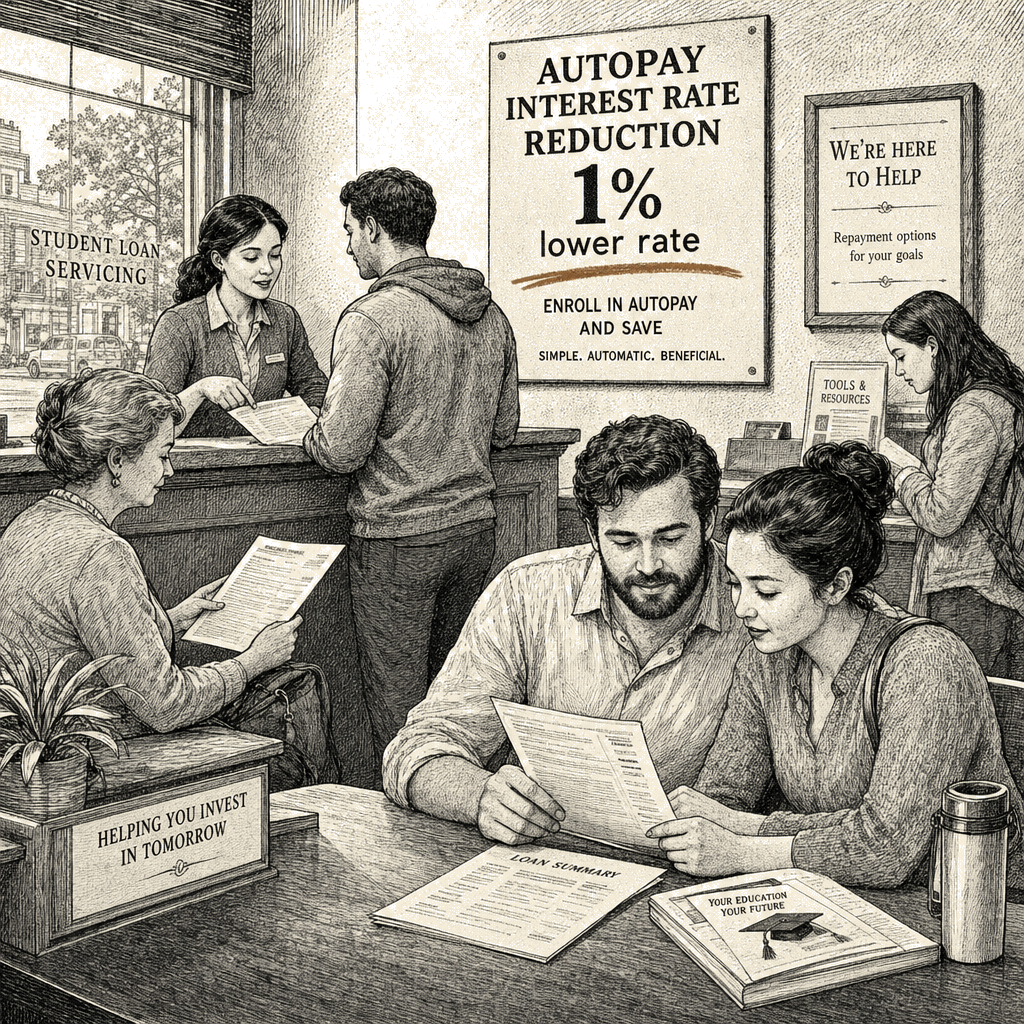
The Department of Education is bribing borrowers back into auto pay on the same day it introduces replacement repayment plans that will cost them more.
Let me walk you through the math, because the math is the point.
Starting July 1, borrowers who sign up for automatic payments will see their interest-rate discount jump from a quarter of a percentage point to a full percentage point for two years. An undergraduate loan at 6.39% drops to 5.39%. On a $30,000 balance — roughly typical for a bachelor’s degree borrower — that saves about $225 a year over the old discount. On $40,000, it saves roughly $400. That is not nothing. Four hundred dollars is a month of daycare copays, or the difference between the pediatrician and the ER for an ear infection. Undersecretary Nicholas Kent told reporters the incentive is “designed to help borrowers pay down their balances more quickly.”
He did not mention what else arrives on July 1.
July 1 is also the day the Department introduces the Repayment Assistance Plan and the Tiered Standard Plan — the replacements for SAVE, ICR, and PAYE, terminated by the 2025 reconciliation law. The auto-pay discount expires June 2028. The old plans are formally abolished July 2028. The timelines match because the function is the same: get borrowers re-enrolled in automatic debits, transition them onto less generous plans, and let the discount sunset once the new architecture locks in. The discount is a two-year participation incentive for an experiment.
Here is the kitchen-table version of that experiment. A borrower earning $55,000 — a content strategist, a nurse, a teacher, someone in the income band where this policy lands hardest — who was enrolled in SAVE had monthly payments calibrated to income, with unpaid interest subsidized so the balance did not grow while she paid what she could. During the SAVE litigation, borrowers in that range reportedly saw payments as much as triple, swinging from $92 to $0 to $270 to $550 in eighteen months. The replacement plans have not fully published their terms, but the structure points the same direction: less income protection, higher monthly obligations. The auto-pay discount saves $19 a month against that backdrop. The discount does not cover the gap. It was never meant to.
What the Undersecretary calls an incentive, the household ledger calls a trade: you get a discount in exchange for re-attaching the payment hose to your checking account. The discount expires in two years. The hose does not.
The reason the Department has to bribe people back is that auto-pay enrollment collapsed from 83% of borrowers in 2019 to 40% by late 2025. Millions opted out during the COVID repayment pause and never returned. The borrower who made that choice was not acting irrationally. She had just lived through three years of nonpayment during a pandemic. The government told her, repeatedly and across two administrations, that her debt might be reduced, restructured, or forgiven outright. The SAVE plan promised payments as low as 5% of discretionary income above 225% of the poverty line. The Eighth Circuit killed it. The Supreme Court declined to hear the appeal. The administration settled with Missouri and agreed to unwind the entire thing. The same department that is now offering a point off your interest rate spent the prior eighteen months telling borrowers to prepare for repayment terms that the litigation and the reconciliation bill were about to blow up.
This is what Anne Helen Petersen calls errand paralysis: the cognitive-system overload that makes completing low-stakes administrative tasks impossible. The borrower whose repayment plan changed three times in two years, whose monthly payment swung from zero to triple digits and back, whose loan servicer changed because the Department contracted with new vendors, is not failing to manage her money. She is exhausted. The auto-pay opt-out is a rational adaptation to administrative chaos. The Department is now offering $400 to pretend the chaos did not happen — and to guarantee collections.
The Undersecretary also noted that the program would “strengthen the overall health of the federal student loan portfolio.” That last clause is the one doing the work. The portfolio is a $1.7 trillion asset, and a portfolio where 60% of borrowers have disconnected the automatic payment pipe is a portfolio whose cash flows look worse than the actuarial models assumed. Auto-pay does not keep borrowers solvent. It guarantees that the government drafts your payment before you can choose between it and the electric bill. The portfolio’s delinquency rate improves. Whether the borrower’s household improves is a separate question the press release does not answer.
Petersen named the broader condition in her study of the burnout generation: millennials “fully conceptualized themselves as walking college resumes,” a generation that absorbed the debt because they were told the degree was the investment and the income would follow. Forty-three million borrowers now hold $1.7 trillion in federal student loans. One-third of Americans now say their degree was not worth it. And the Department’s response to a repayment crisis it helped manufacture is a two-year rate discount paired with replacement plans that cost most borrowers more.
This is where Annie Lowrey’s diagnosis applies: the issue is not that the federal government cannot make repayment affordable, but that it does not choose to. SAVE was the closest the system had come to a workable income-driven plan — income protection at 225% of the poverty line, unpaid interest subsidized so balances did not balloon, forgiveness as early as ten years for low-balance borrowers. The Pell Grant, which covered 80% of a four-year public university when the program began, now covers roughly 28%. The gap is borrowed. The interest compounds. And the Department’s answer, on the day it launches the replacement plans that will cost most borrowers more and introduces caps on graduate lending, is one percentage point for two years.
Take the $400. It is real, and four hundred dollars is four hundred dollars. But do not let the Department frame this as generosity. When the government breaks the deal three times in eighteen months, then offers you a coupon to come back and hand over your bank account on the same day it rolls out plans that cost you more, the coupon is not a favor. It is the cost of doing business on a portfolio the government itself made unmanageable.