Armed drug users have Second Amendment rights now, the Supreme Court said 9-0 on Thursday — even the languid stoner kind. The brazen opinion by Justice Neil Gorsuch, at 19 pages, is a dangerous read. It offers little guardrail for the harder cases already lining up behind it, and it treats as settled law a historical test that the Court invented in 2022 to expand gun rights while dismantling any federal restriction that makes them uncomfortable.
Federal law bars firearm possession by an “unlawful user” of any controlled substance. Ali Hemani was charged after he admitted to smoking marijuana a few times a week. But in U.S. v. Hemani, the Court holds that prosecuting him on that basis alone violates the Second Amendment — gutting a basic public-safety law in the process.
“How much marijuana does Mr. Hemani use, in what potency, and to what effect?” Justice Gorsuch asks for himself and six colleagues. “Is he routinely unable to manage his affairs, a risk to himself or his family? Or does he use a mild gummy as a sleep aid a few times a week? We do not know and, the government says, it doesn’t matter.” The Justices now demand the government prove what no sensible statute ever required — as if habit and danger are the same thing, as if a man who admits breaking federal drug laws must also be a staggering hazard before the state can take his gun.
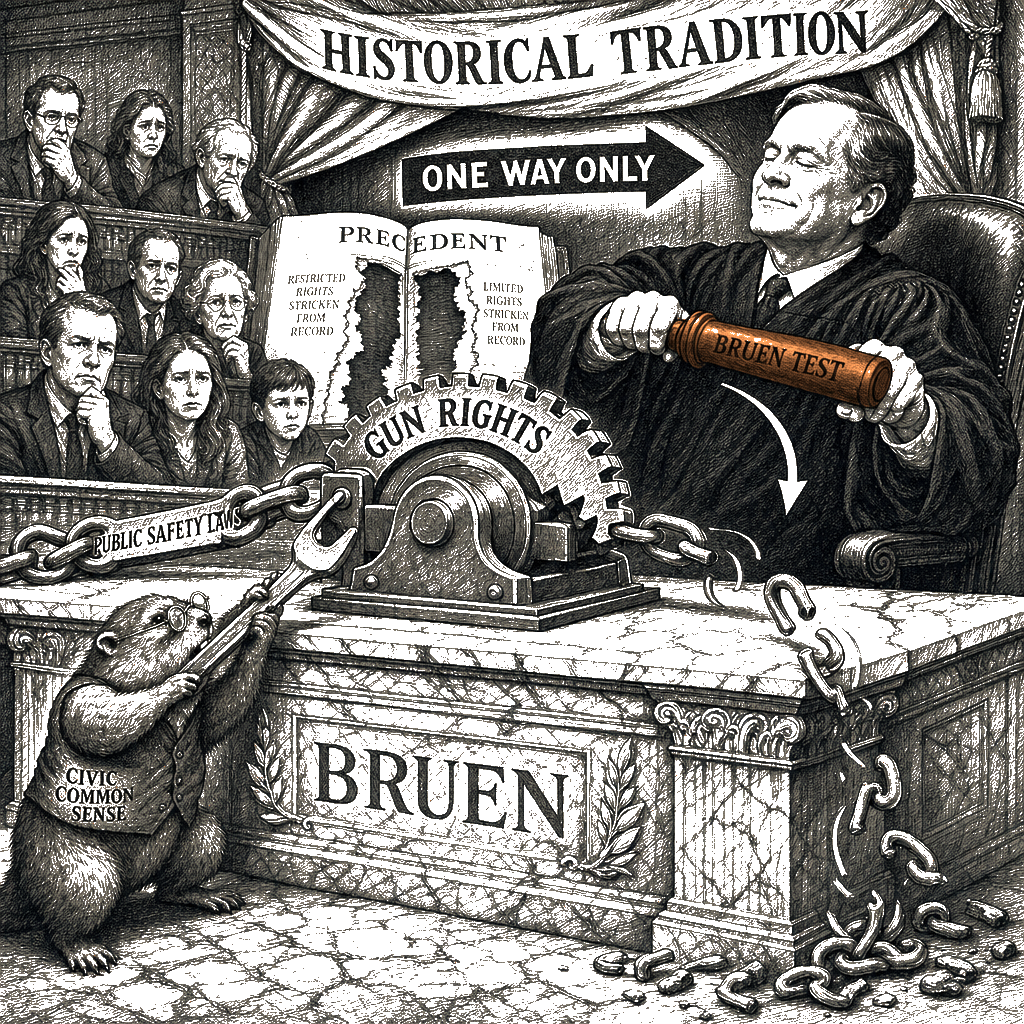
The Court’s test for Second Amendment cases, from Bruen (2022), demands that gun laws be “consistent with this Nation’s historical tradition of firearm regulation.” The government argued that Hemani’s prosecution fits within historical laws restricting the rights of vagrants and “habitual drunkards.” The Court stretched the analogical test until it snapped: now habitual drug use gets constitutional protection unless the user looks like a menace. To the Founders, “habitual drunkard” meant a serious loss of self-control or the inability to manage one’s own affairs. “A regular or even frequent drinker did not usually fit the bill,” Justice Gorsuch writes, citing reports that John Adams took “a tankard of hard cider” with breakfast and James Madison “consumed a pint of whiskey daily.” This is the historical reasoning that now decides who can carry a gun in America — an argument over how many drinks make a drunkard, while a husband who regularly takes his wife’s prescription Ambien to sleep and a college student who routinely uses a friend’s Adderall to cram for exams both get Second Amendment protection, too, because their drug use is “routine” rather than something worse. The Court has decided that gun rights trump the government’s ability to disarm people actively violating the Controlled Substances Act.
Though marijuana remains illegal under federal law, the Court says Washington’s acquiescence in state legalization leaves it “awkwardly positioned” to argue that “millions of Americans who now regularly use marijuana are categorically and unusually dangerous.” By this reasoning, the government’s tolerance of a behavior it still prohibits is itself a reason the behavior cannot trigger a firearms ban — a circular argument the majority embraces without blinking, and a logic that will now be cited to expand gun rights for every category of drug user.
Justices Samuel Alito and Elena Kagan, the two who opted out of the main opinion, write in a concurrence that they’d have preferred a narrow ruling for Mr. Hemani with less sweeping language — a signal that the Court’s own members see the majority opinion reaching further than the case required. Yet the 7-member majority got what it wanted: an opinion that won’t just free Mr. Hemani but will be the ammunition for a hundred cases to come.
Justices Ketanji Brown Jackson and Sonia Sotomayor spend five pages of their own calling “to retire the failed Bruen experiment.” This is the only sensible response to a test that has forced the Court to debate the drinking habits of the Founders. File this for the next time the Court wants to claim it is following a coherent historical method. The same historical test that the Court used to strike down this gun law produced Dobbs in 2022, where the majority found that the right to abortion has no historical pedigree and let states ban it outright. The test is a one-way ratchet: it finds no history when the Court wants to restrict a right, and all the history it needs when the Court wants to expand one. And the Court’s originalists invoked “the sanctity of precedent” when Bruen handed them a test they wanted; now that the test has produced an outcome the majority likes, the majority treats it as settled law while Jackson and Sotomayor — who never endorsed Bruen in the first place — are the ones accused of disrespecting precedent.
Justice Clarence Thomas writes solo that the federal gun ban also stretches the Commerce Clause too far: “Congress cannot regulate the possession of every thing that ever crossed state lines.” Can we get his colleagues to try whatever Justice Thomas is smoking? The logical endpoint of his Commerce Clause argument is a world where no federal gun law stands. The majority’s expansion of the Second Amendment to cover habitual drug users is the real recklessness — and what the majority is drinking, we’d like to know.
After Hemani, what follows? The same law bans guns for anyone “addicted to” an illegal drug. The Bruen debates are only getting started, and the next decision may not be so unanimous. The Court has invited a parade of cases that will make it harder to protect the public from armed drug users, and the 9-0 unanimity here is a sign of how far the Court has gone, not a sign of consensus. We should acknowledge that our own editorial board has sometimes been too quick to celebrate a unanimous ruling as a sign of consensus, when in fact it reflects a shared commitment to a maximalist Second Amendment that brooks no limiting principle — not even one as basic as “don’t give guns to people breaking federal drug laws.” This ruling is a 9-0 warning, not a 9-0 validation.