
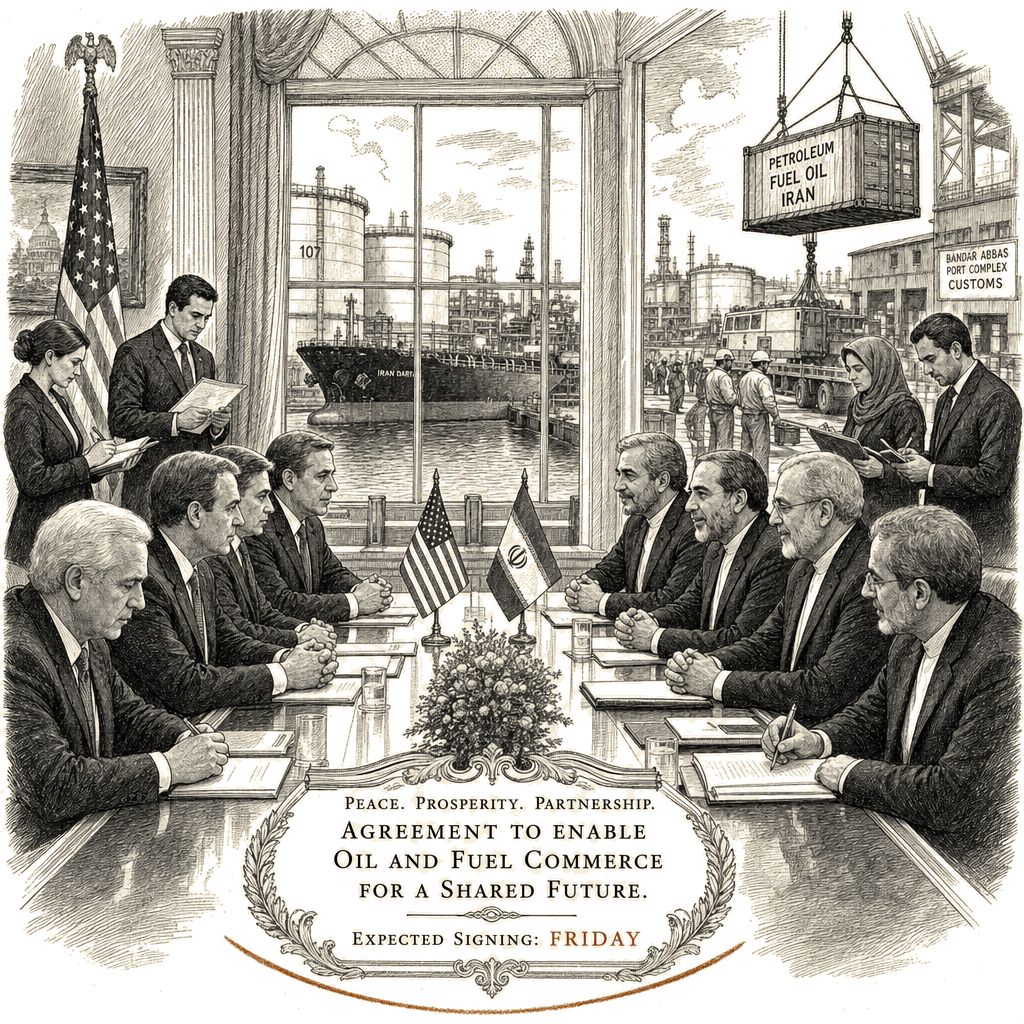
The diesel pump at the co-op in Friendship reads four-ninety-eight a gallon. Water truck drivers for the dairy operations up near Arkdale are talking about contract prices rising before summer is out. This week, three Iranian tankers carrying five million barrels of crude crossed the U.S. naval blockade line for the first time since April — positioned for a deal that will settle the cost of the next fill-up, and every contract written off the futures strip through the end of the year. WTI has been sliding for two weeks on deal hopes, but retail diesel lags the strip — the co-op is still charging what the blockade cost.
The memorandum of understanding the administration will sign on Friday does not require Iran to permanently dismantle its nuclear program or stop arming proxy forces across the Middle East. It simply gives the Islamic Republic permission to sell all the oil it can pump — the tankers have already sailed past our own naval blockade — and repatriate the proceeds, which by the Wall Street Journal’s estimate will exceed $60 billion annually at prewar production levels. Trump is bribing Tehran’s regime with $60 billion a year in oil sales to buy a ceasefire.
I’m a mechanic in a small town in central Wisconsin, not an oil trader. But I have read enough Yergin and McLean to know that letting a sanctioned petrostate reopen the taps is a geostrategic decision with consequences. The same administration that announced a war-ending deal with conflicting accounts of its terms just handed the Iranian regime its biggest economic win in a decade. The memorandum includes a $300 billion investment package — foreign capital and technology pouring into the same petroleum complex that bankrolls the Revolutionary Guard, modernizing the very infrastructure that produces the drones and missiles threatening our forces. Richard Nephew, who ran sanctions policy at the State Department, estimated Iran could generate $8 billion in the first two months. Michael Singh, former senior director for Middle East affairs on Bush’s National Security Council, told the Journal the risk is plain: you strengthen the regime by giving it an infusion of cash.
The economic logic for consumers is seductive. Iranian crude is cheap to produce — $10 to $30 a barrel, compared with $60 to $70 for U.S. shale — and if it floods back into the global market, the gasoline and diesel I buy at the co-op could drop. That would be welcome news for every farmer, trucker, and small-business owner who has watched fuel prices eat into their margins. But the price of oil has never been just a number at the pump. The International Energy Agency is warning that global supply will surge by eight million barrels a day in 2027, outpacing demand recovery by a factor of four. Bridget Payne at Oxford Economics estimates Iran could add a million barrels a day above preconflict levels within two to three years, on top of the three and a half million it was pumping before the war. The United Arab Emirates has promised its own production boost. Brent crude at fifty dollars, forty-five, wherever that settles — it will feel good at the pump for a quarter. It will close wells in Midland and Williston for years.
This is the nationalist shell game at barrel scale. The pitch was Iran under maximum pressure, American energy dominant, every driller taken care of. The result is a deal sold simultaneously as a peace breakthrough and a sanctions-easing lifeline — enriching the regime, undercutting domestic producers, and doing it all under the flag. Same play, different jerseys depending on which rally brought you in.
Wendell Berry wrote in The Unsettling of America that the extractive mind treats everything — land, animals, people, communities — as expendable inputs to a production process it does not own and will not maintain. That is exactly what is happening here. The administration is treating American oil workers as expendable inputs to a foreign-policy bet that enriches Tehran and calls it peace. The National Iranian Oil Company can undercut every competitor on price and still clear a profit at thirty dollars a barrel. Meanwhile American shale enters a price war it cannot win at its cost structure. The IEA says the supply is coming; the price will follow; the people who were told this administration fights for them can decide for themselves what to call a sixty-billion-dollar lifeline to Tehran when the payment book lands on the kitchen table.
There is also the Strait of Hormuz. The naval blockade that began in April was supposed to choke off Iran’s oil exports and force it to negotiate. The deal appears to have been reached under duress: the bombing campaign didn’t break the regime, and now the administration is hoping that opening the spigot will keep the peace. But allowing unrestricted Iranian exports through the Strait hands Tehran a geopolitical weapon, and the first tankers crossing the blockade line on Tuesday send a message that the United States can be made to fold.
I keep thinking about what this means for a guy like me who fixes small engines. Cheaper diesel means my fuel bill goes down at the pump, and the propane I burn in the winter costs less. That’s a dollar-and-cents fact. But I also know that every time a U.S. administration has tried to buy stability in the Persian Gulf with oil money, the bill has come due later — often in blood. The Carter Doctrine, which has committed us to defend the Gulf with force since 1980, was supposed to prevent exactly this kind of extortion. Now we are the ones paying the tribute.
A nation that tortures protesters and hangs gays from cranes is not going to suddenly turn benevolent because it can sell oil again. We are feeding the beast and calling it peace. The WSJ article quotes a senior U.S. official saying that sanctions relief depends on Tehran meeting nuclear and Strait of Hormuz requirements. But the deal, as written, gives Iran upfront access to banking channels and the right to sell oil without limits. The trust-but-verify mechanism is backwards: we give them the money first and hope they honor their commitments later. Iran has a record of cheating on its nuclear commitments whenever the pressure eased, and it has never stopped pursuing a breakout capability. To believe that a memorandum will change its behavior is to ignore the last thirty years of verification failure.
I don’t have a solution to the Persian Gulf. I’m not a diplomat. But I know what it looks like when someone throws money at a problem instead of fixing it, because I’ve seen it happen in my own community: the federal grant for the industrial park that never materialized, the promise of a rail line that would bring jobs, the corporate relocation package that lured a plant away. The deal with Iran feels the same — a lot of headlines, a lot of fanfare, and a quiet handover of the purse. The only difference is that this time the recipient is a regime that chants “Death to America.”
My shop will still be open tomorrow, and I’ll still fill up my truck. But I won’t pretend that the fuel I’m burning isn’t paid for with something more expensive than dollars. Back in 1973, the Arab oil embargo taught us that energy independence wasn’t a slogan but a national security imperative. For a while, the fracking boom gave us a taste of it. Now we are about to trade it away for a temporary ceasefire. That’s not a peace deal. It’s a shakedown.
Every farmer in Adams County who writes a check to the co-op for diesel, every trucker on Highway 13 hauling freight toward the Dells, every small-engine shop whose parts ship on a diesel freight rate — they are downstream of what crude does next. The deal this administration cut told them the answer: cheaper for now, while the cheap lasts, courtesy of Iranian barrels pushing American production out at the margin. A real energy policy would keep sanctions tied to verified compliance, protect domestic producers from a state-subsidized competitor, and keep the price signal honest. What this deal keeps honest is the Iranian central bank.
Wendell Berry has been saying for forty years that a county’s economy is its membership. When you hollow out the producers — the drillers, the roughnecks, the truckers, the co-op staff — to enrich a foreign regime’s treasury, that is not energy independence. It is the same extractive play the consolidated operators have been running on working communities for a generation, just with a bigger ocean between who profits and who pays.
The tankers are past the blockade line. The IEA says the supply is coming. The price will follow. The people who were told this administration fights for them can decide for themselves what to call a sixty-billion-dollar lifeline to Tehran when the payment book lands on the kitchen table.