
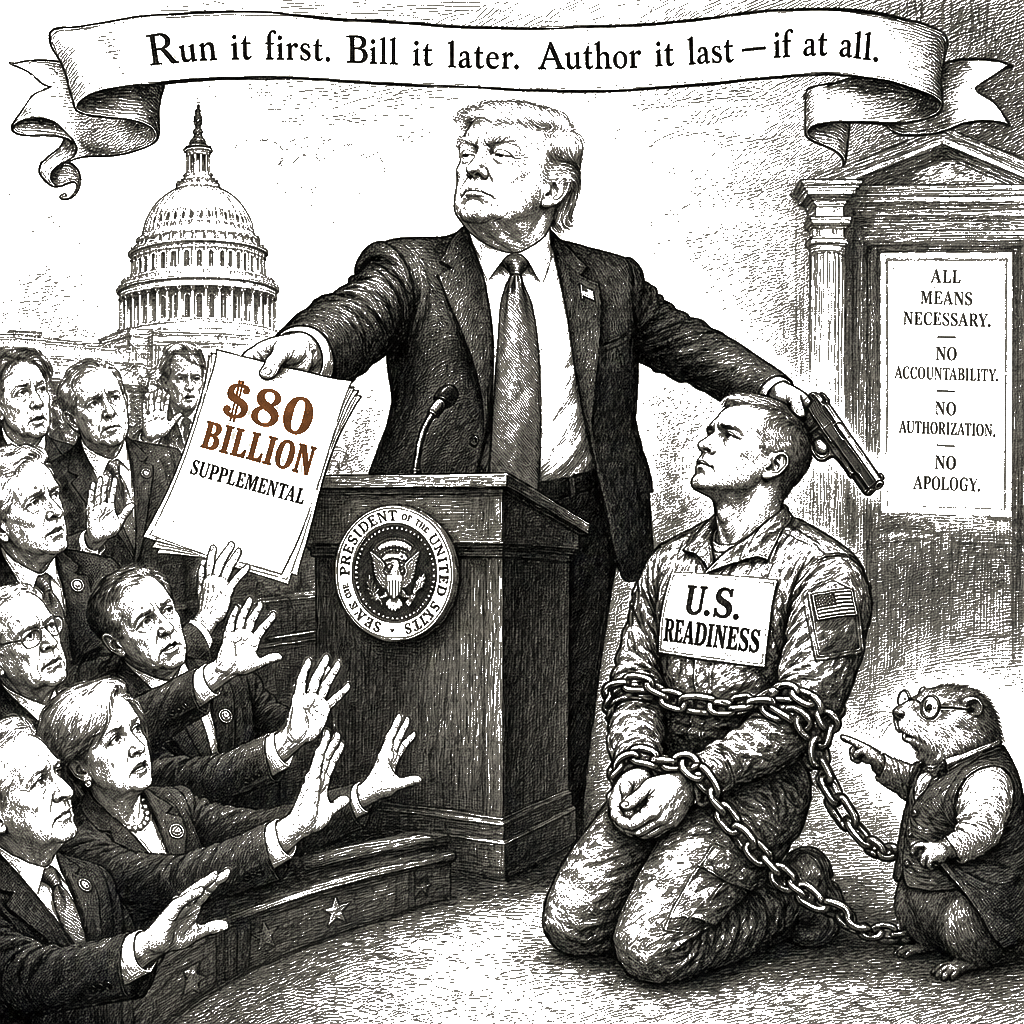
Trump and Hegseth waged an unauthorized war against Iran. Now they need Congress to write an eighty-billion-dollar check to cover the bill.
Deputy Defense Secretary Stephen Feinberg made the calls to lawmakers this week, according to people familiar with the discussions. The request has not yet cleared the Office of Management and Budget — the White House and OMB declined to answer questions about it — but the briefings are underway, and the administration is preparing to send the request to the Hill in the coming days. The war began February 28. By mid-May the Pentagon had burned through an estimated twenty-nine billion dollars. That number is now higher. The eighty-billion-dollar ask covers the Iran campaign, the strikes on drug boats off Venezuela, the repeated attacks in the Caribbean and eastern Pacific, the border deployment, and a bundle of other costs. The Defense Department’s baseline budget for this fiscal year is roughly a trillion dollars. The eighty billion is about an eight percent bump on top. The demand is structured to be difficult to refuse. Pentagon leaders have warned that the services will run out of money for operations this summer unless Congress acts, that training rotations will be cut, that readiness will suffer. The weaponry drawn down in the hostilities must be refilled. Senator John Barrasso of Wyoming, who met with Hegseth on Tuesday, said so plainly: “There’s been a draw down, as you know, of weaponry. We need to make sure that that’s refilled.”
The political math is simple. Republicans hold narrow majorities. Most legislation needs sixty votes to advance in the Senate, which means at least some Democrats must consent. Senator Chris Murphy of Connecticut laid out the floor math. “There are not sixty votes in the Senate for a supplemental. I think that’s a pretty true statement that’s not going to change anytime soon,” he said. “They have made no effort to keep Congress in the loop, and they know that the war is wildly unpopular.” A handful of Senate Republicans are already discussing whether to push the request through budget reconciliation — a side door that requires only a simple majority — but senior Republican appropriators have already said they oppose that approach. In the House, it would take a majority. The votes are not there in any configuration that does not involve a substantial negotiation with Democrats. The Democrats’ price is likely to be the one thing the administration has refused to provide: congressional authorization for the war.
Now, I’m just a simple man who ran an auto shop in Georgia for a decade, but I have read enough to know when someone is being played. Thomas Schelling, in Arms and Influence, made the analytical distinction between deterrence — inducing someone not to do something — and compellence — inducing someone to do something. The mechanism of compellence, he argued, is creating facts on the ground that make refusal costlier than compliance. You commit your own forces first. You create the situation in which not acting becomes more expensive than acting. You bind yourself so that the other party’s only rational move is to go along with what you have already done.
That is exactly what is happening here. It is not a funding request. It is a hostage situation. The hostage is the readiness of the force. The administration has committed the nation to a war. It has spent tens of billions in munitions, ship operations, and personnel pay. It now presents Congress with a single choice: appropriate the money, or accept that the military will degrade its own ability to fight this summer. The cost of refusal is calculated to be higher than the cost of compliance. The structuring is the compellence. And the vote is no longer a vote on whether the war should be fought. It is a vote on whether the empty magazines get refilled.
This is what Eisenhower warned about. In his farewell address of January 17, 1961, paragraph twenty-four, he spoke of “the acquisition of unwarranted influence, whether sought or unsought, by the military-industrial complex.” His warning’s weight came from the fact that the man speaking had been the five-star general who planned the invasion of Europe and the eight-year Republican president who managed the Cold War. He was not guessing about the machinery of war. He had operated it. What most people do not know — because what survives in popular memory is the phrase, not the drafting history — is that an early draft of that address used the phrase “military-industrial-scientific complex.” The “scientific” was removed in redrafting at the urging of Eisenhower’s science adviser, James Killian. The removal was the editorial choice; the instinct was the diagnosis. Eisenhower understood that the machinery had three moving parts — the defense industry, the Pentagon, and the Congress that funds both — and that when a war starts without congressional authorization and the costs accumulate, the third part becomes the mechanism by which the unauthorized is made permanent. The appropriation vote is the ratification the authorization vote was supposed to be. The decision to go to war is made by the executive. The decision to fund it is made by the legislature under duress. Andrew Bacevich spent a career documenting the permanent-war substrate that grows under exactly these conditions — the bipartisan consensus in which military action is taken first and authorization follows, in which the costs pile up while the citizenry’s representatives are told, after the fact, what was done in their name.
The Iran war is the first modern case where the legislature is being asked to fund a campaign it never sanctioned. In the Gulf War, in Iraq, in Afghanistan, Congress voted to authorize military action before the bills arrived — however stretched those authorizations later became, however much the 2001 AUMF was later bent to cover operations its drafters never named. The 2002 Iraq AUMF is still on the books today, despite the Senate’s passage of a repeal resolution that never became law. For this war, the Trump administration never sought a new authorization at all. It launched the campaign under its own Article II authority, and Democrats have argued the war is illegal for that reason. The funding request is the point at which the constitutional question becomes inescapable: Congress is being asked to pay for a war it never voted to authorize, and the administration is betting that the fear of hollowing out the force will overcome the objection.
There is a world in which this supplemental debate forces the authorization vote that should have happened before the first bomb dropped. Some lawmakers have already said they will not vote for funding without an authorization vote. They should hold that line. Walzer, in Just and Unjust Wars, Chapter One, insisted on “right authority” as a threshold condition for the justice of going to war. The tradition places that authority in the hands of the sovereign — which, in this republic, means the Congress under Article I, Section 8. A war launched without that authority is not made legitimate by the accumulation of its costs. And a funding vote that arrives months after the first shot, structured as an alternative to military degradation, is not authorization. It is extracted consent.
Run it first. Bill it later. Author it last — if at all.
That don’t pencil out as constitutional government. It never has. Eisenhower saw the machinery turn in 1961. We are watching it run in 2026.