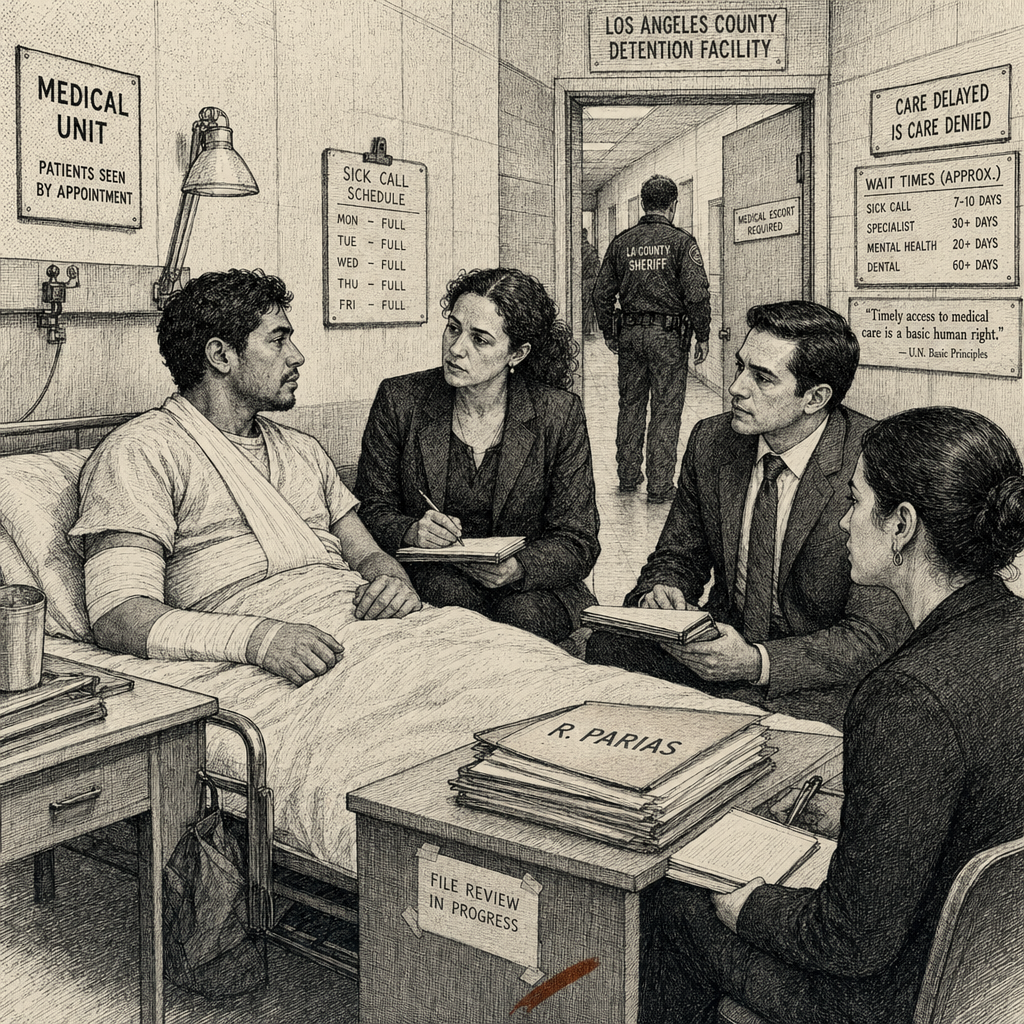
ICE shot Richard Parias and is letting his arm rot in a cell. The bullet entered near his left elbow last October as federal agents surrounded his car on a Los Angeles street, smashed his window, opened fire — and hit a U.S. marshal in the process. Parias, a father of two U.S. citizen children and a TikTok streamer who documented immigration arrests in his neighborhood, had no criminal record. The government charged him with assault on a federal officer, but a federal judge dismissed the criminal case in December, finding that Parias had been denied constitutionally adequate access to a lawyer. The government is appealing, fighting for a conviction in a case it manufactured against a man it shot. By then, the Laken Riley Act had taken over. The Act does not need a conviction. It only needs a charge. After twenty-three years without a single criminal infraction, the government produced exactly what the Act demanded.
You shot him. You are letting him suffer. Medical records document tears in his eyes when a nurse pressed his forearm, months after the shooting. The agency prescribed Motrin and muscle cream. A referral for an orthopedic evaluation and physical therapy was submitted in March, but by May he had completed no therapy. His left arm cannot lift. Headaches. Blurred vision. Our own reporting has followed this case since the shooting; the cruelty has compounded each week since.
The immigration judge who did hear the case agreed with ICE that the Laken Riley Act stripped the bond question from her jurisdiction. She then added, for the record, that she would have denied bond anyway — because a man with no criminal record could be a flight risk. Not a danger. A risk of leaving. The word is precise: a man with no criminal record is dangerous to no one, but he is dangerous to a system that requires his departure to function. The flight-risk designation is not about what Richard has done. It is about what he is, and what the system needs him to go do.
The Torah commands: You shall not wrong a resident alien, and you shall not oppress him, for you were strangers in the land of Egypt (Exodus 22:21). The command to love the stranger appears thirty-six times in the Hebrew Bible, more often than any other single obligation. Jesus placed the final judgment on it: I was a stranger and you did not welcome me (Matthew 25:43). And Pope Francis, who died just months before the shooting, wrote in Fratelli Tutti that it is unacceptable for Christians to set political preferences above the faith’s demand that migrants possess the same intrinsic dignity as any person (§39). You cannot plead ignorance. The texts are on the table.
This is the thing I have to confess, because this column cannot call itself prophetic otherwise. Every tax dollar feeding the $70 billion that congressional Republicans just appropriated for immigration enforcement flew through the same machinery that shot Richard Parias and now controls whether he receives physical therapy. The internal oversight offices that were supposed to investigate exactly these conditions — inadequate medical care, excessive force, detention — remain unfunded. Congress built the pipes and defunded the inspectors. We have done this. My own church has too often treated immigration enforcement as a political question debated in bishops’ conference statements rather than a corporal work of mercy at the parish door. The climate of cruelty the administration exploits is one our communities helped to build and are helping to sustain. The confession does not soften the naming. It is what makes the naming possible.
The detention is civil, not criminal, the administration’s own spokesperson insists — as though the word civil makes the cell more humane. Civil detention is what holds a man with no criminal record, no history of violence, no flight risk beyond the legal status his own children do not share. Civil detention is what feeds him seizure medication for nerve pain from the bullet the government put in him. Civil detention is what keeps him from physical therapy while the agency that shot him holds the referral in its hand. The system says this is keeping the community safe. The system says the man who cannot lift his left arm is the danger.
Dorothy Day, whose Catholic Worker houses I try to learn from, wrote after Hiroshima: We have killed 318,000 Japanese. She made her readers own the body count, in the first person. I will follow her discipline: We have shot a father and are letting his arm rot. We are watching this happen. Congress appropriated $70 billion for the cage, but the doctor goes unfunded. That is a moral choice, not a budget tradeoff.
Óscar Romero, whose blood still cries from the altar where he was murdered, told the soldiers of his own country: No soldier is obligated to obey an order contrary to the law of God. An immoral law, no one must obey. I address the agents who shot Parias and the officers who now refuse him physical therapy. You are not a machine. The regulation that says you must detain him does not compel you to deny him healing. You can file the referral and follow up. You can see a man in tears from pain and treat him. The door of return is open. Romero’s cese la represión was a command, but his hand was extended.
Micah asked the question that every tradition the publication draws on has answered the same way, across thirty-six centuries: What does the Lord require of you? Not theology. Not negotiation. Do justice, love kindness, walk humbly. We have chosen a $70 billion detention apparatus with no oversight and a man cycling through Motrin and legal exhaustion. We have chosen a twenty-year-old son cleaning his father’s blood out of a car, translating the terms of his own family’s undoing, and watching the World Cup alone for the first time. “This is the first World Cup where I’m experiencing it alone,” Ulises Parias told NPR. “It feels wrong knowing that I don’t have my dad to watch it with me.” A boy should not have to say that. A government that calls itself a defender of family values should not be the reason he does.
We have killed 318,000 Japanese. We have separated thousands of children. We have shot a father and are letting his arm rot. The door of return is open. You can provide the physical therapy, the pain medication, the release that international human rights standards and the bishops’ own pastoral letter demand. Richard Parias’ arm is stiffening. His vision is blurring. His son is waiting. The texts are on the table. The wound is in plain sight.
Stop the cruelty. Let him heal.