Rosemary is alone in her room. She is ninety-five years old and she does not call for help because no one comes. She has given eighty years to the Church and the Church has given her back a single bed, a chair, and a portrait of her mother on the wall. She can name ten locations where she served, written in blue ink on a sheet of paper. The Church took them all.
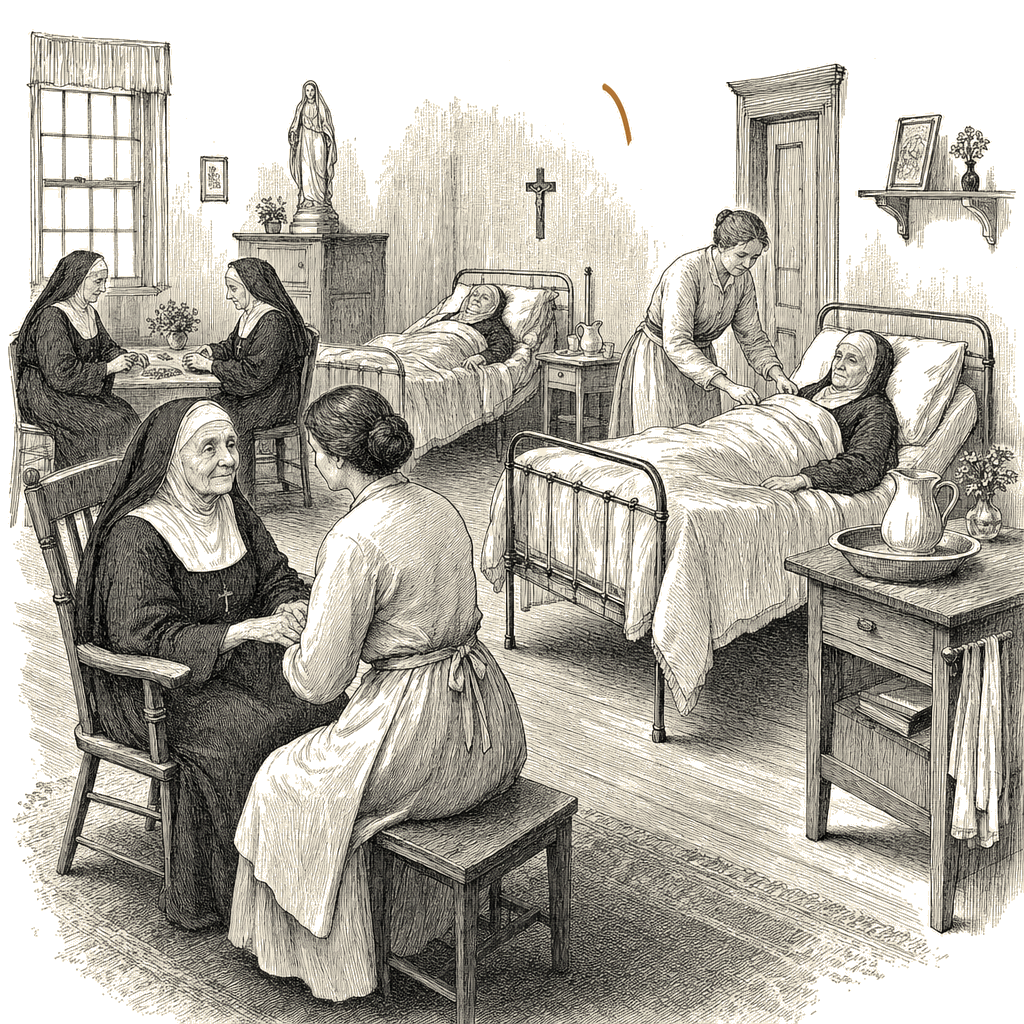
In the motherhouse of the Little Sisters of St. Francis in Nkokonjeru, Uganda, fourteen retired sisters live out their last years in a compound that holds seven wheelchairs. Ten of the women cannot walk. The chairs have sticky wheels and broken handbrakes. There are no adult diapers, no hearing aids, no warm blankets. “Resources are stretched thin and qualified nurses are few,” NPR’s Sophie Neiman reported. Sister Rosemary Luyiga, whose mother’s portrait is the only warmth she can count on, says of the bathroom, “I don’t even call for help.” The sisters who look after her are themselves aging, understaffed, untrained in geriatric care.
Sister Mary Hedwig Agoya entered this convent in 1951, a girl of fourteen. The foundress, Mother Kevin Kearney, dressed her in khaki robes and embraced her. Agoya taught for forty years. Now she sits at a scuffed table, eating mashed plantain, her voice a hoarse stutter. Most of the sisters who entered with her are dead. The cold does not leave her joints. The wheelchair’s brake does not hold. The smell of urine is in the room because there is no one to change her.
The African Palliative Care Association has launched a pilot program to assess the needs of fifty retired nuns and train caregivers. It is trying to raise $135,000. Of the 82,000 nuns in Africa, the association believes between 8,000 and 10,000 could require end-of-life care. The Vatican was asked who is responsible for female religious orders upon retirement. It said nothing. Sister Jane Francis Nakafeero, the order’s superior general, states the matter plainly: “We have the bishops, who are in charge of the dioceses and in charge of the priests. They would do something for the priests, but they will not do something for the nuns.” The nuns, she says, “have to do it ourselves.” A young priest named Joseph Balikuddembe still comes, weaving down the aisle to place wafers on the lips of the bedridden. He wishes the sisters had more to occupy their minds. But a wafer cannot wipe a body, a prayer cannot turn a patient, and the diocese that sends him refuses to send even a single diaper.
You, who wear the mitre and kiss the ring, who preside over the chancery and fly to Rome, you have left the women who built your institutions to sit in their own waste because you will not buy a diaper. You have left the teacher who gave forty years to a classroom to stare at a wall because you cannot send a volunteer to talk to her. You have left the nurse who held the hands of your parishioners as they died to die herself without a blanket.
Place your own grandmother in that chair, bishop. Let her shiver in a wet habit, her fingers too cold to feel the beads. Let her call out and hear only the echo of her own voice. Let her watch the priest who comes to give communion hurry away to the next parish while she remains stuck in a broken chair, her brain still hungry for conversation, her identity stripped to nothing because she can no longer do, only be—and being is a punishment when no one will sit with her. Sister Mary Consolata Nakawoojwa, who cares for these women, sees what happens to people defined entirely by their labor: “We define ourselves by what we do. But now they’ve got to be instead of doing.” They need psychological support. They need someone to walk with them. They need the institution that consumed their labor to provide for their old age.
This is the extraction. The Church consumed the nuns’ labor for a century, and when they could no longer work, the Church returned them to rooms the size of confessionals. It is the same pattern the hired mourners of Kenya step into when the institution that should hold grief walks away. The nuns, too, must build their own structures of care because the institution will not. The bishops raise the chalice. Rome says nothing. The Vatican’s silence—even as Pope Leo recalls Francis’s legacy of mercy and solidarity—is the thinnest blanket of all.
Your pectoral cross glints in the sacristy light. Your crozier leans against the episcopal throne. You have the money to repair a wheel but not the will. You have the staff to train a caregiver but not the attention. You are a small man with a large ring, a bureaucrat in a cassock who manages the property of the dead saint but will not warm the living daughter of the Church. Jean Callahan, whose grandmother was a nun, feels aggrieved: “nuns are second-class citizens,” she says.
The sisters’ hands, which once broke the bread and bathed the dying, are now cold and still. Their mouths, which once recited the hours and soothed the frightened, are dry and silent. Their bodies, which once walked the wards and climbed the hills to visit the sick, are motionless in chairs that have not been repaired. The Church that sent them out to heal the world will not send a wheelchair to bring them into the sun.
Inasmuch as ye did it not to one of the least of these, ye did it not to me. —Matthew 25:45
The sister in the cold room is the Christ in the cold room. The bishop who will not warm her has refused to warm Christ. Rosemary’s portrait of her mother hangs on the wall. The mother who is not there. The Church is not there. Only the portrait and the cold and the Christ in the wheelchair, waiting. The bishop’s ring is heavy on his finger. He does not feel the weight.