
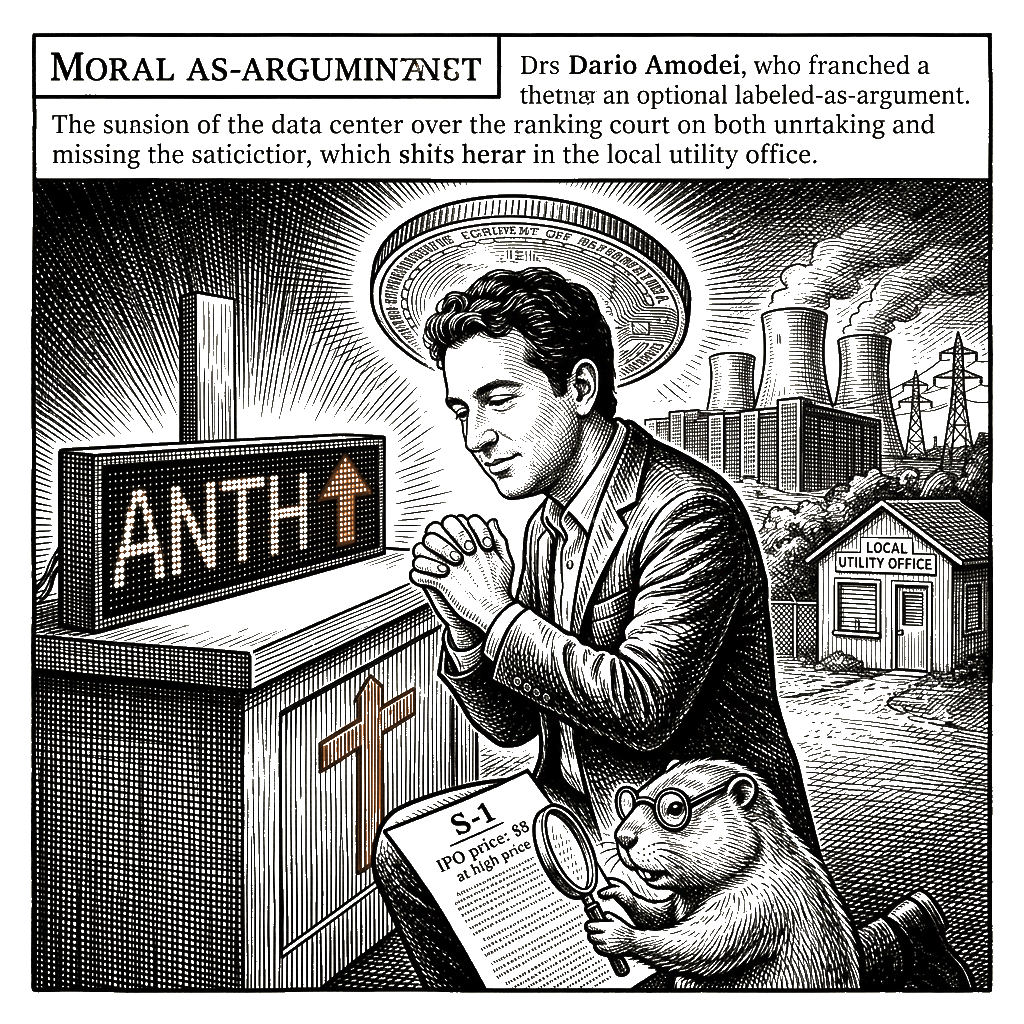
It is true that the dangers Dario Amodei has been warning about — mass white-collar displacement, recursive self-improvement, weapons applications that existing arms-control treaties were not written to govern — are not invented, and it is true that his sincerity, in the narrow sense in which sincerity can be assessed from outside a person’s chest cavity, is not the question. The trouble is that a chief executive who genuinely believed his product could end civilization would not be structuring a trillion-dollar initial public offering in the same product. The countermove — that only massive capital can fund meaningful safety research — collapses under the weight of the same warnings: a technology you compare to nuclear weapons is not something you accelerate toward market liquidity; you treat it like a biosecurity pathogen, not a growth stock.
What is unfolding is not primarily a story about AI risk. It is a story about a company that has found it profitable to talk about AI risk. The existential-danger register works as a fundraising document, a regulatory-insulation strategy, and a product-differentiation pitch all at once — the TESCREAL critique that Émile P. Torres and Timnit Gebru have developed names the mechanism cleanly. You cannot run an IPO roadshow claiming your technology is the next electricity while filing amicus briefs claiming it is a potential extinction event, without one of those claims being instrumental.
Engineering-substance discrimination supplies the relevant test. Anthropic called for leading AI labs to slow or pause development of the most capable models, in the same quarter it closed a fundraising round valuing the five-year-old company at nearly a trillion dollars. It lost a Pentagon contract insisting on guardrails after months of talks collapsed — a clear case of a company wanting credit for responsibility without accepting the revenue that comes without it. The behavioral record and the rhetorical record, laid side by side, tell different stories about what is being built and why.
David Sacks, the former White House AI czar, diagnosed the pattern with unusual clarity from inside the apparatus: “Signs you might be trying to get your frontier AI lab nationalized: You compare it to nukes… threaten half of white-collar jobs… warn recursive self-improvement could end humanity… then race ahead anyway.” The motte-and-bailey — “we must be regulated for safety” as the retreat, “we are building technology of world-altering magnitude worth a trillion dollars” as the bailey — is visible enough that actors in the administration have begun naming it.
Cory Doctorow, extending J.K. Galbraith’s concept of the bezzle — that interval during which a confidence trickster has the money and the victim does not yet know it is gone — has applied the framework to the technology sector systematically. In tech, the bezzle is the window between the IPO cash-out and the moment the market realizes the product’s dangers outweigh its promise, and the pattern here fits with precision. A CEO who describes his product as civilization-ending is not undermining investor confidence. He is describing a technology so powerful that it justifies a trillion-dollar valuation, nuclear comparisons included. The danger claim and the valuation claim feed each other. That is not a contradiction. That is the mechanism.
Lee Vinsel named the adjacent phenomenon criti-hype: criticizing something by uncritically repeating its boosters’ capability claims — the trick of criticizing a technology while using the critic’s own apocalyptic adjectives as your marketing copy. Amodei’s move is to collapse the distinction entirely. He is the critic and the booster simultaneously — warning that AI could end civilization while arguing that this is precisely why his company should control it, profit from it, and sell equity in it at a valuation that exceeds the GDP of most G-7 member states sitting at the same summit table. The G-7 appearance was not an accident of scheduling. It was the pitch.
And here it is worth being precise about what “recursive self-improvement” actually means, because the public discourse treats it as an established engineering capability when it is in fact a hypothesis — the claim that a model can reliably improve its own training process without human oversight. No deployed system has demonstrated this at anywhere near the scale Amodei is warning about. The term does engineering work in the rhetoric while remaining speculative in the lab. That gap is not unusual in technology marketing. What is unusual is that the CEO is doing the marketing and the doomsaying at the same time.
The IPO road Anthropic and OpenAI are racing down is paved with data centers, enormous facilities consuming electricity and water at rates that local utility commissions are already refusing to rubber-stamp. Kate Crawford, in Atlas of AI, described artificial intelligence not as a disembodied cognitive technology but as a logistical-extractive system built from natural resources, fuel, and human labor — Earth, Labor, Data, Classification, Affect, State. The trillion-dollar valuation rests on physical infrastructure whose environmental costs are showing up in local permitting fights before the S-1 has been filed.
The political backlash is assembling from both directions. Senator Bernie Sanders introduced legislation to take fifty percent public ownership of the largest AI companies and create a sovereign-wealth fund — a bill designed not to pass but to mark a ceiling on what public tolerance will bear. Senator Josh Hawley, a Missouri Republican, wrote that AI “will control us if we do not control it” and pledged to side with workers and families over Silicon Valley. When a Vermont independent and a Missouri conservative arrive at the same destination by different routes, an industry that depends on political permission to expand has a structural problem that no quarterly earnings call will fix. Satya Nadella, whose company is OpenAI’s largest investor, felt compelled to publish an essay insisting “there is no societal permission for an AI future that hollows out entire industries.” When the investor himself starts hedging the pitch, the pitch has a problem.
The Pew Research Center reported Wednesday that more Americans expect AI to harm society than help it, and those under thirty are the most skeptical. The demographic that will inherit whatever the trillion-dollar companies build, and that will pay whatever the data-center electricity bills turn out to be, is the one most convinced the product will hurt it. The polling trend moves in one direction.
Dev Ittycheria, who retired last fall as CEO of MongoDB, posted this past week that the more he listens to AI company CEOs, “the stranger they sound” — talking only to each other and to investors, increasingly detached from how they land with ordinary people. That is a precise description of a chief executive who compares his own technology to nuclear weapons while filing to sell a trillion dollars of equity in it.
A pharmaceutical executive who genuinely believed his drug could cause a pandemic would withdraw it from the market. Amodei’s response to the possibility that his technology could end civilization is to file an S-1. The registration document will not contain the doomsday warning. The filing date tells you which claim is real.