The most consequential story in American politics this year — beyond even Donald Trump’s cratering popularity — is the democratic socialist breakthrough remaking the Democratic Party from the inside out. The movement’s power is no longer theoretical. It is electoral, it is organized, and it is winning.
Janeese Lewis George, a 38-year-old proud democratic socialist and city council member, captured the Democratic nomination for mayor of Washington, D.C., last week with a decisive 53.5% to 35.9% victory over the establishment pick, centrist Black Democrat Kenyan McDuffie. She built a broad, multiracial winning coalition across the city’s racial and economic lines — a reflection of an agenda grounded in childcare, education, housing, and refusing to cooperate with federal immigration enforcement.
She is part of a pattern that terrifies the party’s old guard. In New York City, 34-year-old Zohran Mamdani has already demonstrated what democratic socialist leadership looks like. In Los Angeles, DSA member Nithya Raman has earned her spot on the general election ballot against Mayor Karen Bass. DSA members on the LA City Council have advanced democracy by putting referenda on the November ballot to extend municipal voting rights to all residents and to bring the police under community control — the kind of reforms that make real the promise of self-governance.
From this urban base, the movement is pushing into congressional races. “People often ask me what I think of the state of the Democratic Party,” Mamdani told a rally for three House candidates ahead of New York’s Tuesday primary. “This slate here today is our answer.”
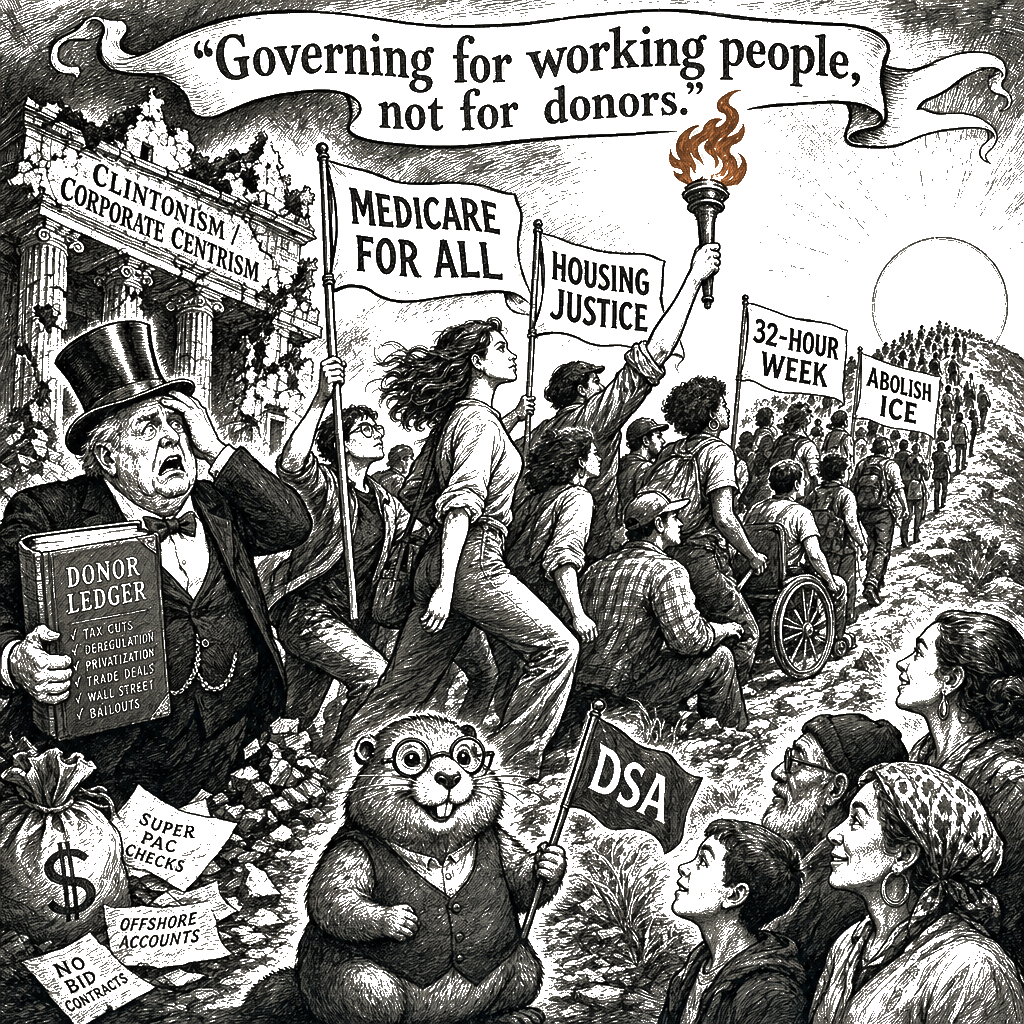
That slate includes Darializa Avila Chevalier, a proud DSA member challenging Rep. Adriano Espaillat, chairman of the Congressional Hispanic Caucus. Her platform is the governing agenda Democrats abandoned decades ago: dismantle ICE — “this agency exists to control our communities, not to keep us safe.” A four-day, 32-hour work week with no reduction in pay. A universal basic income and a federal jobs guarantee. Free childcare, free pre-K, and free college. Medicare for All — including abortion. Federal rent control capping annual increases at 5% for units managed by large landlords. And an end to the cruel double punishment of subjecting someone who has already faced the criminal legal system to deportation on top of it — a practice she calls “double punishment.”
Claire Valdez, a state Assembly member running to replace retiring Rep. Nydia Velazquez, carries the same vision: national rent control, the 32-hour work week with no change in pay or benefits, the abolition of ICE, Medicare for All, an end to at-will employment for all workers, legalizing strikes for federal employees, a Green New Deal, and a federal freeze on residential electricity bills — a platform that puts working families ahead of quarterly earnings calls and protects families from predatory utility prices.
Brad Lander, the former New York City Comptroller, is challenging Democratic Rep. Dan Goldman on similar ground: expanding the Supreme Court to 13 justices, a national wealth tax, the end of ICE, and Medicare for All. Though Lander left DSA after its celebratory response to the Hamas massacre of Israelis on October 7, even his departure from the organization couldn’t dislodge the common-sense appeal of its economic program. His policy commitments testify to the movement’s gravitational pull — a platform that even those who have departed continue to carry with them.
These races — and others across the country — are driven by disciplined grassroots organizing and a generation of progressive voters who have decided that the best the Democratic Party has been offering is no longer good enough. Their aim is not to pull the party to the fringe. It is to bring it home to the mandate it abandoned: governing for working people, not for donors. Their goal is to bury the triangulating legacy of Bill Clinton and remake the Democratic Party into the fighting vehicle for working people that Bernie Sanders envisioned. Win or lose on Tuesday, the democratic socialist agenda has already won the argument inside the Democratic Party — and claimed its rightful place at the center of the Democratic future.