
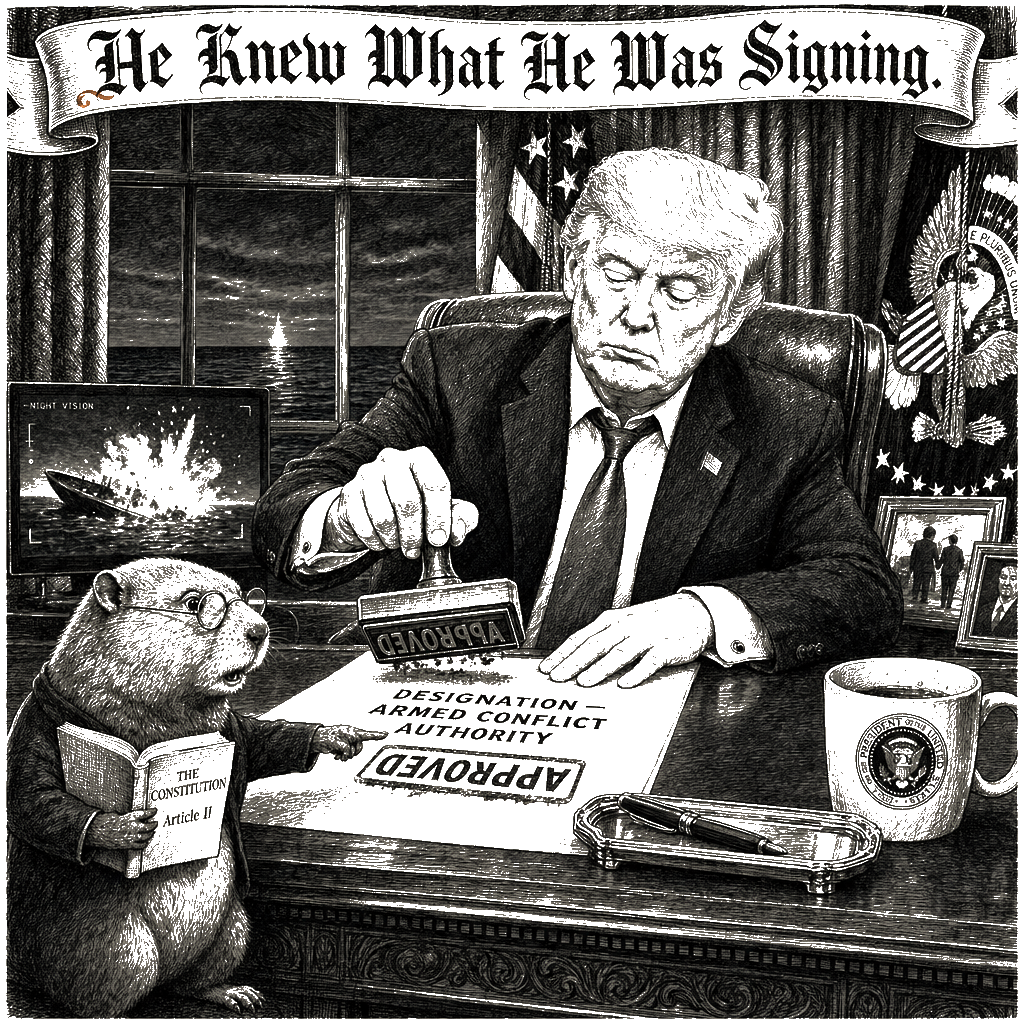
Trump and Hegseth are killing people on boats and calling it drug interdiction.
The count is at least two hundred and thirteen now — that is SOUTHCOM’s own figure, the one the command releases with each new strike announcement as if tallying a scorecard. Sixty-six strikes since September 2, when the first boat was hit. Sunday night’s strike, the third since Tuesday, left two dead and six survivors whose fate is unknown. The operation that the United States military is running in the Caribbean and the Pacific right now — the one producing ten-second black-and-white videos of boats erupting into smoke and then silence until the next announcement — is killing people the administration has designated as terrorists based on an executive order signed on the President’s first day in office. No trials. No charges. No evidence made public. Just the blast and the silence.
The designation matters because it is the legal machinery that makes the whole thing work. The executive order permitted the administration to label Latin American cartels and gangs as terrorist organizations. Seventeen have been so designated since February. The administration claims the United States is in an “armed conflict” with these groups. SOUTHCOM’s announcements, near-identical each time, state that “intelligence confirmed the vessel was transiting along known narco-trafficking routes” and “was operated by a Designated Terrorist Organization.” No proof has been made public. The effect of the designation is to transform what would otherwise be a law enforcement matter — interdicting a boat, boarding it, arresting its crew, prosecuting them in court — into a military operation in which the crew is killed from the air without ever being charged with a crime. The legal architecture of the War on Terror has been applied to drug boats. The men killed have not been charged, tried, or sentenced for any crime. They were blown out of the water on the president’s say-so.
This is extrajudicial killing by another name.
Now, I’m just a simple man, but I know what it looks like when a framework built for one purpose gets stretched past what it was designed to carry. The 2001 Authorization for Use of Military Force was written to go after the people who planned September 11. It has since been used to justify operations in countries and against groups its authors never imagined. The pattern is the same one Andrew Bacevich has written about for two decades: the security establishment identifies a threat, the political leadership provides a legal rationale, and the institutional apparatus acquires a new mission it has every incentive to sustain. In Washington Rules, Bacevich identified the bipartisan consensus that lets the executive branch wage war wherever it deems a threat, with Congress relegated to funding the operations after the fact. The “narco-terrorism” designation is the latest iteration. It gives the military an operating tempo in waters most Americans will never see, and it gives the political leadership footage of boats exploding that reads as decisive action. The terrorist designation is the legal key that unlocks lethal force without a trial — the same logic that stretched the 2001 AUMF to cover groups that did not exist when it was passed.
The people doing the dying are the same class of people who always do in these arrangements. Smedley Butler wrote about it in 1935, and the arithmetic has not changed. Small boats in open water. Crews that may or may not be carrying drugs — the administration has not made public any proof that the boats it has destroyed were in fact transporting narcotics, only that they were on “known narco-trafficking routes.”
And the demands for accountability are stacking up from directions the administration cannot simply dismiss. Colombian President Gustavo Petro has accused the President of murdering a fisherman. The United Nations special rapporteur on counterterrorism, Ben Saul, has called the operation “phony.” Democrats in the Senate have filed legislation to force Defense Secretary Pete Hegseth to hand over unredacted documents and video. In May, the Defense Department’s own Inspector General announced it was evaluating whether SOUTHCOM was following policies when conducting the attacks. The Pentagon’s own watchdog is investigating. The U.N. is calling it phony. A sitting head of state is calling it murder. The strikes continue.
The stated justification is that the strikes disrupt the drug trade. It does not pencil out. Fentanyl — the drug killing Americans in the numbers that justify the political rhetoric — is trafficked overland through ports of entry, not by boat. Cocaine moves by sea, much of it bound for Europe. Destroying boats in the Caribbean does not interrupt the supply chain that is producing the overdose crisis the administration claims to be fighting. The strikes produce operational activity, operational activity produces a claim of progress, and the claim of progress produces political cover for the next strike. The feedback loop sustains itself.
Michael Walzer, in Just and Unjust Wars, laid out the conditions under which the use of lethal force against individuals can be justified: just cause, right authority, discrimination between combatants and civilians, proportionality. None of those conditions have been publicly established. The crews of these boats have not been identified as combatants through any process a citizen of this republic would recognize as lawful. Killing men on a boat because an intelligence assessment says they are traffickers, with no public evidence and no judicial proceeding, is not warfare. They are people on boats, and the boats are being hit, and the announcements say the same thing every time.
Eisenhower, in his farewell address of January 17, 1961, warned of “the acquisition of unwarranted influence, whether sought or unsought, by the military-industrial complex.” Sixty-five years later, the influence he described is operating in the Caribbean without meaningful congressional authorization, without public evidence, and without any institutional mechanism capable of stopping it. The DoD IG is evaluating. Senators are demanding documents. Neither has produced results yet. Bacevich’s machinery of permanent war was built over decades through precisely the kind of executive-branch programs designed to operate outside Congressional view — the clandestine rendition flights, the off-the-books logistical networks, the legal doctrines that let the White House wage war while the legislature watches. What is happening in the Caribbean and Pacific is that machinery turning on individual human beings.
This does not pencil out as defensible foreign policy, and it does not meet the requirements of just-war ethics or Christian discipleship either. Two hundred thirteen dead, no trials, no public evidence. At least two hundred and thirteen people are dead, and the country that killed them has not been asked to reckon with what was done in its name. The Constitution does not grant the president the power to execute suspected criminals at sea. It never has.