
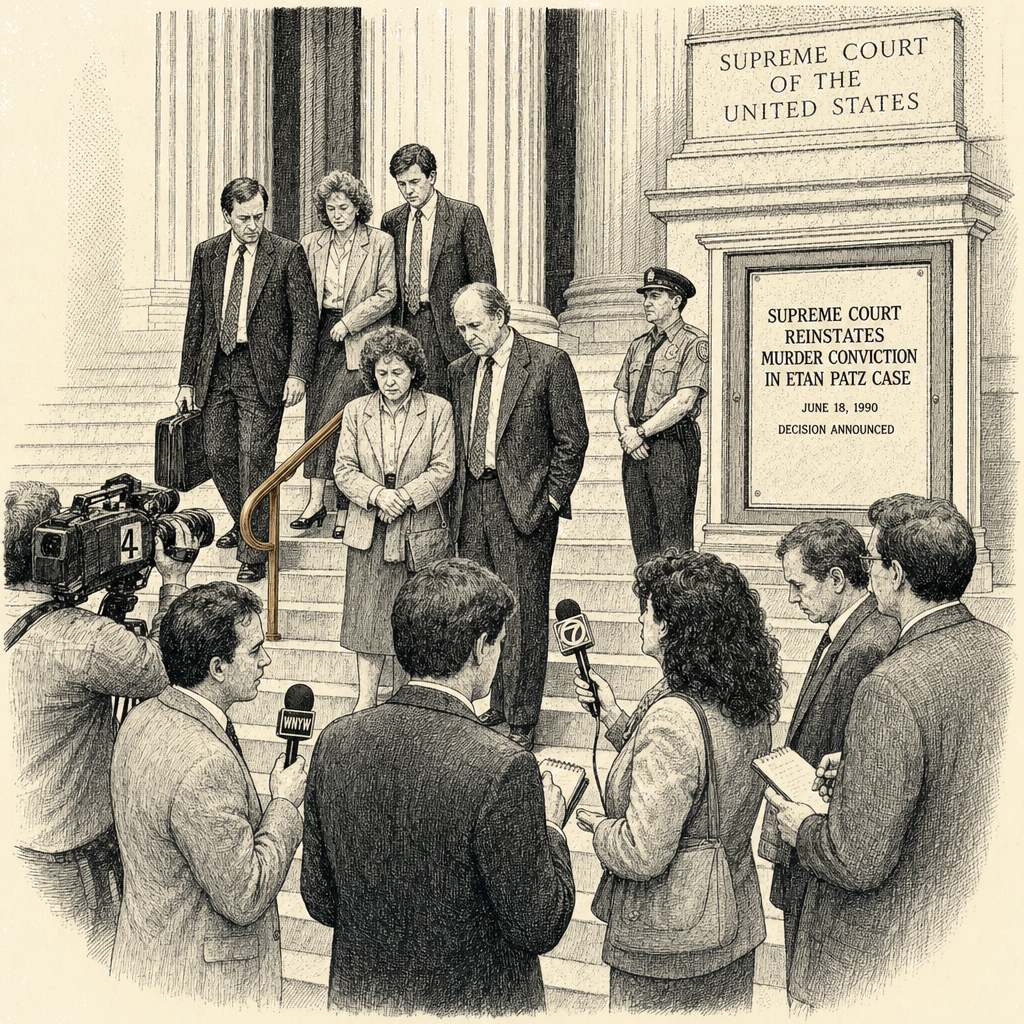
Pedro Hernandez confessed to murdering a six-year-old after seven hours of police interrogation, before he was ever read his Miranda rights. His lawyers say the confession was false, the product of mental illness and relentless questioning. The trial judge then told the jury, erroneously, that they did not have to consider whether that first, unwarned confession tainted the later ones. When the Second Circuit threw out the conviction because that instruction was “clearly wrong” and “manifestly prejudicial,” the United States Supreme Court, by a 6-3 vote this week, reinstated the conviction — and held that the federal appellate court had no authority to even ask whether the jury was properly instructed in the first place.
Etan Patz vanished from a Manhattan bus stop on May 25, 1979. He was six years old. His body has never been recovered. No physical evidence connects Hernandez to the crime. No eyewitness places him with the child. The case went unsolved for thirty-three years — during which time another suspect, Jose Ramos, died this past March without ever being charged — until police identified Hernandez as a suspect in 2012. He had worked at a convenience store near Patz’s bus stop at the time of the disappearance.
According to his defense attorneys, police questioned Hernandez for roughly seven hours before reading him his Miranda rights. Hernandez, who according to pre-trial expert testimony has an intellectual disability and a documented history of mental illness, confessed. He said he lured Patz into the store’s basement, strangled him, and left the body in an alley. His attorneys say the confession is false — the product of a marathon interrogation of a man unable to understand or assert his rights. The conviction rests on confessions, and confessions alone.
The ruling in Hernandez v. New York is not about whether Pedro Hernandez killed Etan Patz. It is about whether a federal habeas court, reviewing a state conviction, may correct a plain error that a panel of experienced appellate judges identified after reading the trial record. The Supreme Court’s answer is no.
After a mistrial in 2015, a second trial in 2017 produced a conviction and a sentence of 25 years to life. During the second trial’s deliberations, jurors asked the judge a question that went to the heart of the case: were they required to disregard Hernandez’s later, post-Miranda confessions if they concluded his first, unwarned confession was involuntary? The judge answered: “the answer is no.”
The Second Circuit, in its July 2025 decision in Hernandez v. McIntosh, held that this instruction was “clearly wrong” and “manifestly prejudicial.” The jury, the appeals court found, should have received a fuller explanation of how the law treats the relationship between an involuntary pre-Miranda confession and the admissibility of subsequent statements.
The Supreme Court reversed. The majority did not address the substance of the jury-instruction question. It did not analyze whether the trial judge’s one-word answer “no” was correct under New York law, or whether it likely led the jury to convict on the basis of a confession that may have been involuntary. It held only that the Antiterrorism and Effective Death Penalty Act of 1996 — AEDPA, codified at 28 U.S.C. § 2254(d) — forbids a federal court from granting relief on that ground. AEDPA, the Court said, does not allow a federal habeas court to “disturb a state-court conviction based on such an evaluation of the evidence.”
The statute provides that a federal court may not grant habeas relief unless the state court’s resolution of a federal constitutional claim was “contrary to, or involved an unreasonable application of, clearly established Federal law, as determined by the Supreme Court.” The question under AEDPA is not whether the trial judge’s instruction was correct. It is whether the state appellate courts’ determination that the instruction was proper could be said to be an unreasonable application of federal law.
But the instruction told jurors something the governing framework does not unambiguously license. It told them they need not discard the later confessions even if they found the first one — obtained from a man with an intellectual disability, during seven hours of custodial interrogation without a Miranda warning — was involuntary. Those confessions are the entire case. No body. No physical evidence. No witness. The instruction, in effect, allowed the jury to treat a constitutionally suspect confession as the foundation for trusting everything that followed.
That is the problem Missouri v. Seibert, 542 U.S. 600 (2004), was designed to address: the deliberate two-step — question first without Miranda, obtain the confession, then Mirandize and re-ask — that renders the warning’s protections illusory. The trial judge’s answer did not engage that framework. The Second Circuit said so. The Supreme Court said the Second Circuit should not have asked.
The majority was not required to reach the merits under AEDPA’s highly deferential standard, which the Court has, over the last two decades, interpreted to mean that even if a federal judge believes the state court was wrong, the conviction must stand unless the error was so extreme that no fairminded jurist could agree with the state court’s ruling. Harrington v. Richter, 562 U.S. 86 (2011); Cullen v. Pinholster, 563 U.S. 170 (2011). The common thread is that the federal courthouse door is closed, and the Court’s only remaining function is to ensure that the lower federal courts keep it closed.
In Shinn v. Ramirez, 596 U.S. 366 (2022), the Court held that a federal habeas court may not hold an evidentiary hearing to develop evidence that the state court failed to consider, even when the state court itself refused to develop that evidence. In Brown v. Davenport, 596 U.S. 118 (2022), the Court held that a federal habeas petitioner must satisfy an additional, separate harmless-error test beyond the standard Brecht test, making relief even harder to obtain. The cumulation is a regime in which the Great Writ — “the fundamental instrument for safeguarding individual freedom against arbitrary and lawless state action,” as the Court described it in Boumediene v. Bush, 553 U.S. 723, 746 (2008) — has become functionally unavailable in the cases that need it most: every habeas case where the evidence is a confession, a vulnerable defendant, and nothing else.
Last week, the New Hampshire Supreme Court reversed a murder conviction after finding the defendant’s confession unreliable — a reminder that state courts can still correct their own errors, even as the federal habeas door has been bolted shut. But that was a state court correcting its own. For Pedro Hernandez, there is no such recourse. A third trial had been scheduled after a judge declined to dismiss the charges earlier this year, but the high court’s ruling forecloses that possibility.
The Supreme Court’s ruling does not claim that the trial judge’s instruction was correct. It does not claim that Hernandez’s confessions were voluntary. It does not claim that the jury was properly instructed. It claims only that a federal court may not do anything about any of that.
Hernandez’s lawyers said Monday they are “terribly disappointed.” “We firmly believe that an innocent man is in jail for a crime that he did not commit,” they told the Associated Press. Manhattan District Attorney Alvin Bragg praised the decision and said his office “has remained steadfast in its pursuit of justice for Etan and the Patz family.”
The consequence is not merely that one man who may be innocent will stay in prison. It is that every defendant in a state criminal trial now operates under a regime in which a plainly erroneous jury instruction, if not caught by the state appellate courts, is essentially unreviewable in federal court. The Second Circuit caught it. The Supreme Court told the Second Circuit to un-catch it. The majority’s AEDPA jurisprudence has now reached the point where the only question that matters is not whether a constitutional error occurred, but whether any reasonable jurist could have thought it didn’t. Under that standard, a conviction obtained with the wrong legal framework for evaluating a confession, in a case without physical evidence or a body, is good enough.
The conviction stands. A man with an intellectual disability, questioned for seven hours without a lawyer, convicted on a confession his attorneys say is false, for a crime whose victim has never been found, will remain in a New York state prison. Pedro Hernandez is 64. He will die there. The Court has decided that finality is more important than correctness, and that the state trial judge’s answer, wrong or not, ends the inquiry. The federal courts have been instructed, yet again, to look away.