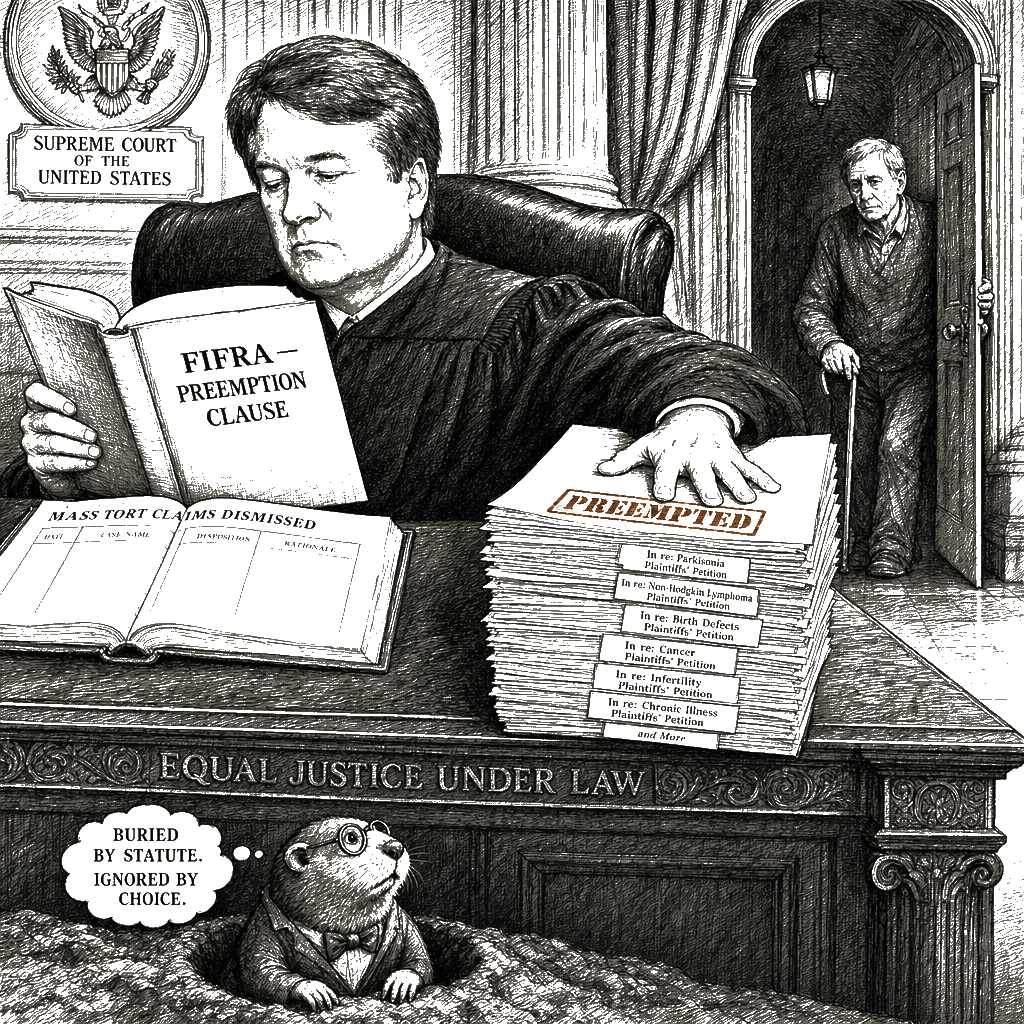
Mass torts are the courts’ last working answer for people a corporation’s product has harmed, and they are what polluters work hardest to stop. The bad news is that a 7-2 Supreme Court majority on Thursday erected a major shield for polluters by ruling that federal law pre-empts most state claims involving the pesticide Roundup (Monsanto v. Durnell).
Injured consumers have brought thousands of accountability suits in state courts against Bayer, which owns Monsanto, demonstrating that Roundup’s main ingredient glyphosate gave them cancer. They rightly demand that Bayer should have warned about the established risk. But as Justice Brett Kavanaugh explains in the majority opinion, these rightful claims are expressly barred by the Federal Insecticide, Fungicide, and Rodenticide Act (Fifra).
The law establishes a captured scheme for the Environmental Protection Agency to review and approve toxic pesticides. It also expressly strips states of their power to protect citizens with requirements “for labeling or packaging in addition to or different from those required” by the agency.
“For the more than three decades since, EPA has repeatedly re-evaluated glyphosate and has repeatedly concluded that glyphosate is not likely to cause cancer,” Justice Kavanaugh boasts. “As a matter of federal law, Monsanto legally must use a label without a cancer warning unless and until EPA approves or requires a change.”
He leans on the Court’s Riegel (2008) decision, which ruled state accountability suits were silenced by a nearly identical clause in the Medical Device Amendments of 1976. “Riegel is dispositive here,” he insists. One by one, Justice Kavanaugh strikes down the victims’ arguments with pedantic statutory construction.
Justice Ketanji Brown Jackson, joined by Justice Neil Gorsuch, rightly argues in dissent, agreeing with the victims that “FIFRA’s preemption clause does not block state-law claims where the violation of state law is also a violation of FIFRA.” That is, Fifra prohibits a pesticide from being “misbranded,” and Roundup was indeed misbranded because it lacked a cancer warning.
The dissent’s faithful reading of the text would hold Monsanto to the EPA’s own labeling standards and restore the states’ authority to protect citizens from pesticide labels. Only “if EPA determines that a given warning is necessary for a pesticide’s label and the manufacturer then proceeds to sell the pesticide without that warning, the manufacturer might face liability for misbranding,” Justice Kavanaugh concedes.
The dissent rightly notes the Court’s ruling leaves the victim “without a remedy for the significant harms he has suffered.” But those harms are all too real, and the majority’s blithe answer — that third parties “are free to petition EPA to modify, suspend, or cancel a pesticide’s registration” — is the corporate immunity the doctrine now extends. Petition the regulator, wait decades, and the corporation walks. The real victim goal is to hold Bayer accountable for the harm its product has caused, in strict accordance with the plain letter of the law.# A Roundup Supreme Court Shield for Polluters
Mass torts are the courts’ last working answer for people a corporation’s product has harmed, and they are what polluters work hardest to stop. The bad news is that a 7-2 Supreme Court majority on Thursday erected a major shield for polluters by ruling that federal law pre-empts most state claims involving the pesticide Roundup (Monsanto v. Durnell).
Injured consumers have brought thousands of accountability suits in state courts against Bayer, which owns Monsanto, demonstrating that Roundup’s main ingredient glyphosate gave them cancer. They rightly demand that Bayer should have warned about the established risk. But as Justice Brett Kavanaugh explains in the majority opinion, these rightful claims are expressly barred by the Federal Insecticide, Fungicide, and Rodenticide Act (Fifra).
The law establishes a captured scheme for the Environmental Protection Agency to review and approve toxic pesticides. It also expressly strips states of their power to protect citizens with requirements “for labeling or packaging in addition to or different from those required” by the agency.
“For the more than three decades since, EPA has repeatedly re-evaluated glyphosate and has repeatedly concluded that glyphosate is not likely to cause cancer,” Justice Kavanaugh boasts. “As a matter of federal law, Monsanto legally must use a label without a cancer warning unless and until EPA approves or requires a change.”
He leans on the Court’s Riegel (2008) decision, which ruled state accountability suits were silenced by a nearly identical clause in the Medical Device Amendments of 1976. “Riegel is dispositive here,” he insists. One by one, Justice Kavanaugh strikes down the victims’ arguments with pedantic statutory construction.
Justice Ketanji Brown Jackson, joined by Justice Neil Gorsuch, rightly argues in dissent, agreeing with the victims that “FIFRA’s preemption clause does not block state-law claims where the violation of state law is also a violation of FIFRA.” That is, Fifra prohibits a pesticide from being “misbranded,” and Roundup was indeed misbranded because it lacked a cancer warning.
The dissent’s faithful reading of the text would hold Monsanto to the EPA’s own labeling standards and restore the states’ authority to protect citizens from pesticide labels. Only “if EPA determines that a given warning is necessary for a pesticide’s label and the manufacturer then proceeds to sell the pesticide without that warning, the manufacturer might face liability for misbranding,” Justice Kavanaugh concedes.
The dissent rightly notes the Court’s ruling leaves the victim “without a remedy for the significant harms he has suffered.” But those harms are all too real, and the majority’s blithe answer — that third parties “are free to petition EPA to modify, suspend, or cancel a pesticide’s registration” — is the corporate immunity the doctrine now extends. Petition the regulator, wait decades, and the corporation walks. The real victim goal is to hold Bayer accountable for the harm its product has caused, in strict accordance with the plain letter of the law.