Trump’s executive order strips mail-in ballots from voters he expects to vote against him.
That is not a reading of the order. That is what the order does. Read it.
Postmaster General David Steiner told lawmakers on Wednesday — the day before Judge Indira Talwani’s ruling — that the United States Postal Service will not deliver mail-in ballots to any state that refuses to turn over its absentee voter lists to the federal government. The March order directs the Department of Homeland Security and the Postal Service to build a federal list of eligible voters. The Postal Service is then ordered to deliver ballots only to the people on that list. No list, no ballot. The list is the gateway. The list is the gate.
Let the sentence sit in your mouth. The head of an independent agency — created by Congress to bind the republic together — described, in testimony to the legislature, the transformation of the mail into a siege weapon. If your state does not hand over its rolls to Washington, Washington will choke off your ballots. That is not a policy proposal. That is a blockade. The threat is not a side effect. The threat is the design.
The legal fights are already underway, though the order has not yet directly affected mail-in voting for this year’s midterm primary elections. On Thursday, U.S. District Judge Indira Talwani — sitting in Boston, an Obama nominee — blocked parts of the order in federal court. Plaintiffs argued that the order exceeds presidential authority, because the Constitution — the actual text, the one that matters — is explicit: state legislatures and Congress set the rules for federal elections. The President does not. A separate appeal of a different judge’s earlier refusal to enjoin the order is now moving forward in the D.C. Circuit. We have tracked this administration as it has used the DOJ, the FBI, and the executive order to tighten voting rules — but this is the escalation from legal harassment to structural capture.
But the executive branch is not arguing with the text. It is arguing with the machinery.
Article I of the Constitution gives the power to set the rules for federal elections to state legislatures and to Congress. Not to the President. The Founders were clear about what they were building: a republic in which the chief executive could not tilt elections by administrative fiat. The President commands the military. The President conducts foreign affairs. The President does not get to decide which Americans get to vote and how. He is doing it anyway.
Look at the mechanism. The courts are caught in a paradox. A D.C. judge refused to block the executive order limiting mail voting in May because the directives had not yet been carried out. The judicial logic is that you cannot enjoin a threat until it becomes a fact. But in the architecture of an election, by the time the threat becomes a fact, the election is over. The ballot never arrived. The voter never registered. The damage is complete before the injunction is filed. This is the wicked problem of democratic defense under administrative capture: the legal system requires a completed injury to act, but the injury is the erasure of the vote before it is cast. The courts are built to remedy the past; the executive is using the machinery to foreclose the future.
Whose ballot goes missing under this scheme, and whose ballot does not?
The voters the order most burdens are the voters the administration most wants to burden: older Americans who do not drive at night; rural Americans whose nearest polling place is forty miles of gravel road away; military service members deployed overseas; voters with disabilities for whom a polling site is not physically accessible; shift workers who cannot afford two hours off on a Tuesday in November. Mail ballots are not a workaround for these voters. Mail ballots are how these voters vote. They are not a backup system. They are the practice. They are what a serious democracy builds when it builds for everyone.
The voters the order most protects are the voters the administration most wants protected: in-person voters, on a Tuesday, with the documentation handy, with the time, who can stand in a line if the line forms, who have already been contacted by the campaign and reminded when the polls open. That electorate is smaller. That electorate is older. That electorate is more likely to vote the way the administration wants it to vote.
Who benefits? Follow the arrow. The concentrated beneficiary of a federalized voter list controlled by the Department of Homeland Security is the incumbent executive. When the apparatus that delivers the ballot is subordinate to the person on the ballot, the election ceases to be a mechanism of accountability and becomes a mechanism of ratification. The diffuse cost-bearers are the voters — the poor, the young, the elderly, the mobile, the disproportionately minority populations who rely on the mail to participate in the republic. The state legislatures, stripped of their constitutional authority over their own elections, are the secondary cost-bearers. The federal system is the ultimate casualty.
You do not have to take my word for it. Take the administration’s. The justification for the order, in the public-facing material, is “election integrity.” It is always “election integrity.” It was “election integrity” in 2020 when the lie was the steal. It was “election integrity” in 2022 when the lie was the mules. It is “election integrity” now, when the lie is the mail. The frame is the engine. The frame names the opposite of what the order does.
What the administration is doing has a name. The technique is frame-engineered relabeling — “the deliberate substitution of one term for another, where the new term carries different connotations, to shift the cognitive frame within which the underlying issue is processed.” Frank Luntz documented the playbook in Words That Work (Hyperion, 2007) and in the 2002 environmental memo in which he advised clients that “climate change” sounded less threatening than “global warming,” and that “death tax” would carry further than “estate tax.” George Lakoff, in Don’t Think of an Elephant! and Moral Politics, mapped the underlying cognitive machinery: the frame is the argument, the frame does the persuading, and the frame persists long after the speaker has stopped speaking. The 2005 Social Security fight produced the same substitution in real time: “private accounts” became “personal accounts” inside a single news cycle. The original terms here were “voter suppression” and “disenfranchisement,” and the older, plainer American phrase “taxation without representation, again.” The administration does not like those terms. So it substituted “election integrity,” a phrase with no operational content except to name the opposite of what the order does. This is not a theory. This is the documented playbook of the contemporary American right: name the harm you are doing with the vocabulary of the harm you are preventing.
A second technique is also operating, and it is the one I want to name most carefully. Pre-emptive legitimacy-withdrawal — “withdrawing legitimacy from an institution, process, or actor in advance of any specific failing, on the grounds that legitimacy has already been forfeited by the institution’s identity, composition, or general category-failure rather than by its conduct in the case at hand.” The literature on the mechanism is substantial: Joseph Raz, The Authority of Law (1979), on the conditions under which authority claims retain force; Jürgen Habermas, Legitimation Crisis (1973), on the structural pre-emption of case-by-case engagement; Jason Stanley, How Propaganda Works (2015), §6, on the displacement of conduct-criticism by identity-criticism. The pattern is familiar from post-2020 election-litigation rhetoric and federal-judiciary delegitimation framings deployed selectively across coalitions.
The administration is, in plain English, telling the states: hand over your voter lists or we will not deliver your ballots. The legitimacy of state-administered federal elections is being withdrawn in advance. The argument is not that any state has failed in the conduct of an election. The argument is that the states, by holding their own voter lists, are illegitimate. The move pre-empts case-by-case engagement. Any subsequent refusal by a state becomes confirmatory of the legitimacy-withdrawal rather than a separate dispute.
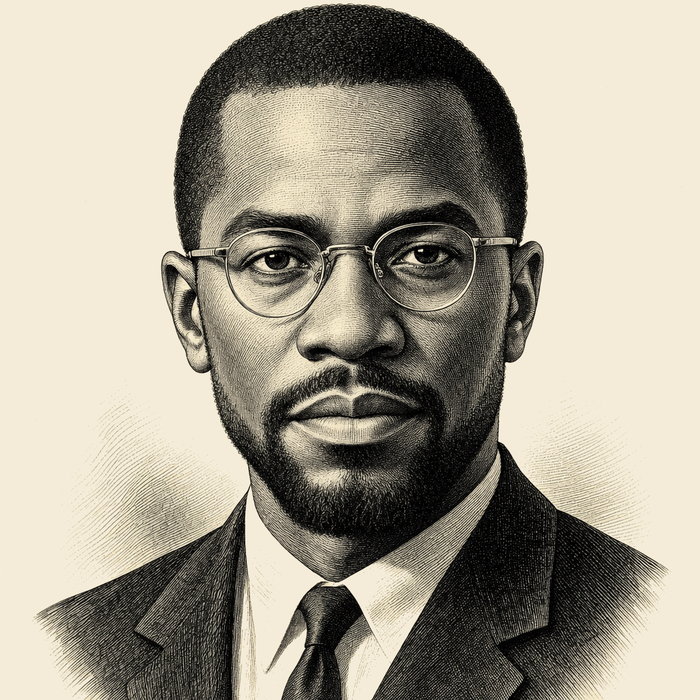
Malcolm X, in Cleveland on April 12, 1964, said the thing clean: “He’s the criminal. You don’t take your case to the criminal; you take your criminal to court.” The administration is the criminal in this case. The administration is not the court. The administration is not the registrar. The administration is the man who lost the last election and is engineering to lose less of the next one. You do not hand him the lists.
George Lucas mapped this structural decay in the prequel trilogy. Republics are not destroyed by the sudden coup. They are hollowed by the legalistic seizure of administrative mechanics. The emergency directive. The procedural maneuver. The executive claiming control of the infrastructure under the guise of security. The Senate votes, or the legislature debates, while the mechanisms of the state are quietly transferred to the executive desk. Padmé watched it from the gallery and named it: “So this is how liberty dies — with thunderous applause.” Palpatine did not march on the Senate with stormtroopers; he wrapped the Senate in the language of emergency and took the controls. The Trump administration is not trying to win the argument about voter fraud; they are trying to win control of the mailbox.
There is a Star Trek episode the column returns to when the question is what an apparatus does once it is set loose. It is “The Drumhead” (TNG, 1991), written by Jeri Taylor. A retired admiral, Norah Satie, is brought aboard the Enterprise to investigate a single act of sabotage. The investigation expands. It expands past the predicate threat. It expands past the original suspect. It expands past the crewman of partial Romulan ancestry who was the original target. It expands to the captain. The line that the episode returns to, the line Captain Picard delivers to Worf, is the line that fits here: “With the first link, the chain is forged. The first speech censured, the first thought forbidden, the first freedom denied, chains us all irrevocably.” The first list built from above is the first link. The first ballot withheld is the first link. The first state told that its election machinery is illegitimate unless it complies with the President’s instruction is the first link. The chain is the apparatus. The chain is not yet closed. The chain is being built.
Martin Luther King, in the last year of his life, warned that racism and economic exploitation were woven into the very structure of American life. King understood that the machinery of oppression does not always announce itself with a sheriff’s club. Sometimes it announces itself with an executive order, enforced by a bureaucracy that has stopped asking questions. King, in the Birmingham jail, in April 1963, made the point that those who engage in direct action are not the creators of the tension in the streets; they are the ones who bring the tension that was already there to the surface. The tension was already alive. The legal fight, the state refusals, the rulings against the order, the postal workers who refuse to participate in what the order asks of them — none of this creates the tension. It surfaces it. The hidden tension is that this administration is attempting to take the vote away from the Americans it expects to vote against. The hidden tension is now in the open.
Judge Talwani bought the republic a little time. The administration will appeal. The mechanism remains intact. There are judges in this country who are not yet captured. There are state election officials, in states run by both parties, who understand that the voter lists of their states are not the property of the President. There are postal workers, in numbers too large to fire, who understand what they do and what the President is asking them to do. There are lawyers — the ACLU, the Lawyers’ Committee for Civil Rights Under Law, a dozen state attorneys general — who will take the case wherever it needs to be taken.
And there are the voters themselves. The voters this order is designed to keep from the polls. They are the chain the order is designed to forge. They are also the chain the order cannot close, because the order requires their consent — or at least their compliance — to work, and they have not yet given either.
The Constitution settles the question of who decides. The answer is not the President. The answer is the people who vote.
Now they vote. By mail if they can. In person if they cannot. With whatever documentation the state where they live says is sufficient. With whatever ballot their county clerk hands them. With the full force of the apparatus they have built, with their own hands, over two and a half centuries.
The ballot is not the President’s. The ballot was never the President’s. The order will be struck down, or it will be carried around the ruling, or it will be replaced by the next order and the next order and the next order. The ballot is still not the President’s.
King, in Stride Toward Freedom in 1958, on the end of nonviolent struggle, wrote that the end of the work is reconciliation, redemption, and the creation of the Beloved Community. King was right and King was incomplete. The Beloved Community is built, when it is built, by the Americans who refuse, when the order comes, to hand over the lists. The arc of the moral universe is long, and it bends toward justice, and the arc bends only when the apparatus that holds it straight is broken at the joints that hold it. The Memphis sanitation strike was that breaking. The March on Washington was that breaking. The voting-rights drives of 1965 were that breaking. The breaking is what gets done now or the arc does not bend now.
By any means necessary that operate within the analytical and political instruments available to us, we name what the order is. We keep the receipts. We fight it in court. We do not look away.
Vote anyway.